April 27th, 2026 | 07:55 CEST
Mustard Power as a Growth Turbo! Agricultural Giants vs Green Rebels: Evaluating the Return Potential of Bayer, KWS Saat, and MustGrow Biologics
The global population continues to grow relentlessly, while the amount of arable land available per capita is shrinking. In this challenging environment, companies working on solutions to secure our food supply are taking center stage. But while the industry’s major players, such as Bayer or KWS Saat, grapple with regulatory hurdles and a rigid market landscape, innovative players like MustGrow Biologics could disrupt the field from behind. The key question for investors is no longer just who sells the most seeds, but increasingly who offers the smartest solutions for healthy soil. In this report, we examine the current situation at Bayer, where a major court ruling in the US is imminent. We also take a closer look at seed specialist KWS Saat, as well as a smaller but dynamic challenger, MustGrow, that could be on the verge of a technical breakout. All three stocks have the potential for exceptional performance. Read on to find out why the power of nature, in particular, could play a decisive role in the future—and may ultimately tip the scales.
time to read: 7 minutes | Author: Mario Hose
ISIN: BAYER AG NA O.N. | DE000BAY0017 , MUSTGROW BIOLOGICS CORP. | CA62822A1030 | TSXV: MGRO , OTCQB: MGROF , KWS SAAT KGAA INH O.N. | DE0007074007
Table of contents:
Author

Mario Hose
Born and raised in Hannover, Lower Saxony follows social and economic developments around the globe. As a passionate entrepreneur and columnist he explains and compares the most diverse business models as well as markets for interested stock traders.
Tag cloud
Shares cloud
Bayer: A Fragile Recovery Under Legal Pressure
A look at the German heavyweight in the sector currently reveals a picture that, following the sharp rise, seems contradictory at first glance. The company is still grappling with the shadows of the past. A decisive hearing is pending before the Supreme Court in Washington regarding the glyphosate lawsuits, which hang like a millstone around the Leverkusen-based company's neck; others would draw a comparison to the famous Sword of Damocles. Although CEO Bill Anderson was just recently confirmed in office until 2029 to drive the corporate restructuring forward, the stock is currently suffering once again from massive uncertainty. The fact that the pharmaceutical active ingredient Asundexian has received fast-track status is a ray of hope, but it can hardly mask the deep concerns in the agricultural sector. While Anderson attempts to smash the entrenched bureaucracy within the group with his "Dynamic Shared Ownership" model, US lawyers are eating into a portion of the hard-earned profits. It is a high-risk balancing act under constant uncertainty, while the corporate restructuring increasingly resembles a long and demanding endurance race with no easy shortcuts. Investors have long been calling for a radical divestiture of the divisions, but so far, management has stuck to the integrated model. The dependence on agricultural chemicals is both a curse and a blessing, but this is precisely where the hidden opportunity lies: Bayer urgently needs new, unencumbered growth paths to regain the market's confidence. At least the chart looks better, and the stock price is higher than it was a few months ago.
KWS Saat: Solid, but too conservative
A bit further north, at KWS Saat in Einbeck, things are much more tranquil, but also more focused on seeds. As a specialist in this field, the company has carved out a niche that is far less in the crosshairs of major scandals than Bayer's chemical products. KWS focuses on genetic diversity and yield optimization through state-of-the-art breeding methods for sugar beets, corn, and grains. It sees itself as an innovator in the art of breeding and thus controls the very origin of the agricultural value chain. Yet even KWS feels the global pressure. Regulatory hurdles for new genomic techniques in Europe are noticeably slowing the pace of innovation. Compared to the agile players in the biocontrol scene, KWS sometimes seems almost a bit too conservative and sedate. While the company is rock-solid and profitable, it appears to lack the revolutionary element that could be perceived as disruptive by the market and potentially turn the industry on its head. While researchers in Einbeck are still tinkering with the perfect plant DNA, farmers worldwide are already seeking ways to protect the soil itself as a living organism. However, traditional breeding reaches its limits when the soil in which the seeds are to germinate is contaminated by pests and chemical residues.
MustGrow: The Underdog with the Secret Weapon
It is precisely at this point in the strategic search for biological alternatives that the paths of the "two giants," Bayer and KWS, cross with a company from Canada: MustGrow Biologics. It is almost ironic that a smaller company delivers exactly what the big players are desperately seeking. MustGrow specializes in harnessing the natural defenses of mustard seeds to combat soil diseases and pests. The connection to Bayer is no coincidence, but part of a deliberate strategy. As early as late 2023, MustGrow even signed a commercial licensing agreement with Bayer for Europe, the Middle East, and Africa. This shows that even Bayer recognizes that the future of agriculture lies in regenerative biology and no longer solely in traditional chemistry. But it is also an alliance born of necessity, as Bayer provides market access and MustGrow provides the clean technology.
Field trial with a bang
A closer look at the latest news from MustGrow underscores this optimism. In early February 2026, the company published impressive results from two-year field trials with canola in Canada. On an area of approximately 100 hectares, it was demonstrated that the TerraMG™ technology massively suppresses the dreaded clubroot, a parasitic root disease. In wet years, spore concentrations were reduced by up to 95%. For farmers, this means not only healthier plants but also hard cash: an additional yield of up to seven bushels per acre resulted in an increase in value of about CAD 91 per acre. In a market like Canadian rapeseed cultivation, which generates billions in export revenue, this is a major breakthrough, especially since there are currently hardly any effective, approved treatments for this disease. Nature provides the solution here where chemistry has so far failed.
Radical Cure: Getting Rid of the Ballast
Just a few weeks later, at the end of March, the next bombshell followed, as MustGrow decided to close its Canadian sales division, NexusBioAg. What may sound like a retreat at first glance could, upon closer inspection, be a shrewd move. NexusBioAg primarily distributed third-party products—a business with thin margins and fierce price competition. With the closure effective April 15, 2026, MustGrow is putting all its eggs in one basket, and that basket is its own high-margin product, TerraSante. The company is now focusing its resources on the US market, where demand for this organic bio-fertilizer has already exceeded production capacity as of 2025. With fresh financing of USD 2 million and an equally large credit line behind it, the company now plans to ramp up inventory to meet the needs of large US agricultural operations in states like California and Florida.
Here is an interview by GBC Research with CEO, Corey Giasson.
110 Patents, One Clear Vision
This story of a company evolving from a pure developer and distributor to a focused producer of patented technology products is exactly what investors like. MustGrow has an impressive portfolio of approximately 110 granted and pending patents. With around 63 million outstanding shares, the company's structure is kept relatively lean, with management and advisors holding approximately 20% of the shares. This signals confidence in their own vision. Considering that the world's population could surpass the 10-billion mark by mid-century, it becomes clear that the priority for food security and soil health will rise exponentially. Chemistry alone will not be able to solve this problem, as soils are becoming increasingly depleted. With its mustard-based proteins and carbohydrates, MustGrow delivers exactly the product that farmland needs to remain productive in the long term.
Technical Analysis: CAD 0.80 as a Key Level
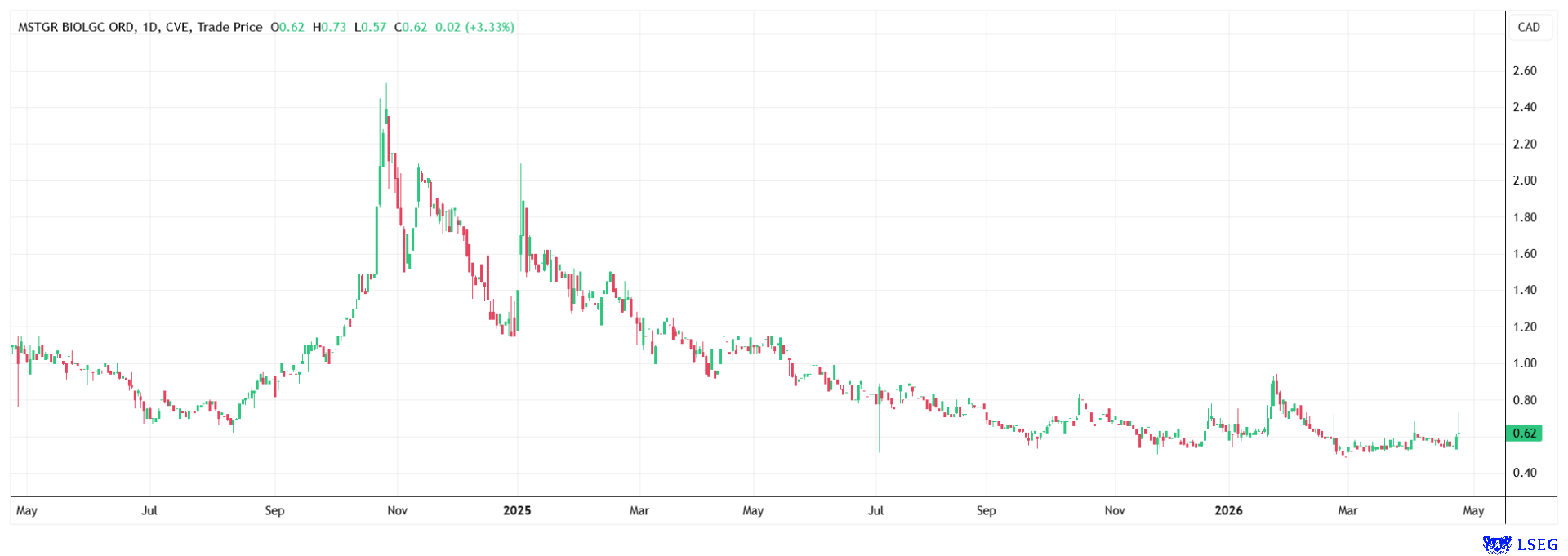
For investors hoping for the next big run, things are getting exciting from a technical perspective. MustGrow has already proven in the past that the stock is capable of rapid doubling and upward movements, as 2024 impressively demonstrated. Currently, the stock is poised for an upward breakout. For this to succeed sustainably, the CAD 0.80 mark would need to be significantly surpassed. That mark is not far off, as the current price stands at CAD 0.62. If this jump succeeds, it could create new momentum that catapults the stock into entirely different territory. It is a rather rare combination of a solid product, a market niche, and tailwinds from global trends, such as increasing population growth and the associated focus on food security, that makes MustGrow such an interesting candidate.
Conclusion: The time will come for Bayer, KWS, and MustGrow
In summary, while Bayer carries the most weight, it also bears the heaviest legacy burdens. The company remains a bet on successful restructuring under extreme legal pressure. KWS Saat remains the partner for the foundation of agriculture, but MustGrow Biologics is currently seen as having even greater innovative potential and the chance for above-average returns. The company has demonstrated the courage to divest itself of low-margin legacy assets and focus fully on its patented bio-technology. The partnership with Bayer also shows that the industry already views the Canadians as an integral part of the future value chain and has them on its radar. As global hunger grows and conventional chemistry reaches its limits, the time has come for natural biology. For MustGrow, this means the groundwork has been laid. Now all that is needed is for the spark to ignite in the market and for the stock to clear the CAD 0.80 hurdle. A sober look at the facts leads to the conclusion that a small player is on the verge of taking on a very large role on the global stage.
Conflict of interest
Pursuant to §85 of the German Securities Trading Act (WpHG), we point out that Apaton Finance GmbH as well as partners, authors or employees of Apaton Finance GmbH (hereinafter referred to as "Relevant Persons") currently hold or hold shares or other financial instruments of the aforementioned companies and speculate on their price developments. In this respect, they intend to sell or acquire shares or other financial instruments of the companies (hereinafter each referred to as a "Transaction"). Transactions may thereby influence the respective price of the shares or other financial instruments of the Company.
In this respect, there is a concrete conflict of interest in the reporting on the companies.
In addition, Apaton Finance GmbH is active in the context of the preparation and publication of the reporting in paid contractual relationships.
For this reason, there is also a concrete conflict of interest.
The above information on existing conflicts of interest applies to all types and forms of publication used by Apaton Finance GmbH for publications on companies.
Risk notice
Apaton Finance GmbH offers editors, agencies and companies the opportunity to publish commentaries, interviews, summaries, news and the like on news.financial. These contents are exclusively for the information of the readers and do not represent any call to action or recommendations, neither explicitly nor implicitly they are to be understood as an assurance of possible price developments. The contents do not replace individual expert investment advice and do not constitute an offer to sell the discussed share(s) or other financial instruments, nor an invitation to buy or sell such.
The content is expressly not a financial analysis, but a journalistic or advertising text. Readers or users who make investment decisions or carry out transactions on the basis of the information provided here do so entirely at their own risk. No contractual relationship is established between Apaton Finance GmbH and its readers or the users of its offers, as our information only refers to the company and not to the investment decision of the reader or user.
The acquisition of financial instruments involves high risks, which can lead to the total loss of the invested capital. The information published by Apaton Finance GmbH and its authors is based on careful research. Nevertheless, no liability is assumed for financial losses or a content-related guarantee for the topicality, correctness, appropriateness and completeness of the content provided here. Please also note our Terms of use.