January 28th, 2026 | 12:00 CET
In the eye of the commodities storm: How Aspermont, with its 190-year history, is becoming the data center of the mining industry
Gold is breaking records, copper is driving the energy transition, and critical raw materials such as rare earths are becoming a geopolitical currency. While investors are considering direct commodity investments, a company that has transformed itself into an indispensable architect of this new era is operating in the background: Aspermont. Once a traditional specialist publisher, the Company has quietly evolved into a data-driven control center for global mining. In a market characterized by resource nationalism and supply chain stress, reliable information is the most valuable commodity. Aspermont delivers just that, not as a cyclical player, but as a provider of critical infrastructure for decision-making. This transformation is complete, financially sound, and meets with a perfect environment.
time to read: 4 minutes | Author: Armin Schulz
ISIN: ASPERMONT LTD | AU000000ASP3
Table of contents:
Author

Armin Schulz
Born in Mönchengladbach, he studied business administration in the Netherlands. In the course of his studies he came into contact with the stock exchange for the first time. He has more than 25 years of experience in stock market business.
Tag cloud
Shares cloud
The foundation that no one can copy: A 190-year moat
Aspermont's true value lies not in its current quarterly figures, but in its history. The Company manages a digitized archive of proprietary industry data collected through publications such as the 190-year-old Mining Journal. Imagine a library that documents every mining boom, every bankruptcy, every technical innovation, and every geopolitical event in industry since the Industrial Revolution. This historical context is priceless in a world of superficial information noise. It is a moat that no start-up and no generalist data provider can close in the foreseeable future. This depth is the basis for everything that follows.
From print to data-driven platform: A three-stage metamorphosis
This unique collection of knowledge would be worthless if it remained trapped in old print archives. That is why Aspermont underwent a radical evolution in three acts.
First came the move from print to digital. This was necessary, but not revolutionary. The real turning point came around 2015 with the strategic decision to no longer be a digital publisher, but rather a SaaS (Software-as-a-Service) platform. This meant moving away from the vagaries of the advertising market toward predictable, recurring subscription revenues. Today, more than two-thirds of revenues come from these memberships, which have been growing for 37 consecutive quarters. This creates stability in a volatile market.
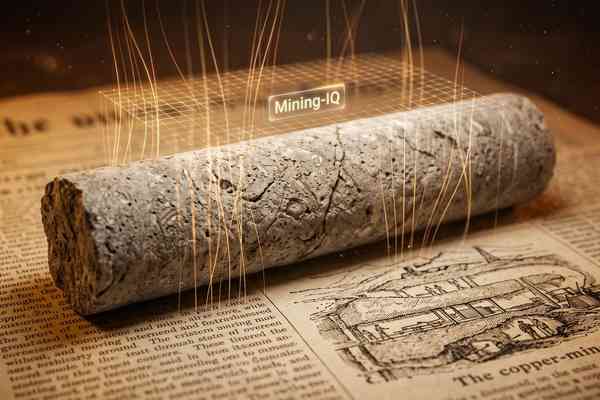
The third and current phase is the rise to become a comprehensive data and intelligence company. The crowning glory of this development is the in-house platform Mining IQ. It bundles global data streams with the historical archive and enables analyses of risks, project pipelines, and ESG performance. The platform is not a theoretical product. Its market readiness was proven by a groundbreaking contract with mining giant Rio Tinto. For around AUD 550,000, Aspermont is developing an AI-powered search and analysis platform based on historical archives. A Tier 1 customer, as the first buyer, is the ultimate validation and a blueprint for scalable enterprise solutions.
But this is where a crucial difference to other AI-driven hype becomes apparent. For Aspermont, AI is not an end in itself, but a precision tool. The real magic lies not in a generic language model, but in specialized ontologies. Basically, it is about "mining DNA" that has been trained over the years to understand the nuances of technical language from two centuries. This makes it possible to extract not only data from the archive, but also contextual intelligence and causal relationships. This ability to link historical patterns with real-time data is invaluable to risk managers and commodity strategists.
The integrated ecosystem: Four mutually reinforcing business areas
Aspermont's strength lies not in a single product, but in a self-reinforcing cycle of data, access, and expertise. This manifests itself in four distinct business areas:
-
Subscription media & memberships: The core business and stable revenue base. Through digital brands such as Mining Journal and Mining Magazine, the Company reaches a global community of over 3 million professionals. This platform not only generates recurring fees but also acts as a continuous sensor, providing new data and trends for the entire ecosystem.
-
Data & Intelligence (Mining IQ): The primary growth driver and the logical increase in value of the data. Here, raw information is transformed into high-quality analytical products. The focus is on solutions for complex problems such as geopolitical risk management, due diligence for acquisitions, ESG monitoring, and the identification of project opportunities. The platform architecture makes it possible to develop customized solutions, such as for Rio Tinto, which can later be scaled as standardized modules for the entire market.
-
Integrated Marketing Solutions (Nexus): Where the credibility and reach of the network are directly monetized. Nexus acts less as a traditional advertising agency and more as a strategic communications partner for governments and corporations. Whether Saudi Arabia is pushing ahead with its "Vision 2030" in the mining sector or Timor-Leste wants to position itself as a new mineral destination, Nexus uses its editorial depth and targeted database to run highly effective campaigns. These projects not only have high margins but also demonstrate the practical influence of the Aspermont ecosystem on real investment decisions.
-
Live events & conferences: The physical extension of the digital platform. Events such as "Future of Mining Australia" are seeing record attendance. They serve as opportunities for intensive networking, deepen customer loyalty, and generate additional, often predictable revenue. In an increasingly digital world, this personal exchange is regaining strategic value and providing unique qualitative insights.
Macro tailwinds and financial discipline: The timing is perfect
Aspermont's strategic realignment coincides perfectly with structural megatrends. The global energy transition, the race for critical minerals, and growing "resource nationalism" are dramatically increasing the complexity and risk of mining. At the same time, the demand for transparency (ESG) is growing exponentially. These factors mean that reliable, in-depth intelligence is no longer a nice-to-have, but an operational and strategic necessity. Aspermont addresses precisely this pain point.
This transformation required investment, but it was implemented with remarkable capital discipline. A solid cash position was built up from a situation of debt. The latest capital increase of AUD 2.8 million, of which AUD 1.75 million was at a 40% premium to the then share price, was a strong signal of confidence from institutional investors and gives the Company financial leeway for the aggressive scaling of Mining IQ and international expansion. The core business is already generating positive operating cash flow. So the Company is investing from a position of strength, not necessity.
The share is currently trading at AUD 0.008.
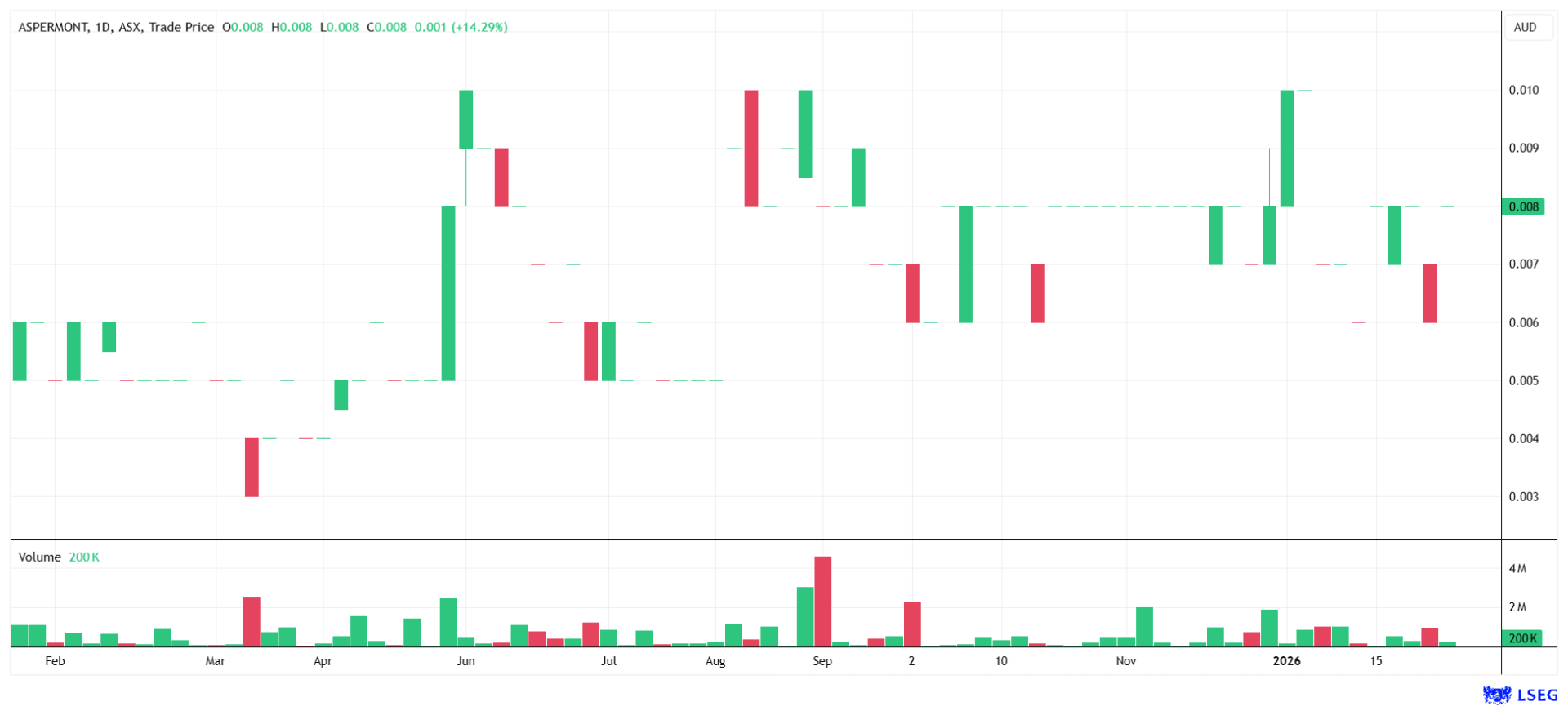
Aspermont is not a bet on rising commodity prices. It is an investment in the essential infrastructure that makes this boom navigable in the first place. The Company has already accomplished the most difficult part: fundamentally transforming its business model while maintaining financial stability. The result is a unique ecosystem that combines an irreplicable treasure trove of historical data with modern SaaS, AI, and platform approaches.
Conflict of interest
Pursuant to §85 of the German Securities Trading Act (WpHG), we point out that Apaton Finance GmbH as well as partners, authors or employees of Apaton Finance GmbH (hereinafter referred to as "Relevant Persons") currently hold or hold shares or other financial instruments of the aforementioned companies and speculate on their price developments. In this respect, they intend to sell or acquire shares or other financial instruments of the companies (hereinafter each referred to as a "Transaction"). Transactions may thereby influence the respective price of the shares or other financial instruments of the Company.
In this respect, there is a concrete conflict of interest in the reporting on the companies.
In addition, Apaton Finance GmbH is active in the context of the preparation and publication of the reporting in paid contractual relationships.
For this reason, there is also a concrete conflict of interest.
The above information on existing conflicts of interest applies to all types and forms of publication used by Apaton Finance GmbH for publications on companies.
Risk notice
Apaton Finance GmbH offers editors, agencies and companies the opportunity to publish commentaries, interviews, summaries, news and the like on news.financial. These contents are exclusively for the information of the readers and do not represent any call to action or recommendations, neither explicitly nor implicitly they are to be understood as an assurance of possible price developments. The contents do not replace individual expert investment advice and do not constitute an offer to sell the discussed share(s) or other financial instruments, nor an invitation to buy or sell such.
The content is expressly not a financial analysis, but a journalistic or advertising text. Readers or users who make investment decisions or carry out transactions on the basis of the information provided here do so entirely at their own risk. No contractual relationship is established between Apaton Finance GmbH and its readers or the users of its offers, as our information only refers to the company and not to the investment decision of the reader or user.
The acquisition of financial instruments involves high risks, which can lead to the total loss of the invested capital. The information published by Apaton Finance GmbH and its authors is based on careful research. Nevertheless, no liability is assumed for financial losses or a content-related guarantee for the topicality, correctness, appropriateness and completeness of the content provided here. Please also note our Terms of use.