March 10th, 2026 | 07:05 CET
Running out of ammunition? The key role of Antimony Resources, Rheinmetall, and Boeing
The arms industry is facing a severe test amid the war in the Middle East. The enormous consumption of ammunition is pushing already limited Western production capacities to their limits. While the US has raised its defense spending for 2026 to a record level of USD 901 billion, the intense exchange of fire in the Middle East and the use of modern defense systems are depleting stockpiles at a record pace. In this environment, the critical semi-metal antimony is becoming a focus of national security. The element is irreplaceable as a hardening agent for lead alloys in armor-piercing projectiles and for high-precision infrared sensors. According to the US Geological Survey (USGS), the global supply situation is becoming increasingly tense. This is mainly due to strict export restrictions imposed by China, which dominates global mining with a market share of just under 60% and has long used the metal as a strategic weapon. To guarantee defense capabilities, industry giants such as Rheinmetall and Boeing must ramp up their production. The problem is that raw materials are finite. This is where players such as Antimony Resources come into play, securing the coveted antimony in Canada.
time to read: 3 minutes | Author: Nico Popp
ISIN: ANTIMONY RESOURCES CORP | CA0369271014 | CSE: ATMY , OTCQB: ATMYF , RHEINMETALL AG | DE0007030009 , BOEING CO. DL 5 | US0970231058
Table of contents:
Author

Nico Popp
At home in Southern Germany, the passionate stock exchange expert has been accompanying the capital markets for about twenty years. With a soft spot for smaller companies, he is constantly on the lookout for exciting investment stories.
Tag cloud
Shares cloud
Rheinmetall pushes ahead with European ammunition production
Rheinmetall has become a key player in the rearmament of Europe. To meet the enormous demand for ammunition in current conflicts, the company is currently building 13 new plants in Europe or expanding existing facilities. One milestone is the new plant in Unterlüß, where production of 155 mm artillery shells is set to increase from 25,000 units in 2025 to 140,000 in the current year and finally to 350,000 from 2027 onwards. The financial impact of this comprehensive scaling is reflected in the operating profit of the defense business, which climbed to EUR 825 million in the first nine months of last year. With an order backlog of nearly EUR 64 billion, an almost unimaginable figure, the Group is benefiting from the expansion of the European defense architecture. However, all these capacity expansions depend on a functioning supply chain for hardening agents such as antimony. At the same time, successes are already priced into Rheinmetall shares. This is reason enough for investors to look elsewhere.
Boeing and its dependence on high-tech sensors
At US-based Boeing, too, the availability of raw materials dictates the pace. In its Defense, Space & Security segment, the company is focusing on stabilizing its production and, like Rheinmetall, has a record order backlog of USD 85 billion. Boeing is particularly dependent on unhindered access to critical raw materials in the areas of missile defense and guided missiles. The compound indium antimonide forms the technological heart of infrared sensors in seeker heads, which are used, for example, in the modern AIM-9X Sidewinder air defense system. To ensure the precision of these weapons in long-range programs such as "Golden Dome," Boeing is forced to intervene even deeper in the supply chain and protect itself against material shortages. The company faces the enormous challenge of ramping up production while the US government is simultaneously struggling with Chinese export bans on military end uses. Boeing must therefore also focus on securing its supply chain and urgently needs critical raw materials such as antimony.
Antimony Resources secures the Western raw material base
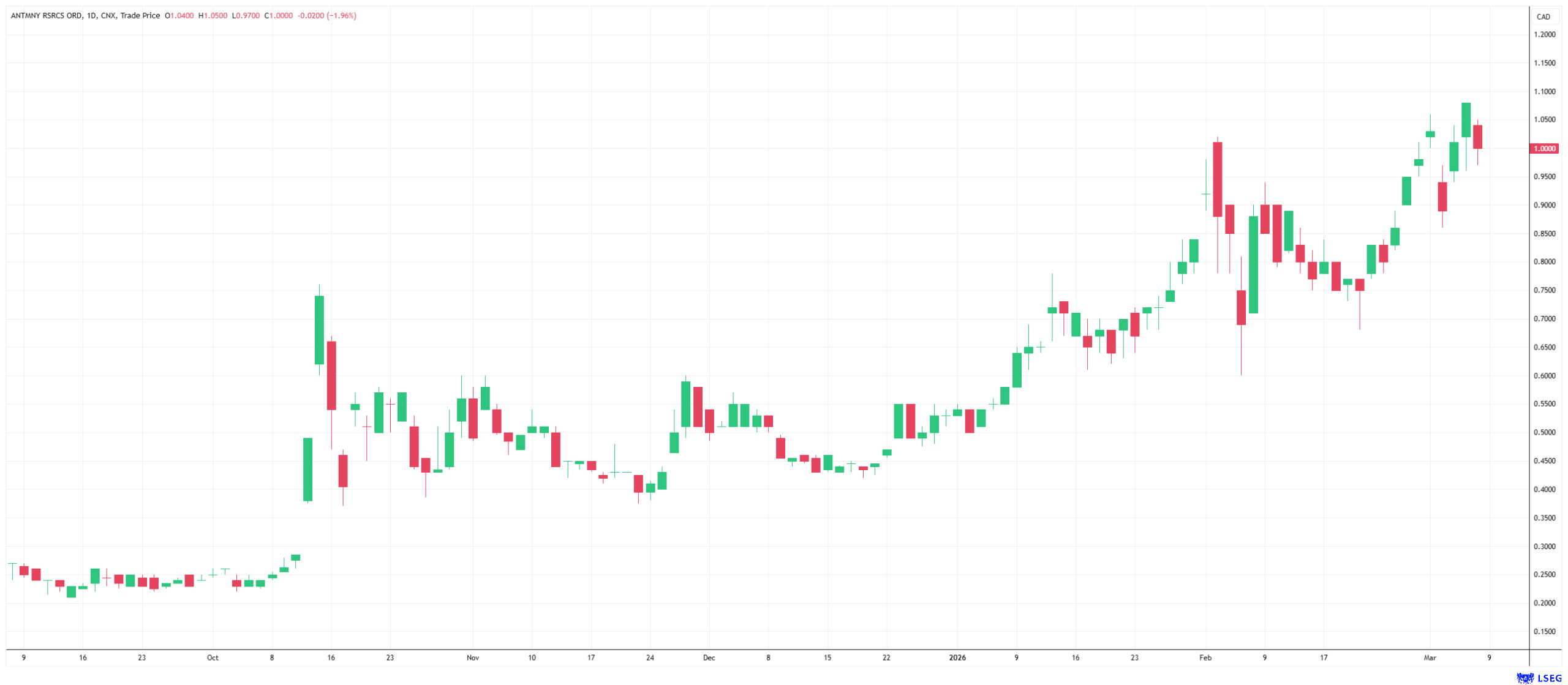
Amid these palpable supply concerns, Antimony Resources is increasingly moving into a key strategic position. The junior explorer focuses exclusively on the development of antimony deposits in North America and offers investors the opportunity to benefit from the scarcity of this sought-after element. Management's primary focus is on the Bald Hill project in the Canadian province of New Brunswick. To precisely define the system there, the company has launched an extensive 10,000 m drilling program. Initial results confirm the high geological potential of the area, including drill intercepts of 4.17% antimony over 7.40 m. With a market capitalization of approximately CAD 103 million, the company is still relatively inexpensive. Also, it operates in a politically secure and mining-friendly jurisdiction, which further underpins the value of the asset in the current geopolitical environment.
Strategic self-sufficiency will determine the future
Without a stable supply of this strategic metal, Western arsenals risk remaining structurally undersupplied, which jeopardizes defense capabilities in the current extremely volatile geopolitical situation. While industry giants such as Rheinmetall and Boeing are driving industrial scaling and represent established basic investments, Antimony Resources is what makes the production of the major arms manufacturers possible in the first place. Material that Antimony Resources could extract within the next two to three years could already be used to fulfill defense contracts awarded today by companies such as Rheinmetall or Boeing. The reason for this is the long lead times that now exist in the industry. If the market recognizes this dependence on new Western deposits such as those being developed by Antimony Resources, the Canadian company's shares are likely to become even more attractive in the future. One thing is clear: Antimony Resources has what many companies urgently need right now.
Watch YouTube videoConflict of interest
Pursuant to §85 of the German Securities Trading Act (WpHG), we point out that Apaton Finance GmbH as well as partners, authors or employees of Apaton Finance GmbH (hereinafter referred to as "Relevant Persons") currently hold or hold shares or other financial instruments of the aforementioned companies and speculate on their price developments. In this respect, they intend to sell or acquire shares or other financial instruments of the companies (hereinafter each referred to as a "Transaction"). Transactions may thereby influence the respective price of the shares or other financial instruments of the Company.
In this respect, there is a concrete conflict of interest in the reporting on the companies.
In addition, Apaton Finance GmbH is active in the context of the preparation and publication of the reporting in paid contractual relationships.
For this reason, there is also a concrete conflict of interest.
The above information on existing conflicts of interest applies to all types and forms of publication used by Apaton Finance GmbH for publications on companies.
Risk notice
Apaton Finance GmbH offers editors, agencies and companies the opportunity to publish commentaries, interviews, summaries, news and the like on news.financial. These contents are exclusively for the information of the readers and do not represent any call to action or recommendations, neither explicitly nor implicitly they are to be understood as an assurance of possible price developments. The contents do not replace individual expert investment advice and do not constitute an offer to sell the discussed share(s) or other financial instruments, nor an invitation to buy or sell such.
The content is expressly not a financial analysis, but a journalistic or advertising text. Readers or users who make investment decisions or carry out transactions on the basis of the information provided here do so entirely at their own risk. No contractual relationship is established between Apaton Finance GmbH and its readers or the users of its offers, as our information only refers to the company and not to the investment decision of the reader or user.
The acquisition of financial instruments involves high risks, which can lead to the total loss of the invested capital. The information published by Apaton Finance GmbH and its authors is based on careful research. Nevertheless, no liability is assumed for financial losses or a content-related guarantee for the topicality, correctness, appropriateness and completeness of the content provided here. Please also note our Terms of use.