June 19th, 2026 | 07:35 CEST
How MustGrow Biologics Benefits from Agrochemical Realignment with Patented Bioactive Technology – Pressure on Bayer and Corteva
Created and published on behalf of MustGrow Biologics Corp.
Extreme heat waves, increasingly degraded soils, and strict regulatory limits on synthetic chemical crop protection products—global agricultural markets are facing a critical period of adjustment. Once temperatures cross the critical threshold of 30 °C, most agricultural crops begin to suffer drastic yield losses, as sterile pollen and weakened cell walls cause irreparable damage to plant biology. According to the joint report by the Food and Agriculture Organization of the United Nations (FAO) and the World Meteorological Organization (WMO) titled "Extreme Heat and Agriculture," even individual heat waves can cause agricultural productivity to plummet by up to 50%. For most major crops, yield losses are already a threat at temperatures as low as 30 °C. The frequency, intensity, and duration of extreme heat events have increased significantly over the past 50 years. These ecological stressors are shifting growing conditions in both temperate and Mediterranean zones, forcing the entire agricultural value chain to rethink its approach.
time to read: 3 minutes | Author: Nico Popp
ISIN: MUSTGROW BIOLOGICS CORP. | CA62822A1030 | TSXV: MGRO , OTCQB: MGROF , CORTEVA INC. DL -_01 | US22052L1044 , BAYER AG NA O.N. | DE000BAY0017
Table of contents:
Author

Nico Popp
At home in Southern Germany, the passionate stock exchange expert has been accompanying the capital markets for about twenty years. With a soft spot for smaller companies, he is constantly on the lookout for exciting investment stories.
Tag cloud
Shares cloud
Bayer: Glyphosate Is Ruining the Business
Bayer operates in the three pillars of Crop Science, Pharmaceuticals, and Consumer Health, but is suffering from shrinking margins in its key agricultural business. In addition to the expiration of major product approvals and falling prices for glyphosate-based herbicides, ongoing US litigation over glyphosate and PCB contamination is weighing on the group's balance sheet. For fiscal year 2026, management forecasts negative free cash flow of between EUR 1.5 billion and EUR 2.5 billion, as litigation-related payments totaling approximately EUR 5 billion are straining liquidity. As a result, net financial debt will temporarily rise again to a level of EUR 32 to 33 billion. Although the European Commission has withdrawn its draft regulation mandating a 50% reduction in pesticide use by 2030, the political goal of the Green Deal remains in place and continues to create regulatory pressure on the industry to adapt. Bayer is responding to this with increased investments in biological active ingredients and is also collaborating with MustGrow Biologics in this context.
Corteva Splits Up for Greater Flexibility
The US-based company Corteva operates a traditional two-part agricultural business comprising seed genetics and synthetic chemical and biological crop protection solutions. To increase flexibility, Corteva plans to fully split the group into two independent, publicly traded companies by the end of 2026. The seed business will continue under the name Vylor, while the crop protection segment will operate as New Corteva. Management estimates the one-time separation costs at approximately USD 350 million, but expects greater long-term efficiency in return. Under the leadership of CEO-designate Luke Kissam, New Corteva aims to position itself as a research-intensive specialist in modern biological crop protection systems.
MustGrow Biologics: Patented Mustard Seed Technology in the Crosshairs of Market Leaders
The Canadian agricultural biotech company MustGrow Biologics develops and patents purely biological active ingredients based on the mustard plant. When applied to the soil, the liquid biocontrol TerraMG releases biological allyl isothiocyanate (AITC), which effectively disrupts the cellular energy production of nematodes and fungal diseases without leaving any chemical residues behind. MustGrow has deliberately chosen not to build its own sales structure and instead relies on exclusive evaluation and licensing agreements with industry leaders. In recent months, MustGrow received regulatory approvals for its organic biofertilizer TerraSante in Georgia, Texas, Utah, and Montana—meaning the product is now approved in more than 10 US states.
At the same time, Bayer is evaluating the TerraMG biocontrol technology in Europe, the Middle East, and Africa as part of the licensing agreement signed in 2023. In April, management closed the Canadian sales arm, NexusBioAg, to focus fully on marketing its own higher-margin product, TerraSante, in the US. According to a study by MarketsandMarkets, the global biopesticide market is expected to grow from USD 8.94 billion in 2025 to USD 17.68 billion by 2030—which would correspond to an annual growth rate of 14.6%. In addition, several insiders, including CEO Corey Giasson, have increased their stakes in the company in the past year, as indicated by filings with the SEDI database. This shows that management believes in the promising prospects of its own business model.
MustGrow Biologics: Technologically Well-Positioned and Still Undervalued
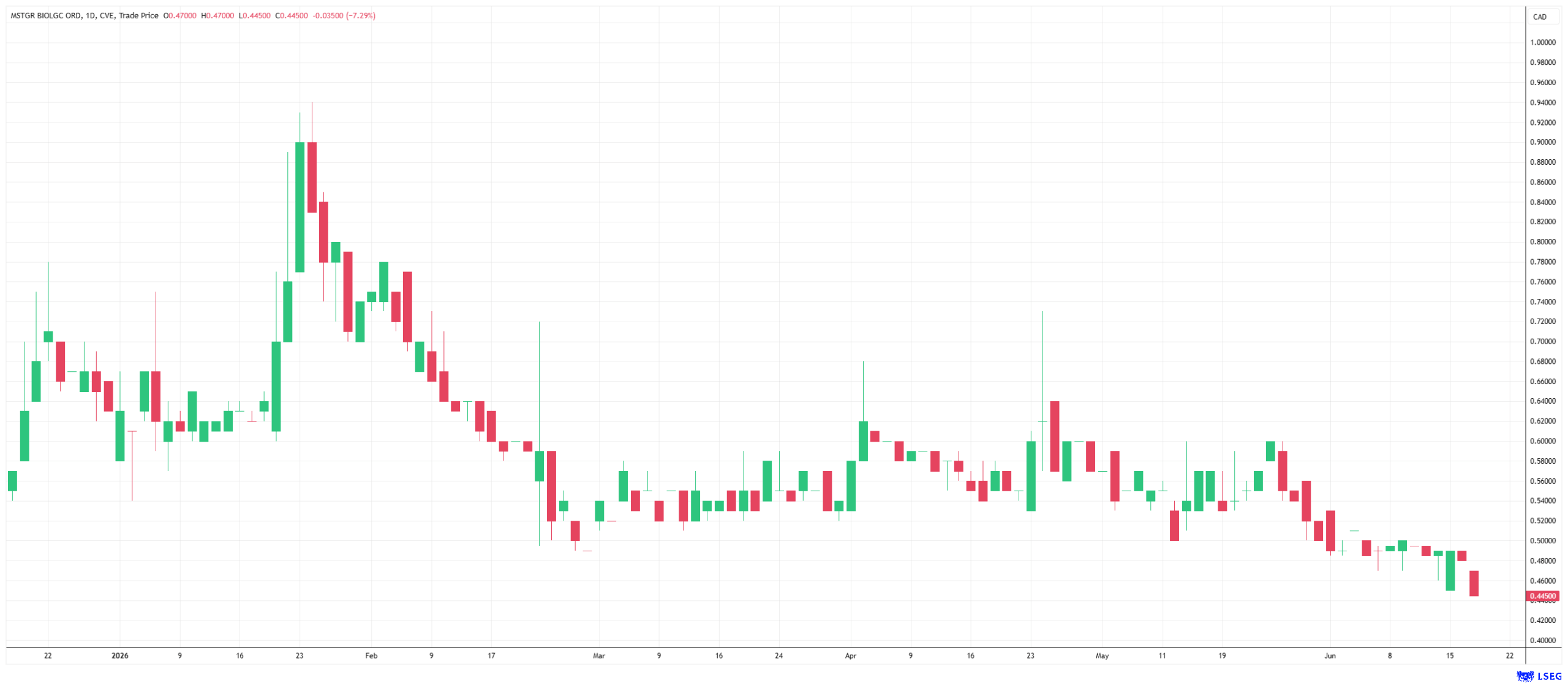
On the Toronto Stock Exchange, the stock stabilized around the CAD 0.50 mark following the most recent financing rounds, giving the company a market capitalization of just over CAD 30 million. Although multi-year evaluation phases with major corporations such as Bayer highlight the typical time-related risks of agricultural biotechnology, MustGrow's patented platform offers promising prospects in the current regulatory environment and is therefore likely to be of interest to agricultural corporations as well. If rapid commercial scaling in the US is successful, speculative investors could benefit from a government-supported growth market with significant acquisition potential. Since MustGrow deliberately relies on contract manufacturers, the conditions for growth are considered favourable. The scorching summer across large parts of North America and Europe also highlights the challenges facing modern agriculture. Sustainable solutions—such as MustGrow's products, which also promise even higher yields for farmers—could therefore increase in demand.
Watch YouTube videoConflict of interest
Pursuant to §85 of the German Securities Trading Act (WpHG), we point out that Apaton Finance GmbH as well as partners, authors or employees of Apaton Finance GmbH (hereinafter referred to as "Relevant Persons") may hold shares or other financial instruments of the aforementioned companies in the future or may bet on rising or falling prices and thus a conflict of interest may arise in the future. The Relevant Persons reserve the right to buy or sell shares or other financial instruments of the Company at any time (hereinafter each a "Transaction"). Transactions may, under certain circumstances, influence the respective price of the shares or other financial instruments of the Company.
In addition, Apaton Finance GmbH is active in the context of the preparation and publication of the reporting in paid contractual relationships.
For this reason, there is a concrete conflict of interest.
The above information on existing conflicts of interest applies to all types and forms of publication used by Apaton Finance GmbH for publications on companies.
Risk notice
Apaton Finance GmbH offers editors, agencies and companies the opportunity to publish commentaries, interviews, summaries, news and the like on news.financial. These contents are exclusively for the information of the readers and do not represent any call to action or recommendations, neither explicitly nor implicitly they are to be understood as an assurance of possible price developments. The contents do not replace individual expert investment advice and do not constitute an offer to sell the discussed share(s) or other financial instruments, nor an invitation to buy or sell such.
The content is expressly not a financial analysis, but a journalistic or advertising text. Readers or users who make investment decisions or carry out transactions on the basis of the information provided here do so entirely at their own risk. No contractual relationship is established between Apaton Finance GmbH and its readers or the users of its offers, as our information only refers to the company and not to the investment decision of the reader or user.
The acquisition of financial instruments involves high risks, which can lead to the total loss of the invested capital. The information published by Apaton Finance GmbH and its authors is based on careful research. Nevertheless, no liability is assumed for financial losses or a content-related guarantee for the topicality, correctness, appropriateness and completeness of the content provided here. Please also note our Terms of use.