August 1st, 2026 | 07:05 CEST
AI and Smart Farming: Growth Opportunities with BASF, MustGrow, SAP, and Nestlé
Created and Published on Behalf of MustGrow Biologics Corp.
Devastating wildfires in Spain and southern France are no longer a rare occurrence. Climate change is taking an increasing toll. Alongside technological progress, we must ensure that the natural resources we depend on—clean water, clean air, and healthy ecosystems—are preserved for future generations. The smart farming approach is transforming agriculture through the targeted use of digital technologies such as drones, artificial intelligence (AI), and IoT sensors. These innovations enable farms to precisely manage resources like water and energy while improving yield forecasting and operational efficiency. A key pillar of this transformation is a stronger focus on sustainability and the protection of natural ecosystems. From this perspective, biological fertilizers are becoming increasingly important, as they help maintain long-term soil health, unlike many synthetic alternatives. Investors stand to benefit in more ways than one. Companies that combine sustainability with technological innovation are well positioned to capitalize on powerful long-term trends. In this report, we take a closer look at the opportunities.
time to read: 7 minutes | Author: André Will-Laudien
ISIN: MUSTGROW BIOLOGICS CORP. | CA62822A1030 | TSXV: MGRO , OTCQB: MGROF , BASF SE NA O.N. | DE000BASF111 , SAP SE O.N. | DE0007164600 , NESTLE NAM. ADR/1 SF 1 | US6410694060
Table of contents:
Author

André Will-Laudien
Born in Munich, he first studied economics and graduated in business administration at the Ludwig-Maximilians-University in 1995. As he was involved with the stock market at a very early stage, he now has more than 30 years of experience in the capital markets.
Tag cloud
Shares cloud
MustGrow: Organic Farming Is Becoming a Sustainable Game-Changer in Food Production
Agriculture is undergoing a profound structural transformation. According to United Nations estimates, the global population is expected to reach approximately 9.7 billion people by 2050, while fertile soil, freshwater resources, and biodiversity continue to come under increasing pressure. At the same time, the Food and Agriculture Organization (FAO) projects that global food production will need to increase substantially by the middle of the century—a challenge that will be difficult to meet without innovative agricultural technologies. Smart farming systems enable organic fertilizers to be applied precisely where crops and soils need nutrients most. This targeted approach helps prevent excessive nutrient runoff into groundwater while supporting biodiversity across agricultural land. By combining precision agriculture with biological inputs, farmers can conserve valuable natural resources and reduce operating costs over the long term. The result is a sustainable symbiosis of cutting-edge technology and ecological responsibility for future generations. Ultimately, the transition toward greener, smarter agricultural production will play a vital role in strengthening global food security in the decades ahead.
MustGrow Biologics has developed solutions that are increasingly in demand. At the heart of the company's business is a patented technology platform that harnesses naturally occurring compounds derived from mustard plants for biological crop protection and soil health applications. The business model rests on two pillars: the sale of proprietary products, such as TerraSante™ in the US, and the licensing of TerraMG™ to global industry partners. The biofertility product, TerraSante™, is designed to enhance soil microbiome activity, improve water and nutrient uptake efficiency, and help farmers increase crop yields more sustainably. Meanwhile, the pre-registered biopesticide candidate, TerraMG™, is being developed as a long-term biological crop protection solution.
IIF moderator Lyndsay Malchuk speaks with COO Colin Bletsky about the future of biofertilizers and their advantages over conventional agricultural methods.
The latest research report from GBC sees significant potential for value growth in this approach. The analysts forecast a jump in revenue from CAD 4.5 million in 2026 to over CAD 31.5 million by 2028, while projecting EBITDA to reach CAD 8.46 million. Notably, these estimates do not include any potential revenue contributions from the company's collaboration with Bayer. Based on these projections, GBC considers a substantially higher company valuation to be justified, reflected in a price target of CAD 2.70 (EUR 1.66) per share—a multiple of the current share price of approximately CAD 0.33. Why are analysts so optimistic? A key driver remains the partnership with Bayer, which not only validates the company's technology platform but also grants MustGrow access to Europe, the Middle East, and Africa through exclusive commercialization rights. According to estimates, Bayer is expected to invest tens of millions of dollars in the development and commercialization of TerraMG™—a vote of confidence that young agtech companies rarely receive.
In addition, the company's independent sales operations in the United States are now gaining momentum. Following regulatory approvals across key agricultural regions, TerraSante™ is now approved for use on high-value crops, including fruits, vegetables, potatoes, grapes, and tree nuts. Meanwhile, the company's recently completed CAD 3.74 million financing is expected to accelerate the expansion of production capacity and support the next phase of commercial rollout. With approximately 110 granted and pending patents, MustGrow has built an exceptionally strong intellectual property portfolio covering formulations, production processes, and product applications. This keeps competitors at bay and enables additional licensing models. With a market capitalization of just CAD 20 million, the stock appears modestly valued relative to its long-term potential. According to research firm GBC, investors now have a clear opportunity to see their investment increase eightfold over the next 12 to 24 months!
BASF: Modern Agricultural Technology for Global Use
Anyone looking for food companies in the DAX 40 index will find very few matches in this industry- and service-heavy index. But with BASF, we come across a corporation that has endured a long dry spell and an unspectacular sideways trend. The stock, however, has been impressing investors for a good 12 months now, showing renewed strength with a price gain of just under 20%. While the chemicals division is undergoing global capacity adjustments, the "Agricultural Solutions" division is experiencing noticeable growth. It has long since evolved from a traditional pesticide manufacturer into a key, state-of-the-art pillar of the entire group. With annual revenue of approximately EUR 9.6 billion in 2025, the agricultural business underscores its enormous strategic importance to the Palatinate-based company. This division successfully compensates for the traditional core divisions, which have been struggling with weakening demand in Europe. Here, the Agricultural Solutions segment has repeatedly proven to be a reliable rock in the storm.
From the division's global headquarters in Rhineland-Palatinate, BASF manages a worldwide research network that stretches from the US to India. The product portfolio extends far beyond traditional crop protection and now includes high-tech seeds, digital farming systems, and biological products. To further consolidate its market position, the company continuously invests billions in a well-stocked innovation pipeline. Despite global currency risks and volatile agricultural markets, the CropScience division thus remains an indispensable source of returns for the company. Given the ongoing corporate restructuring and massive job cuts at the main plant in Ludwigshafen, this serves as a welcome stabilizing factor. The latest quarterly figures were well received, with 13 out of 16 experts on the LSEG Refinitiv platform recommending a "Buy". There is even a dividend yield of a solid 5% at prices around EUR 51.50.
Nestlé: Switzerland, Too, Is Striving for a Flawless ESG Image
Digital agriculture therefore does not mean abandoning nature, but rather supporting it in a data-driven and sustainable way. Swiss food giant Nestlé is also heavily investing in this transformation to achieve its ambitious sustainability goals and win over critics. By 2030, the company plans to source half of its key agricultural raw materials from regenerative farming. To put this plan into practice, the company is investing heavily in digital monitoring tools, data-driven agricultural consulting, and satellite monitoring for CO₂ measurement. A prime example of this success is the Nescafé coffee division, which, as part of its "Plan 2030", already sources nearly one-third of its beans from farmers who have been verified to practice soil conservation. Through precise data analysis, participating farms have already been able to reduce their greenhouse gas emissions per kilogram of green coffee by up to 40%. The strategy is complemented by reforestation programs worth millions and financial incentives for farmers who refrain from using synthetic fertilizers. In this way, management in Vevey is demonstrating that economic efficiency and environmental criteria no longer have to be at odds in a modern supply chain. The share, which has shown long-term stability, is currently trading at approximately EUR 89 within a narrow range of EUR 76 to 94 and pays a dividend yield of nearly 4%. Analysts on the LSEG platform see a price target of just under EUR 97.
SAP: The Cloud and Software Giant Tests a Rebound
A quick note on SAP. As we noted in recent reports, the Walldorf-based software giant has now successfully completed its bottoming process in the range of EUR 130 to 140. Just as the NASDAQ began its major chip and AI correction, investors took note of the attractive valuation, which had dropped to a 2027 P/E ratio of 16.5 at its low. This makes the rebound following better-than-expected Q2 results all the more dramatic. The share price is breaking out strongly to the upside and, at EUR 163, has reached the first resistance zone between EUR 161 and 174. It would now be important for a sustained trend breakout to follow here. After crossing the 50- and 100-day moving averages, the 200-day moving average now looms at around EUR 173 from a technical perspective.
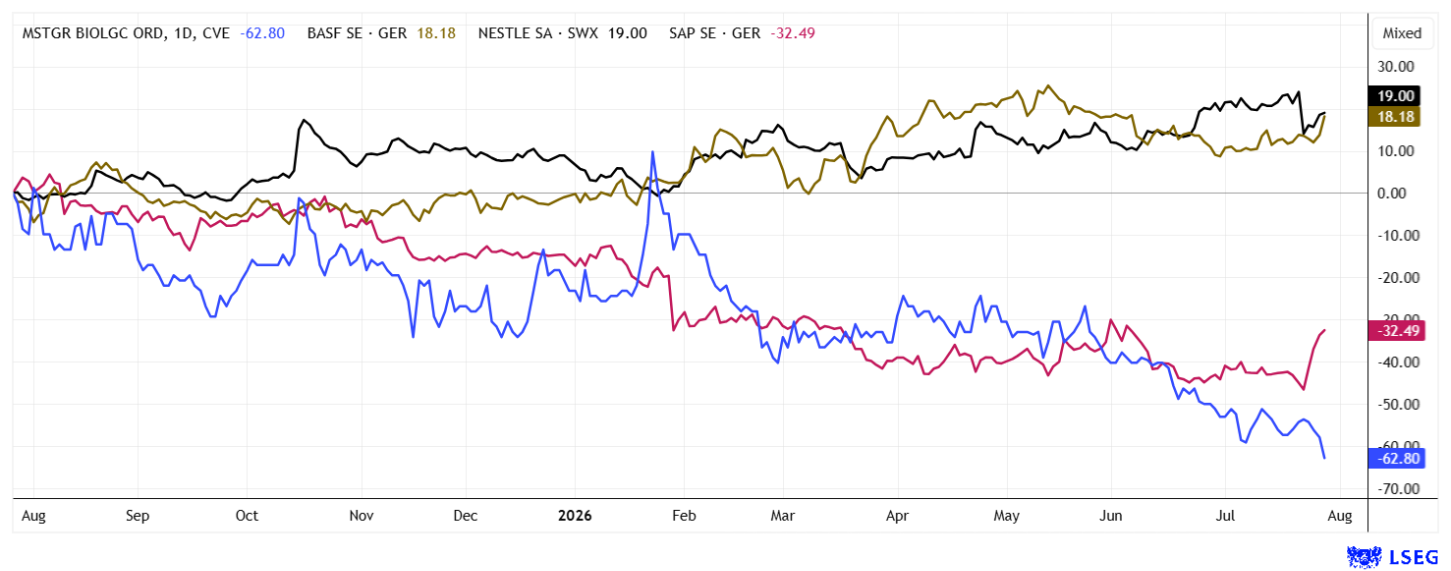
The stock markets remain heavily influenced by the broader international economic climate. This means continued extreme volatility in response to short-term events. While this has little impact on the long-term performance of BASF or Nestlé, the environment remains challenging for SAP despite recent stabilization. With an innovative product portfolio, MustGrow should now be able to leverage its strengths in organic agriculture. ESG-focused investors will find well-founded investment incentives here—a view shared by the research firm GBC, which recommends a "Buy"!
Conflict of interest
Pursuant to §85 of the German Securities Trading Act (WpHG), we point out that Apaton Finance GmbH as well as partners, authors or employees of Apaton Finance GmbH (hereinafter referred to as "Relevant Persons") currently hold or hold shares or other financial instruments of the aforementioned companies and speculate on their price developments. In this respect, they intend to sell or acquire shares or other financial instruments of the companies (hereinafter each referred to as a "Transaction"). Transactions may thereby influence the respective price of the shares or other financial instruments of the Company.
In this respect, there is a concrete conflict of interest in the reporting on the companies.
In addition, Apaton Finance GmbH is active in the context of the preparation and publication of the reporting in paid contractual relationships.
For this reason, there is also a concrete conflict of interest.
The above information on existing conflicts of interest applies to all types and forms of publication used by Apaton Finance GmbH for publications on companies.
Risk notice
Apaton Finance GmbH offers editors, agencies and companies the opportunity to publish commentaries, interviews, summaries, news and the like on news.financial. These contents are exclusively for the information of the readers and do not represent any call to action or recommendations, neither explicitly nor implicitly they are to be understood as an assurance of possible price developments. The contents do not replace individual expert investment advice and do not constitute an offer to sell the discussed share(s) or other financial instruments, nor an invitation to buy or sell such.
The content is expressly not a financial analysis, but a journalistic or advertising text. Readers or users who make investment decisions or carry out transactions on the basis of the information provided here do so entirely at their own risk. No contractual relationship is established between Apaton Finance GmbH and its readers or the users of its offers, as our information only refers to the company and not to the investment decision of the reader or user.
The acquisition of financial instruments involves high risks, which can lead to the total loss of the invested capital. The information published by Apaton Finance GmbH and its authors is based on careful research. Nevertheless, no liability is assumed for financial losses or a content-related guarantee for the topicality, correctness, appropriateness and completeness of the content provided here. Please also note our Terms of use.