June 24th, 2025 | 07:10 CEST
FOCUS online reports on miracle concrete: Argo Living Soils is working on a revolution in construction!
The construction industry is under enormous pressure: infrastructure is aging, the demand for new buildings is growing - and at the same time, CO₂ emissions must be reduced urgently. This presents opportunities for innovators to earn billions. Argo Living Soils is one such innovator. Nanomaterials are being used to create a miracle concrete which could revolutionize the construction industry. The potential has even been recognized by FOCUS Online, which recently reported on the project in detail. The article not only highlights the technological innovation surrounding graphene concrete but also emphasizes Argo's role as the driving force behind its development. The enormous potential relative to the valuation of EUR 10 million speaks in favor of buying the stock.
time to read: 2 minutes | Author: Fabian Lorenz
ISIN: ARGO LIVING SOILS CORP | CA04018T3064
Table of contents:
Author

Fabian Lorenz
For more than twenty years, the Cologne native has been intensively involved with the stock market, both professionally and privately. He is particularly passionate about national and international small and micro caps.
Tag cloud
Shares cloud
FOCUS online: "Thinner than a hair – and stronger than steel"
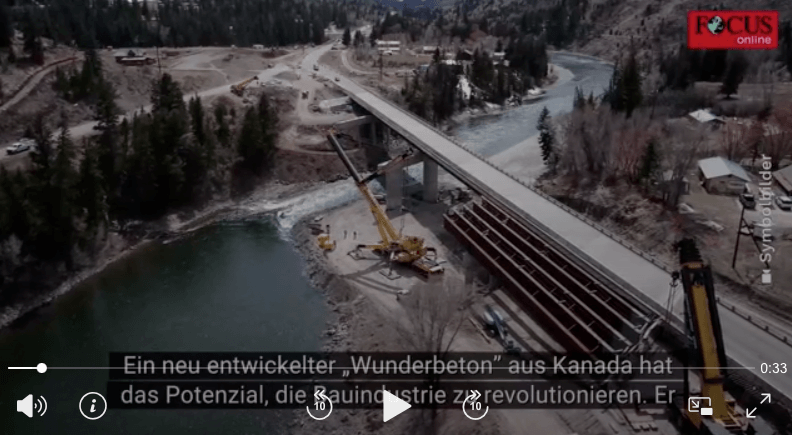
"Thinner than a hair – and stronger than steel" is how FOCUS Online describes the new wonder material: graphene. With this additive, concrete as we know it could be revolutionized and enable a new way of building. This is because its tensile and compressive strength could be significantly increased. This means that bridges, tunnels, and high-rise buildings could become more robust, durable, and less susceptible to damage from water or cracks in the future. This not only reduces renovation costs but also significantly extends the service life of buildings – a financial and ecological gain.
Climate protection through less cement
The climate is also protected: using graphene could reduce the amount of cement in concrete by up to 50% – without compromising stability. This is an enormous lever in terms of climate protection, as cement production accounts for around 8% of global CO₂ emissions. According to studies, almost 450 kilograms of CO₂ could be saved per ton of concrete. For an industry that has had little scope for sustainable innovation to date, this is real progress.
Smart building materials: Concrete that thinks
However, graphene can do even more: in the form of graphene oxide, it can be incorporated into so-called "smart" concrete. This type of concrete can detect cracks or moisture at an early stage and thus signal when maintenance is needed. This could save billions in costs, especially in the infrastructure sector – for example, in highway bridges or tunnels. Expensive repairs and corrosion damage could be significantly reduced. Concrete 2.0 may even be up to four times more water-resistant.
But what is graphene?
Like the more familiar graphite, the nanomaterial graphene is also derived from carbon. Due to its lightness and near transparency, it is often referred to as a "miracle material." It is only one atom thick, over 100 times stronger than steel, and electrically conductive. Graphene can also be combined with other materials, such as plastic. The "miracle material" is already being used successfully in other areas, such as computer chips, medical technology, and energy storage.

In the hot phase
Argo Living Soils is currently putting the new material through its paces together with its partner, Graphene Leaders. The challenge lies in getting the dosage right. Too much graphene or poorly distributed particles can reduce stability. The new concrete could be ready for market in just a few months. According to FOCUS Online, the timing is ideal. In North America alone, the market for ready-mixed concrete is set to grow to USD 250 billion by 2024. Demand is rising – and at the same time, regulatory pressure to build with lower emissions is growing.
Huge opportunities with a valuation of EUR 10 million
For Argo Living Soils, the opportunity is in the billions - yet the Company currently has a valuation of just EUR 10 million. This makes Argo shares – which are now also traded on German stock exchanges – a real hot stock. Incidentally, a name change to Argo Graphene Solutions is imminent, underscoring the Company's confidence in its technology.
Conclusion: Multiplication possible
Climate protection, high-tech materials, and a billion-dollar industry in one stock. That is what Argo Living Soils (soon to be Argo Graphene Solutions) offers. If the test results are positive, the stock will likely multiply in value. Investors still have the opportunity to get in early.
Conflict of interest
Pursuant to §85 of the German Securities Trading Act (WpHG), we point out that Apaton Finance GmbH as well as partners, authors or employees of Apaton Finance GmbH (hereinafter referred to as "Relevant Persons") may hold shares or other financial instruments of the aforementioned companies in the future or may bet on rising or falling prices and thus a conflict of interest may arise in the future. The Relevant Persons reserve the right to buy or sell shares or other financial instruments of the Company at any time (hereinafter each a "Transaction"). Transactions may, under certain circumstances, influence the respective price of the shares or other financial instruments of the Company.
In addition, Apaton Finance GmbH is active in the context of the preparation and publication of the reporting in paid contractual relationships.
For this reason, there is a concrete conflict of interest.
The above information on existing conflicts of interest applies to all types and forms of publication used by Apaton Finance GmbH for publications on companies.
Risk notice
Apaton Finance GmbH offers editors, agencies and companies the opportunity to publish commentaries, interviews, summaries, news and the like on news.financial. These contents are exclusively for the information of the readers and do not represent any call to action or recommendations, neither explicitly nor implicitly they are to be understood as an assurance of possible price developments. The contents do not replace individual expert investment advice and do not constitute an offer to sell the discussed share(s) or other financial instruments, nor an invitation to buy or sell such.
The content is expressly not a financial analysis, but a journalistic or advertising text. Readers or users who make investment decisions or carry out transactions on the basis of the information provided here do so entirely at their own risk. No contractual relationship is established between Apaton Finance GmbH and its readers or the users of its offers, as our information only refers to the company and not to the investment decision of the reader or user.
The acquisition of financial instruments involves high risks, which can lead to the total loss of the invested capital. The information published by Apaton Finance GmbH and its authors is based on careful research. Nevertheless, no liability is assumed for financial losses or a content-related guarantee for the topicality, correctness, appropriateness and completeness of the content provided here. Please also note our Terms of use.