March 16th, 2026 | 07:25 CET
Energy Crisis Drives Agricultural Transformation: Opportunities in MustGrow Biologics, K+S, and Corteva Agriscience
Agriculture is at a turning point. The reason is the renewed escalation in the Middle East. The Strait of Hormuz, through which roughly one-fifth of global liquefied natural gas shipments and significant volumes of fertilizer-related trade pass, represents one of the world's most critical energy chokepoints. The resulting instability has pushed energy prices higher and stalled the production of synthetic nitrogen fertilizers. Since natural gas is the base raw material for fertilizer production, agricultural companies and farmers must rethink their strategies. In this environment, agricultural innovation will play a crucial role in securing future food supply. Companies such as K+S and Corteva Agriscience are responding to cost pressures in energy raw materials, while MustGrow Biologics is attracting attention with biological solutions that could reduce reliance on synthetic fertilizers.
time to read: 3 minutes | Author: Nico Popp
ISIN: MUSTGROW BIOLOGICS CORP | CA62822A1030 | TSXV: MGRO , OTCQB: MGROF , K+S AG NA O.N. | DE000KSAG888 , CORTEVA INC. DL -_01 | US22052L1044
Table of contents:
Author
Nico Popp
At home in Southern Germany, the passionate stock exchange expert has been accompanying the capital markets for about twenty years. With a soft spot for smaller companies, he is constantly on the lookout for exciting investment stories.
Tag cloud
Shares cloud
K+S Between Cost Pressure and Transformation
As a potash and salt producer, K+S finds itself caught between rising costs and a strategic realignment. As a processor of raw materials, K+S is vulnerable to rising energy costs. In fiscal year 2025, the group generated revenue of approximately EUR 3.7 billion, representing no growth compared to the previous year. The company reported an adjusted consolidated net loss of EUR 1.1 billion, primarily due to an impairment charge of approximately EUR 1.6 billion. Despite these factors, K+S exceeded EBITDA expectations in the fourth quarter of 2025, leading to a surge in the stock price. To counter cost pressures, management is focusing on optimizations at production sites. The Werra 2060 project is intended to ensure efficiency in Germany, while the Canadian site in Bethune is being expanded. A key component of the strategy is the refocus on regenerative soil amendments to increase crop resilience through specialized nutrient combinations.
Corteva Agriscience Accelerates the Shift to Biologicals
Corteva Agriscience is positioning itself as a pioneer in the transition from synthetic chemical to biological crop protection products. The company is leveraging its market power and in-house research to transform its portfolio toward sustainability and innovation. In the past fiscal year, Corteva reported a 3% increase in revenue on an organic basis and achieved net revenue of approximately USD 17.4 billion. Growth was driven primarily by the crop protection segment, where volume rose by 5%, driven by demand for new products and biologics. Corteva's strategy is based on the introduction of differentiated technologies, with 65% of crop protection revenue coming from in-house developments. A milestone was the integration of the acquisitions Symborg and Stoller, which made Corteva one of the largest players in the market for biological agricultural products. Revenue from biologics already stood at around USD 500 million in 2024. Technologically, the company is focusing on platforms such as short-statured corn, which enables more precise nutrient application.
MustGrow Biologics as a Problem Solver in the Crisis
While established corporations are also breaking new ground in the wake of the crisis, MustGrow Biologics offers a direct solution to the supply shortages of synthetic fertilizers. The company has developed a patented technology that uses active ingredients from the mustard plant to improve soil and combat pests. At the center of this approach is TerraSante, an organic soil amendment derived from mustard seeds. Unlike synthetic fertilizers, TerraSante is designed to support the soil microbiome and also stimulates beneficial bacteria and fungi. A healthy microbiome unlocks nutrients bound in the soil, such as phosphorus. Since plants can absorb nutrients more efficiently, the need for synthetic fertilizers decreases significantly, which is a clear advantage in times of natural gas shortages. TerraSante's competitiveness is backed by field trials from last year. In the US state of Washington, a potato farmer achieved a yield increase of 2 tonnes per acre. With product costs of USD 180 per acre, this resulted in an added value of USD 5,000, corresponding to a return on investment of 2,700%.
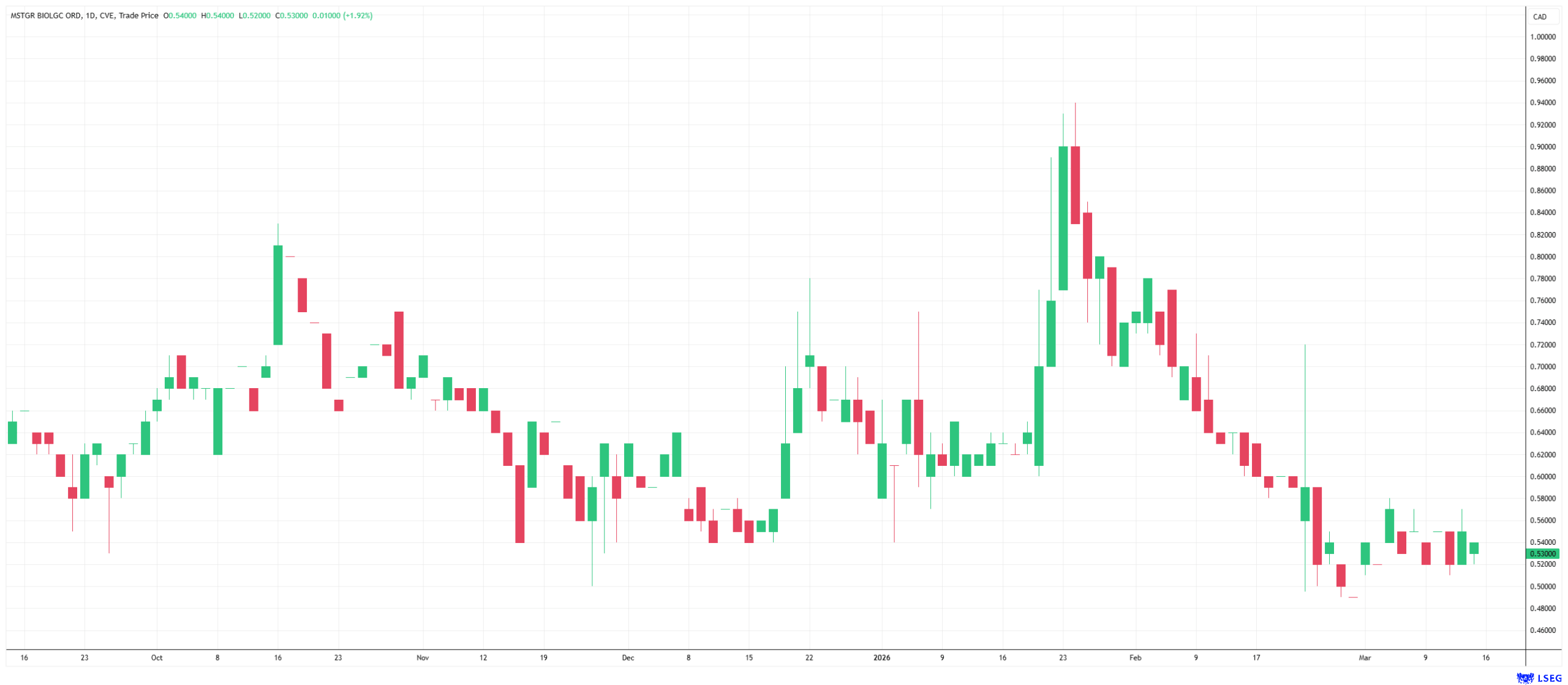
MustGrow has completed its transition to a commercial provider and already achieved record sales in the US last year. To meet demand, management is establishing production lines in Asia designed to enable economies of scale. The partnership with Bayer in the field of biopesticides is progressing, with Bayer contributing resources for the registration of TerraMG technology. Earlier this year, MustGrow completed a USD 2.0 million capital increase to finance production and market entry in new regions.
MustGrow: A CAD 33 Million Market Cap Presents an Opportunity
For investors, the restructuring of the agricultural landscape offers lucrative options. K+S remains a solid choice for investors speculating on a recovery in margins through efficiency programs. Corteva Agriscience is the core investment for investors who want to benefit from the scaling of the biologics market by a global corporation. MustGrow Biologics provides the solution to the problem of fertilizer shortages, reduces dependence on chemicals, and lowers farmers' fertilizer requirements. If the planned expansion succeeds, MustGrow's stock is likely to offer the greatest opportunities among the companies mentioned, given its low market capitalization of approximately CAD 33 million.
Watch YouTube videoConflict of interest
Pursuant to §85 of the German Securities Trading Act (WpHG), we point out that Apaton Finance GmbH as well as partners, authors or employees of Apaton Finance GmbH (hereinafter referred to as "Relevant Persons") may hold shares or other financial instruments of the aforementioned companies in the future or may bet on rising or falling prices and thus a conflict of interest may arise in the future. The Relevant Persons reserve the right to buy or sell shares or other financial instruments of the Company at any time (hereinafter each a "Transaction"). Transactions may, under certain circumstances, influence the respective price of the shares or other financial instruments of the Company.
In addition, Apaton Finance GmbH is active in the context of the preparation and publication of the reporting in paid contractual relationships.
For this reason, there is a concrete conflict of interest.
The above information on existing conflicts of interest applies to all types and forms of publication used by Apaton Finance GmbH for publications on companies.
Risk notice
Apaton Finance GmbH offers editors, agencies and companies the opportunity to publish commentaries, interviews, summaries, news and the like on news.financial. These contents are exclusively for the information of the readers and do not represent any call to action or recommendations, neither explicitly nor implicitly they are to be understood as an assurance of possible price developments. The contents do not replace individual expert investment advice and do not constitute an offer to sell the discussed share(s) or other financial instruments, nor an invitation to buy or sell such.
The content is expressly not a financial analysis, but a journalistic or advertising text. Readers or users who make investment decisions or carry out transactions on the basis of the information provided here do so entirely at their own risk. No contractual relationship is established between Apaton Finance GmbH and its readers or the users of its offers, as our information only refers to the company and not to the investment decision of the reader or user.
The acquisition of financial instruments involves high risks, which can lead to the total loss of the invested capital. The information published by Apaton Finance GmbH and its authors is based on careful research. Nevertheless, no liability is assumed for financial losses or a content-related guarantee for the topicality, correctness, appropriateness and completeness of the content provided here. Please also note our Terms of use.