May 18th, 2026 | 06:55 CEST
West Africa: A Gold Hotspot! What Makes This Region Unique - Desert Gold, Barrick Mining, Endeavour Mining
Without control over high-grade deposits, mines cannot operate sustainably in the long run – this holds true even in the promising West African gold belt. While many market participants are distracted by short-term geopolitical headlines and view countries like Mali rather critically, experienced players focus on geology and grades as the decisive factors. In the current market environment, momentum is shifting away from speculative projects and toward advanced properties with significant potential for future production. As the world's leading growth region, West Africa is at the center of this trend, with the Senegal-Mali Shear Zone (SMSZ) standing out in particular for its geology. We highlight three exciting companies and take a closer look at one promising gold prospector.
time to read: 3 minutes | Author: Nico Popp
ISIN: DESERT GOLD VENTURES | CA25039N4084 | TSXV: DAU , OTCQB: DAUGF , BARRICK MINING CORPORATION | CA06849F1080 | NYSE: B , TSX: ABX , ENDEAVOUR MINING PLC | GB00BL6K5J42
Table of contents:
Author

Nico Popp
At home in Southern Germany, the passionate stock exchange expert has been accompanying the capital markets for about twenty years. With a soft spot for smaller companies, he is constantly on the lookout for exciting investment stories.
Tag cloud
Shares cloud
Barrick Mining: Industry Giant on the Verge of Restructuring
Barrick Mining demonstrates just how stable companies with top-tier assets can be. Under the leadership of Mark Bristow, the group has proven, through the Loulo-Gounkoto complex in Mali, that West Africa can be the cornerstone of a top-tier gold portfolio. The gold giant operates directly within the Gold Belt and, regardless of political instability, generates the most stable cash flows in the industry there. Smaller projects in the surrounding area are considered potential acquisition targets to extend the lifespans of existing large-scale operations if necessary.
Quarterly figures demonstrate that value is being created in Mali. Driven by a realized gold price of USD 4,823 per ounce, Barrick most recently generated quarterly revenue of USD 5.2 billion and net income of USD 1.6 billion. Production, at 719,000 ounces of gold, significantly exceeded market expectations, while all-in sustaining costs (AISC) were reduced by 4% year-over-year to USD 1,708 per ounce. Under the new interim CEO, Mark Hill, management is, however, initiating a strategic realignment. To mitigate geopolitical risk premiums, Barrick plans to list a minority stake in its North American assets by the end of 2026.
Endeavour Mining as a Benchmark for Regional Gold Clusters
Endeavour Mining also demonstrates that scale and synergies are crucial. Through a series of targeted acquisitions, the company has become West Africa's largest pure-play gold producer under the leadership of CEO Ian Cockerill. Endeavour Mining demonstrates how bundling projects into regional clusters yields enormous cost advantages in logistics, procurement, and processing. The SMSZ region is not uncharted territory for the group—Endeavour knows exactly what the region has to offer.
The benefits of the cluster strategy are evident in Endeavour's record-breaking first-quarter 2026 results. Thanks to a realized gold price of USD 4,810 per ounce, adjusted EBITDA rose to a record USD 880 million, while free cash flow reached an impressive USD 613 million. This means that for every ounce of gold produced, the company generates USD 2,176 in cash. By 2030, Endeavour plans to discover an additional 12 to 15 million ounces of gold at extremely low target discovery costs of around USD 40 per ounce, with an increased focus on high-grade new discoveries. A shortcut along this path could be the acquisition of existing projects in development. Desert Gold, for example, fits the bill.
Desert Gold Ventures: High Grades and Approaching Production
With the SMSZ project, Desert Gold controls one of the largest remaining independent land packages, covering approximately 440 km² directly within the region's most productive gold belt, thereby literally filling the gap between the mines of Barrick and Allied Gold. Historical drill results, such as the spectacular interval of 2.15 g/t Au over 18.5 m in the Gourbassi West zone, validate the hypothesis of a continuous, massive gold system.**
The key advantage for investors: Desert Gold has already eliminated many development risks. According to the NI 43-101 mining standard, the project has a solid resource base of 336,800 ounces of gold in the "Measured & Indicated" category and 879,900 ounces of gold in the "Inferred" category. To further increase this potential, a new 4,250-meter drilling campaign was launched in April.
Desert Gold: Cash Flow Strategy Reduces Risk for Shareholders
In times when shareholders of junior miners often have to accept dilution, Desert Gold is taking a pragmatic approach. The company is constructing a cost-effective, modular gravity processing plant at the Barani East site. With the successful shipment of the plant in April and the planned first gold pour on July 19, 2026, Desert Gold will secure its own independent cash flow starting this summer. Furthermore, according to the preliminary economic assessment (PEA), the project is highly profitable even in its initial phase, with all-in sustaining costs (AISC) of just USD 1,352 per ounce.
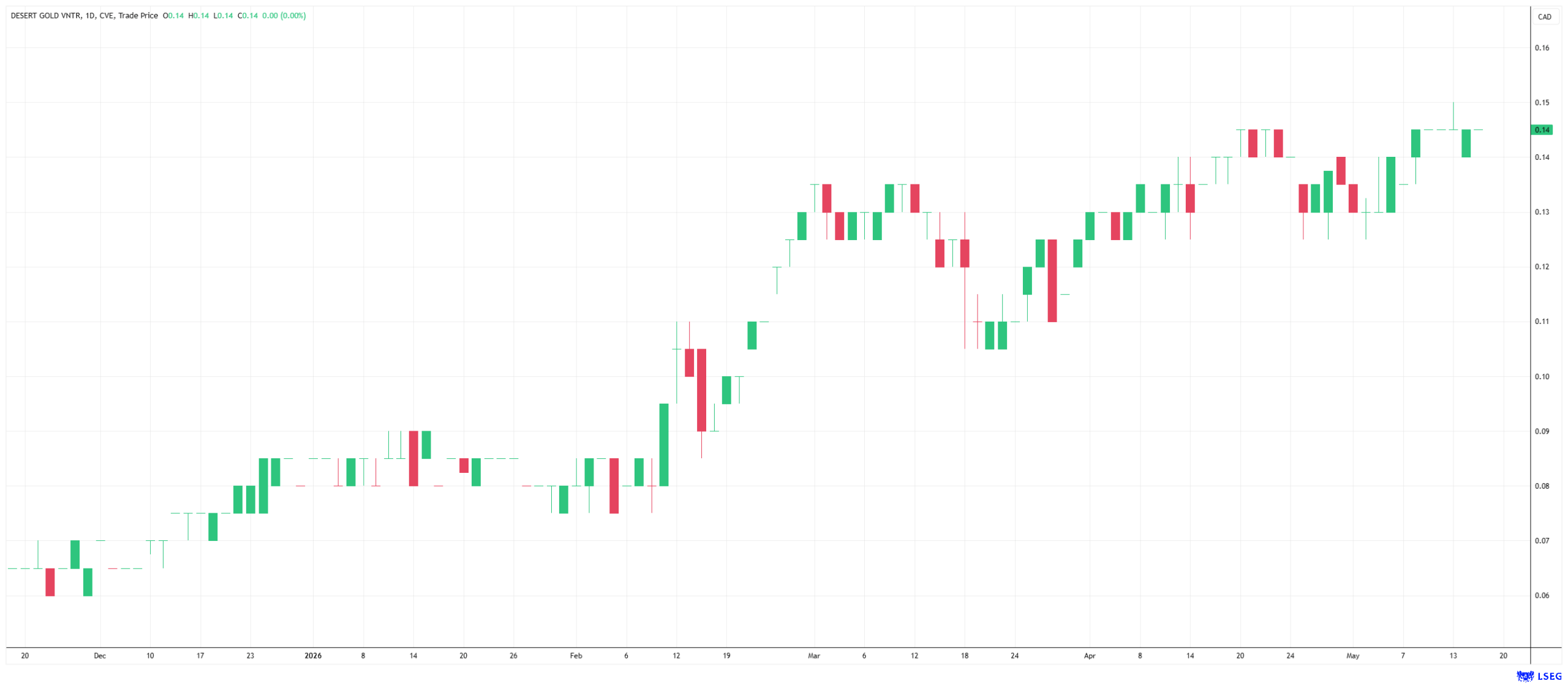
Desert Gold, Barrick Mining, and Endeavour Mining represent different stages of the value chain but share a focus on the world-class geology in Mali's most productive gold belt. The successful merger of Predictive Discovery and Robex Resources in mid-April, which serves as a blueprint for the sector, demonstrates that consolidation along the SMSZ is well underway. Given a market capitalization of just under CAD 50 million, speculative gold investors should take a closer look at Desert Gold's stock. If the planned production start in the summer is successful, the share is likely to attract further attention.
Watch YouTube videoConflict of interest
Pursuant to §85 of the German Securities Trading Act (WpHG), we point out that Apaton Finance GmbH as well as partners, authors or employees of Apaton Finance GmbH (hereinafter referred to as "Relevant Persons") currently hold or hold shares or other financial instruments of the aforementioned companies and speculate on their price developments. In this respect, they intend to sell or acquire shares or other financial instruments of the companies (hereinafter each referred to as a "Transaction"). Transactions may thereby influence the respective price of the shares or other financial instruments of the Company.
In this respect, there is a concrete conflict of interest in the reporting on the companies.
In addition, Apaton Finance GmbH is active in the context of the preparation and publication of the reporting in paid contractual relationships.
For this reason, there is also a concrete conflict of interest.
The above information on existing conflicts of interest applies to all types and forms of publication used by Apaton Finance GmbH for publications on companies.
Risk notice
Apaton Finance GmbH offers editors, agencies and companies the opportunity to publish commentaries, interviews, summaries, news and the like on news.financial. These contents are exclusively for the information of the readers and do not represent any call to action or recommendations, neither explicitly nor implicitly they are to be understood as an assurance of possible price developments. The contents do not replace individual expert investment advice and do not constitute an offer to sell the discussed share(s) or other financial instruments, nor an invitation to buy or sell such.
The content is expressly not a financial analysis, but a journalistic or advertising text. Readers or users who make investment decisions or carry out transactions on the basis of the information provided here do so entirely at their own risk. No contractual relationship is established between Apaton Finance GmbH and its readers or the users of its offers, as our information only refers to the company and not to the investment decision of the reader or user.
The acquisition of financial instruments involves high risks, which can lead to the total loss of the invested capital. The information published by Apaton Finance GmbH and its authors is based on careful research. Nevertheless, no liability is assumed for financial losses or a content-related guarantee for the topicality, correctness, appropriateness and completeness of the content provided here. Please also note our Terms of use.