April 8th, 2026 | 07:25 CEST
ENTRY OPPORTUNITY in the Drone Sector? NEO Battery Materials Tests in a Military Border Zone
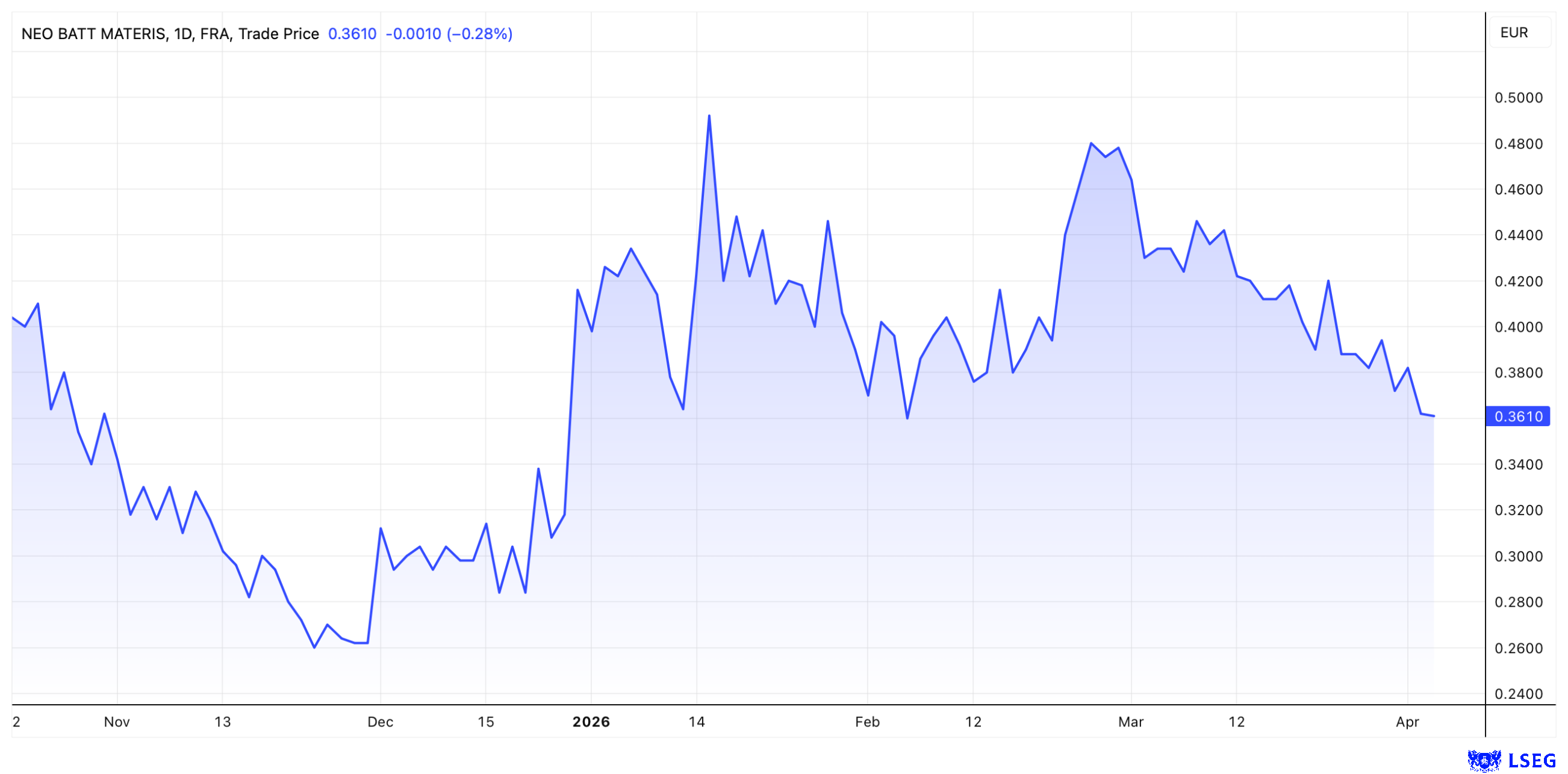
An intriguing entry opportunity is currently emerging in the drone sector with NEO Battery Materials. Amid recent market volatility, shares of this specialist in batteries for drones, robotics, and electric mobility have declined by more than 20%. At the same time, geopolitical conflicts, most recently in the Middle East, continue to highlight the growing strategic importance of drones. NEO's batteries, manufactured in South Korea, have demonstrated in practical tests the potential to significantly extend flight time by up to 100%, while also offering faster charging capabilities. In a recent interview, the company outlined the technological advantages behind these improvements. There is also notable operational progress: NEO is collaborating with the South Korean military to further develop its products, and this is happening at what is arguably one of the world's most critical borders. It can really only be a matter of time before the stock takes off again.
time to read: 3 minutes | Author: Fabian Lorenz
ISIN: NEO BATTERY MATERIALS LTD | CA62908A1003 | TSXV: NBM , OTC: NBMFF
Table of contents:
Author

Fabian Lorenz
For more than twenty years, the Cologne native has been intensively involved with the stock market, both professionally and privately. He is particularly passionate about national and international small and micro caps.
Tag cloud
Shares cloud
Technology with a Competitive Edge
The race for the next generation of batteries is no longer decided solely by the raw material lithium, but by what is inside the cell. This is exactly where NEO Battery Materials comes in. In an interview with Lyndsay Malchuk of the International Investment Forum, NEO's top executive, Danny Huh, makes it clear: The decisive advances are coming from anode technology—and NEO could play a key role here. The focus is on a novel silicon anode that can significantly increase both energy density and charging speed. In a market demanding range, efficiency, and cost reduction, this is a clear competitive advantage.
According to NEO, the company has solved a central problem of traditional silicon solutions, the massive volume expansion during charging, both technologically and economically. While many competitors have failed with complex and expensive approaches, the company relies on metallurgical silicon. The result is remarkable: According to Huh, production costs can be reduced by 60% to 80% compared to competing technologies—a breakthrough, as silicon anodes were previously simply too expensive for widespread use. NEO is thus pursuing a rare combination of performance and cost advantages, which should pay off soon.
Target Markets: Drones, Robotics, and Electric Mobility
Strategically, the company is targeting multiple high-growth segments, including drones, robotics, and electric mobility. In doing so, it is also addressing a geopolitically sensitive issue: the heavy dependence on Chinese battery supply chains. With a fully South Korean-based production setup, NEO is positioning itself as an alternative supplier for Western markets, particularly in defense-related applications. The company has already demonstrated initial capabilities, with its NBM drone cells integrated into a commercial surveillance drone. In real-world testing, flight time reportedly doubled compared to conventional Chinese battery solutions.
The first commercial products are scheduled to be delivered later this year. At the same time, NEO is preparing for the next phase of scaling. A new production facility is expected to deliver 2 to 4 million battery cells annually. The strategy is first to establish South Korea as a reference market and then expand into the US.
https://youtu.be/m_IT1FQvE_4?si=PJHH6GhxARR8NsKV
Partnership in the Border Region
The latest success story also comes from South Korea. NEO Battery Materials has signed a direct cooperation agreement with the South Korean Army's 12th Infantry Division. The goal is the joint development and implementation of high-performance battery systems for drones and robotic applications under real-world operational conditions. In doing so, both sides will exchange technical expertise and tailor the battery solutions specifically to the requirements of military operations, for example, in terms of endurance, fast-charging capability, and performance under extreme temperatures. It is noteworthy that the 12th Infantry Division is an active frontline unit stationed at the Demilitarized Zone (DMZ). Despite its name, the DMZ is one of the most heavily guarded and critical borders in the world and symbolizes the division between North and South Korea that persists to this day. NEO products are thus being developed under extreme conditions.
The collaboration provides NEO Battery Materials with valuable field data from live operations, which is intended to optimize the products and serve as a basis for future procurement processes in the defense sector. Through direct access to an operational unit with over 10,000 soldiers, the company aims to significantly shorten its time-to-market and position itself as a key supplier for military battery applications. The potential is correspondingly vast.
Incidentally, this is not the first partnership in the military sector. NEO is already collaborating with the Korea Institute for Defense Industry (KOIDI) and is thus part of the country's defense industry ecosystem.
Conclusion: Strong Potential for Rising Share Prices
NEO Battery Materials offers investors exposure to several growth markets, including drones, robotics, and electric mobility. In all of these areas, demand for non-Chinese battery solutions is increasing, particularly in the West. The company is currently transitioning from research and development toward commercialization. This phase typically offers unique opportunities. NEO appears well-positioned with strong partners, production facilities, and initial orders. Therefore, there is strong evidence that NEO shares could take off this year.
Conflict of interest
Pursuant to §85 of the German Securities Trading Act (WpHG), we point out that Apaton Finance GmbH as well as partners, authors or employees of Apaton Finance GmbH (hereinafter referred to as "Relevant Persons") may hold shares or other financial instruments of the aforementioned companies in the future or may bet on rising or falling prices and thus a conflict of interest may arise in the future. The Relevant Persons reserve the right to buy or sell shares or other financial instruments of the Company at any time (hereinafter each a "Transaction"). Transactions may, under certain circumstances, influence the respective price of the shares or other financial instruments of the Company.
In addition, Apaton Finance GmbH is active in the context of the preparation and publication of the reporting in paid contractual relationships.
For this reason, there is a concrete conflict of interest.
The above information on existing conflicts of interest applies to all types and forms of publication used by Apaton Finance GmbH for publications on companies.
Risk notice
Apaton Finance GmbH offers editors, agencies and companies the opportunity to publish commentaries, interviews, summaries, news and the like on news.financial. These contents are exclusively for the information of the readers and do not represent any call to action or recommendations, neither explicitly nor implicitly they are to be understood as an assurance of possible price developments. The contents do not replace individual expert investment advice and do not constitute an offer to sell the discussed share(s) or other financial instruments, nor an invitation to buy or sell such.
The content is expressly not a financial analysis, but a journalistic or advertising text. Readers or users who make investment decisions or carry out transactions on the basis of the information provided here do so entirely at their own risk. No contractual relationship is established between Apaton Finance GmbH and its readers or the users of its offers, as our information only refers to the company and not to the investment decision of the reader or user.
The acquisition of financial instruments involves high risks, which can lead to the total loss of the invested capital. The information published by Apaton Finance GmbH and its authors is based on careful research. Nevertheless, no liability is assumed for financial losses or a content-related guarantee for the topicality, correctness, appropriateness and completeness of the content provided here. Please also note our Terms of use.