July 14th, 2026 | 07:10 CEST
Daimler Truck Warns of Charging Station Shortages: NEL Refines Its Strategy While Pure One Rethinks the Entire Approach
The transformation of heavy-duty road transport remains an uphill battle. While increasingly stringent regulations are pushing vehicle manufacturers toward zero-emission technologies, the rollout of charging and hydrogen infrastructure across EU member states continues to lag far behind. The shortcomings are particularly evident along Europe's highways and major freight corridors: for transport operators, an emissions-free truck offers limited value if reliable charging stations or hydrogen refueling infrastructure are unavailable. Against this backdrop of ambitious regulation and slow infrastructure development, agile technology providers are finding new opportunities. We take a closer look at pragmatic solutions and examine where the most promising investment opportunities may emerge.
time to read: 3 minutes | Author: Nico Popp
ISIN: PURE ONE CORPORATION LIMITED | AU0000442865 | ASX: P1E , Daimler Truck Holding AG | DE000DTR0013 , NEL ASA NK-_20 | NO0010081235
Table of contents:
Author

Nico Popp
At home in Southern Germany, the passionate stock exchange expert has been accompanying the capital markets for about twenty years. With a soft spot for smaller companies, he is constantly on the lookout for exciting investment stories.
Tag cloud
Shares cloud
Daimler Truck: Infrastructure Chaos Causes Concern
The pressure is mounting at industry giant Daimler Truck, as draconian fines of EUR 4,250 per exceeded gCO₂/tkm (grams of carbon dioxide per metric ton-kilometre) are already looming—fines that will rise to as much as EUR 6,800 per gCO₂/tkm starting in 2030. Karin Rådström, CEO of Daimler Truck and the new chair of the Commercial Vehicle Committee at the European Automobile Manufacturers' Association (ACEA), strongly warns of the shortcomings in the European charging network and emphasizes that by the end of 2025, there will be only about 2,000 truck-compatible charging points across the entire EU. Although Daimler Truck is relying on sLH2 technology for subcooled liquid hydrogen—developed jointly with Linde Engineering—for heavy-duty long-haul transport, manufacturers face the threat of heavy fines despite their commitment if a comprehensive network is not in place.
To mitigate this risk, the ACEA, under Rådström's leadership, is calling for an accelerated, early review of CO₂ legislation for heavy-duty vehicles. While a temporary adjustment to the calculation method for emissions credits grants manufacturers slightly more short-term flexibility, the strict core targets for 2030 remain unaffected by these adjustments. According to estimates by Eurelectric and ACEA, between 300,000 and 400,000 zero-emission trucks would need to be on EU roads by 2030—a goal the market is still miles away from achieving, given that only about 22,500 battery-electric trucks were registered by the end of 2025. The industry initiative Blueprint 2030 estimates that the necessary investment in European power grids alone amounts to around EUR 600 billion, while the European automotive suppliers' association CLEPA emphasizes that achieving climate targets is inextricably linked to the immediate expansion of charging networks. So there is still much to be done—on all sides.
NEL: New Electrolysis Standard to Counter Margin Pressure
NEL, too, is feeling the pressure from the sluggish expansion of infrastructure. In particular, concerns about government subsidies—which are repeatedly called into question in countries like Germany due to the debt brake and tight budgets—are a source of frustration. Norwegian hydrogen pioneer NEL is responding to the industry's high investment barriers by introducing a new technology platform for pressurized alkaline electrolysis systems. The company promises to reduce the investment costs of such large-scale plants by 40 to 60% compared to current market standards—to less than USD 1,450 per kilowatt—through standardized, factory-preinstalled system designs. Despite ongoing losses due to global scaling, management in Oslo is consistently banking on this modular design to significantly accelerate megaprojects such as supplying Hyundai in Switzerland and the HySynergy project with Everfuel in Denmark.
Pure One: On the Fast Track with Smart Cleantech Solutions
The Australian cleantech company Pure One is positioning itself as a full-service provider in the hydrogen sector with a smart, and thus less capital-intensive, business model, covering a broad cleantech ecosystem ranging from production to zero-emission vehicle platforms. The specialists in the heavy-duty commercial vehicle sector scored a major success with two heavy-duty fuel-cell concrete mixers for Heidelberg Materials, as well as the delivery of a fully electric minibus to South West Community Transport. However, the Australian company's strategic highlight is a scalable battery-swapping platform for heavy-duty road freight transport—an approach that a recent white paper by the Fraunhofer Institute for Material Flow and Logistics (IML) confirms has potential under certain conditions. For time-critical, standardized corridor transport with network or area restrictions, a battery swap can therefore be a sensible complement to corded charging.
Automated battery swapping within a few minutes eliminates unproductive vehicle downtime when time is of the essence. In addition, the system shifts the actual charging process to stationary swap stations, enabling continuous, grid-friendly charging outside peak load times—thereby increasing efficiency and reducing charging costs. To move its ambitious plans forward, Pure One is solidly financed. Thanks to the successful initial public offering (IPO) of its subsidiary, Eastern Gas Corporation, Pure One holds a 69.44% majority stake in the company. Furthermore, the sale of a 40% stake in the Turquoise Group generated cash proceeds of AUD 5 million.
Pure One in the Markets' Crosshairs
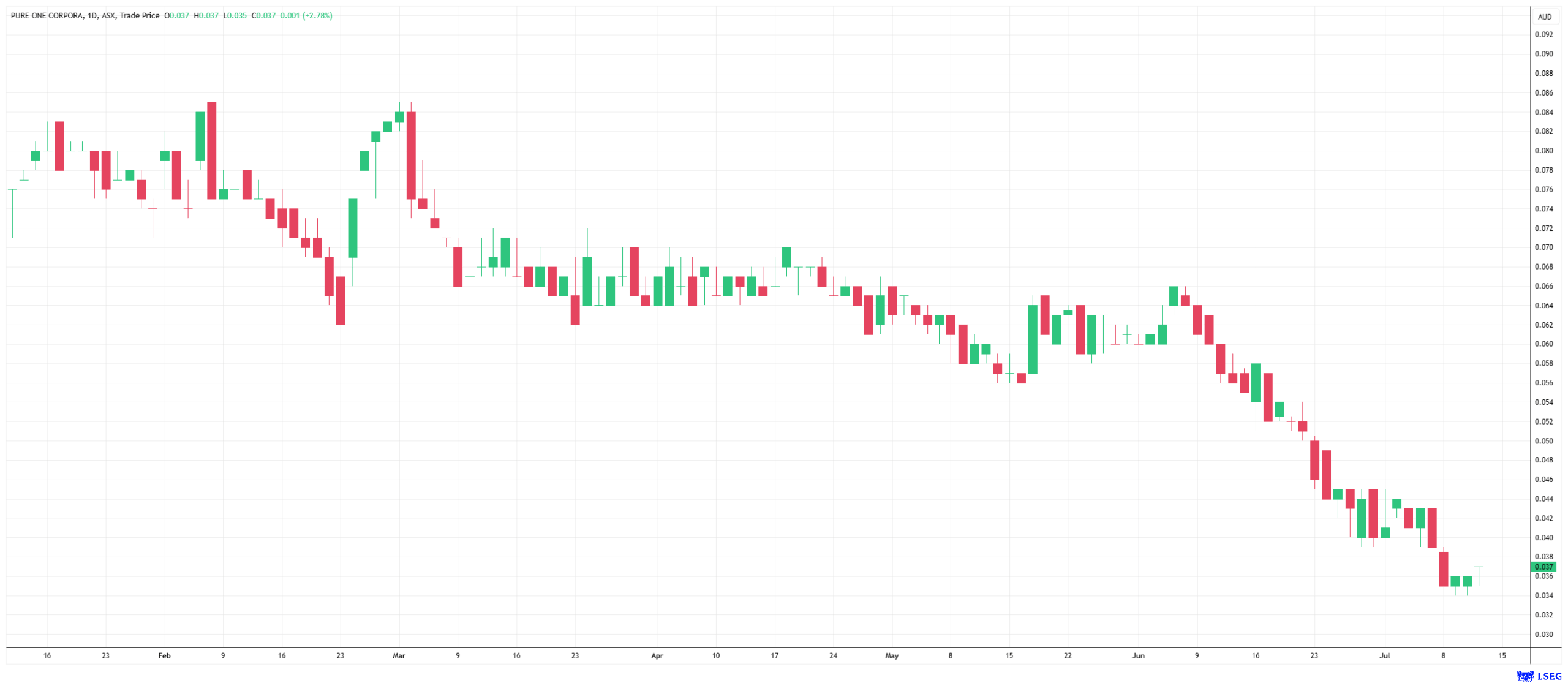
Pure One's clever business model and various innovative approaches make its stock a hot bet in the cleantech market. Potential catalysts for the stock could include the market launch of modular battery-swapping stations for heavy-duty commercial vehicles, as well as additional orders from the transportation sector. While industrial conglomerates like Daimler Truck are calling for more flexibility from regulators, Pure One is consciously pursuing innovative paths. Although competition is fierce, the industry is also in a state of flux. The conditions for the best ideas to ultimately prevail look promising.
Conflict of interest
Pursuant to §85 of the German Securities Trading Act (WpHG), we point out that Apaton Finance GmbH as well as partners, authors or employees of Apaton Finance GmbH (hereinafter referred to as "Relevant Persons") may hold shares or other financial instruments of the aforementioned companies in the future or may bet on rising or falling prices and thus a conflict of interest may arise in the future. The Relevant Persons reserve the right to buy or sell shares or other financial instruments of the Company at any time (hereinafter each a "Transaction"). Transactions may, under certain circumstances, influence the respective price of the shares or other financial instruments of the Company.
In addition, Apaton Finance GmbH is active in the context of the preparation and publication of the reporting in paid contractual relationships.
For this reason, there is a concrete conflict of interest.
The above information on existing conflicts of interest applies to all types and forms of publication used by Apaton Finance GmbH for publications on companies.
Risk notice
Apaton Finance GmbH offers editors, agencies and companies the opportunity to publish commentaries, interviews, summaries, news and the like on news.financial. These contents are exclusively for the information of the readers and do not represent any call to action or recommendations, neither explicitly nor implicitly they are to be understood as an assurance of possible price developments. The contents do not replace individual expert investment advice and do not constitute an offer to sell the discussed share(s) or other financial instruments, nor an invitation to buy or sell such.
The content is expressly not a financial analysis, but a journalistic or advertising text. Readers or users who make investment decisions or carry out transactions on the basis of the information provided here do so entirely at their own risk. No contractual relationship is established between Apaton Finance GmbH and its readers or the users of its offers, as our information only refers to the company and not to the investment decision of the reader or user.
The acquisition of financial instruments involves high risks, which can lead to the total loss of the invested capital. The information published by Apaton Finance GmbH and its authors is based on careful research. Nevertheless, no liability is assumed for financial losses or a content-related guarantee for the topicality, correctness, appropriateness and completeness of the content provided here. Please also note our Terms of use.