August 3rd, 2026 | 07:45 CEST
Alarm at Volkswagen, Steyr Motors Takeover Called Off! When Will dynaCERT Spark a Long-Awaited Breakout?
While some of Germany's largest automakers are grappling with a deepening crisis and planning historic restructuring measures, other well-known companies are also facing major challenges. Volkswagen is struggling with a sharp decline in vehicle sales and sweeping cost-cutting plans that have unsettled investors, a trend reflected in the company's weakening share price. At the same time, Austrian engine specialist Steyr Motors is navigating a highly challenging market environment and is being forced to redefine its strategic direction. Most recently, the company put an end to takeover speculation after acquisition talks failed to result in a transaction. Amid these turbulent times, investors are turning their attention to smaller players, such as the Canadian cleantech company dynaCERT. The company has developed an innovative technology for internal combustion engines designed to reduce fuel consumption and emissions, potentially delivering meaningful cost savings for fleet operators.
time to read: 4 minutes | Author: Matthias Schomber
ISIN: DYNACERT INC. | CA26780A1084 | TSX: DYA , OTCQB: DYFSF , STEYR MOTORS AG | AT0000A3FW25 , VOLKSWAGEN AG VZO O.N. | DE0007664039
Table of contents:
Author

Matthias Schomber
Raised in Giessen, Hesse, Matthias Schomber discovered his passion for the financial markets as early as the 1990s—at a time when stock trading was still largely the domain of true, die-hard traders. After completing his banking apprenticeship, he worked for a private bank there and witnessed the rise and fall of the Neuer Markt firsthand on the trading floor of the Frankfurt Stock Exchange, drawing lessons from the experience that continue to shape his thinking as a trader, author, and trading system developer to this day.
Tag cloud
Shares cloud
Volkswagen: Rough Road Ahead
The latest developments surrounding the Wolfsburg-based automaker read almost like a business thriller. Who would have seriously thought just a few years ago that such a long-established company would be shaken to its core? The recently released figures show an extremely painful slump. In particular, the once-reliable and vital Chinese market is dramatically slipping away from the company. A significant decline in sales of nearly 25.9% in China during the first half of the year speaks volumes. This decline is having a huge impact on the company's bottom line. Operating profit plummeted by over 11.6% to just under EUR 5.9 billion. As a result, the operating margin also shrank to a rather meagre 3.8%. At least electric vehicles now account for 31% of new orders, which offers hope for improvement in the long term.
The internal consequences could be drastic for the entire workforce. Plans have been presented to the supervisory board under which up to 100,000 jobs worldwide are under review. In Germany alone, four long-established plants could face complete closure. The production sites in Emden, Zwickau, Hanover, and the Audi plant in Neckarsulm are trembling for their future. A strict cost-cutting program is now being implemented with full force to turn the company around. Costs must be cut by EUR 10 to 11 billion as a matter of urgency. At the same time, the model lineup is to be reduced by 50%. This dramatic situation is reflected unvarnished on the stock market. The stock is currently trading well below the EUR 75 mark. It has lost over 25% of its value since the beginning of the year. Despite an apparently attractive price-to-earnings (P/E) ratio, many major investors remain extremely skeptical, even as closer cooperation with the Chinese battery manufacturer Gotion is being explored. The stock could fall even further before a rebound sets in.
Steyr Motors: On Its Own in a Tough Market Environment
It is not just in Lower Saxony that tensions are running high right now. Austrian specialist Steyr Motors also faces plenty of challenges that management must consistently tackle. While other large, leading companies are struggling with the radical transition to electric mobility, this renowned manufacturer of specialty engines must also prove itself in a highly demanding environment.
At a time when the entire automotive and engine industry is undergoing a painful upheaval, niche providers like Steyr Motors are required to demonstrate absolute technological perfection and strategic foresight. The focus is on further refining existing highly complex drive and engine systems and safeguarding the company against emerging international competition.
The market currently tolerates no missteps, and every medium-sized or specialized player must demonstrate to investors how future margins can be secured. In addition, Steyr Motors recently made headlines due to a potential takeover scenario. Management confirmed past negotiations regarding a possible public tender offer by the US drone manufacturer Red Cat Holdings, but announced the provisional end of the talks almost simultaneously. Even without a direct takeover premium, the specialty engine manufacturer remains extremely attractive to investors thanks to its well-filled order books. The key level to watch here is the EUR 50 mark. Above that, the stock would be technically unhindered on the upside.
dynaCERT: Technologically Leading the Way to a Cleaner Future
While industry heavyweights such as Volkswagen and Steyr Motors are busy addressing their own significant operational challenges, a smaller Canadian company is pursuing a compelling technological solution. dynaCERT has established itself as an innovative player in the growing cleantech sector. With its patented HydraGEN™ technology, the company offers a retrofit solution for conventional diesel engines. The underlying concept is both simple and effective. A compact, weather-resistant electrolysis unit generates small amounts of hydrogen and oxygen on demand while the vehicle is in operation. This gas mixture is then injected directly into the engine's air intake, where it enhances the combustion process in conventional diesel engines.
Because hydrogen burns at a flame speed approximately nine times faster than conventional diesel fuel, it enables a significantly faster and more complete combustion process inside the cylinder. The measurable benefits include lower fuel consumption, substantially reduced hydrocarbon and CO₂ emissions, increased torque, and extended engine oil life. The system is scalable and is intended to be expanded beyond commercial vehicles to applications such as trains, ships, off-road equipment, and power generation. It has been designed as a versatile retrofit solution that can be adapted to a wide range of engine types.
From a technical perspective, investors are closely watching the stock's next move. The share remains confined within a wedge pattern, although a break above CAD 0.12 could trigger a bullish breakout. The stock made a similar attempt in June, climbing to CAD 0.15, but the move was ultimately rejected by sellers. The share is currently trading at around CAD 0.105. If it breaks above CAD 0.12, it could surge toward the CAD 0.15–0.20 range. While the stock retains the typical risks associated with small-cap companies, the technical setup remains constructive. At current levels, and even somewhat lower, the shares are supported by several well-defined horizontal support levels.
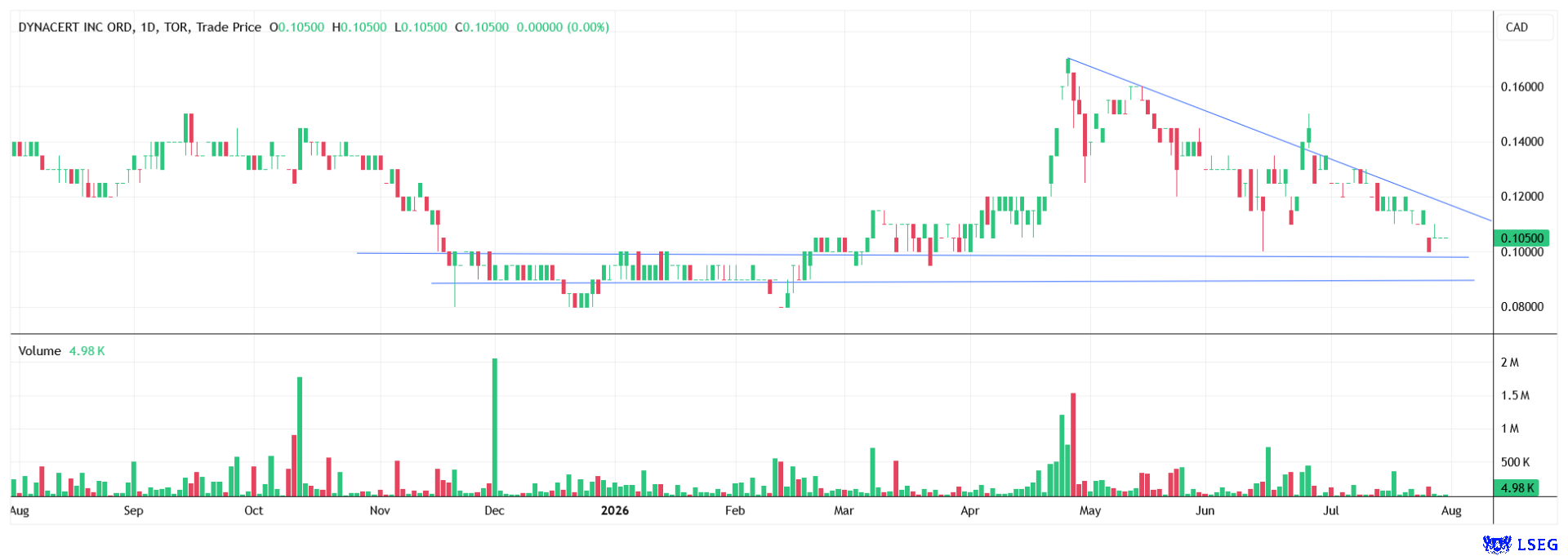
In summary, the stock market is currently showing no mercy and immediately punishes structural weaknesses. Volkswagen is facing a painful restructuring. The planned job cuts and the need to navigate the crisis in China will demand a great deal, if not everything, from the Wolfsburg-based management. Steyr Motors, too, must prove itself amid the general industry slump and demonstrate operational strength to win over investors in the long run. The EUR 50 mark is crucial here! Finally, there is dynaCERT. The Canadian company offers a compelling technology that may be arriving at exactly the right time. Its combination of active emissions reduction and lower operating costs addresses a growing need across multiple industrial sectors. If the company succeeds in scaling up globally beyond road transport and the hoped-for technical breakout on the charts finally materializes, investors will have an extremely interesting stock on their hands.
Conflict of interest
Pursuant to §85 of the German Securities Trading Act (WpHG), we point out that Apaton Finance GmbH as well as partners, authors or employees of Apaton Finance GmbH (hereinafter referred to as "Relevant Persons") may hold shares or other financial instruments of the aforementioned companies in the future or may bet on rising or falling prices and thus a conflict of interest may arise in the future. The Relevant Persons reserve the right to buy or sell shares or other financial instruments of the Company at any time (hereinafter each a "Transaction"). Transactions may, under certain circumstances, influence the respective price of the shares or other financial instruments of the Company.
In addition, Apaton Finance GmbH is active in the context of the preparation and publication of the reporting in paid contractual relationships.
For this reason, there is a concrete conflict of interest.
The above information on existing conflicts of interest applies to all types and forms of publication used by Apaton Finance GmbH for publications on companies.
Risk notice
Apaton Finance GmbH offers editors, agencies and companies the opportunity to publish commentaries, interviews, summaries, news and the like on news.financial. These contents are exclusively for the information of the readers and do not represent any call to action or recommendations, neither explicitly nor implicitly they are to be understood as an assurance of possible price developments. The contents do not replace individual expert investment advice and do not constitute an offer to sell the discussed share(s) or other financial instruments, nor an invitation to buy or sell such.
The content is expressly not a financial analysis, but a journalistic or advertising text. Readers or users who make investment decisions or carry out transactions on the basis of the information provided here do so entirely at their own risk. No contractual relationship is established between Apaton Finance GmbH and its readers or the users of its offers, as our information only refers to the company and not to the investment decision of the reader or user.
The acquisition of financial instruments involves high risks, which can lead to the total loss of the invested capital. The information published by Apaton Finance GmbH and its authors is based on careful research. Nevertheless, no liability is assumed for financial losses or a content-related guarantee for the topicality, correctness, appropriateness and completeness of the content provided here. Please also note our Terms of use.