May 25th, 2021 | 09:52 CEST
Daimler, QMines, Freeport McMoRan, Glencore, BMW - The Gold of Energy Transition
It is not without reason that copper is currently at a 10-year high. On the one hand, the recovering economies in China and the USA have enormously boosted demand for the metal. On the other hand, copper is one of the most important metals in the energy transition. Demand for solar modules, wind turbines and electric cars already exceeded supply last year. Yet, the new technologies are only at the beginning of a new cycle. The copper shortage is expected to increase dramatically in the next ten years. Profit from the new gold.
time to read: 3 minutes | Author: Stefan Feulner
ISIN: DE0007100000 , AU0000141533 , US35671D8570 , JE00B4T3BW64 , DE0005190003
Table of contents:
Author

Stefan Feulner
The native Franconian has more than 20 years of stock exchange experience and a broadly diversified network.
He is passionate about analyzing a wide variety of business models and investigating new trends.
Tag cloud
Shares cloud
Long-term supercycle
The future should be Co²-neutral. It would be interesting to find out whether the " Fridays For Future" disciples know what raw materials and metals it requires to establish a new earth and under which conditions these are mined. The fact is that lithium, cobalt, nickel, rare earth metals and co. are all extremely rare and the demand cannot be procured in the next few years.
Moreover, most materials come from China, which has a hand in the markets here with a production of around 80%. Due to the swelling trade war between the Middle Kingdom and the USA and the substantial increase in domestic demand, bottlenecks are unlikely to disappear soon. We are currently seeing a shortage of chips for the electric car industry, leading to short-time work and production stops at carmakers such as Daimler and BMW.
Copper more in demand than ever
While copper is not one of the "China-dependent metals," the metal's excellent electrical conductivity, good workability and durability put it among the frontrunners when it comes to shortages caused by the massive increase in demand. Already in 2019, the market was short 383,000 tons. In 2020, the supply deficit rose to 559,000 tons, the highest value in more than a decade.
No wonder, after all, it takes around four times more copper to produce a new type of electric car than it does to produce a vehicle with an internal combustion engine. The world's largest copper deposits are located in Chile. Reserves of the non-ferrous metal there totaled 20 million tons in 2019. Australia and Peru follow far behind. Anyone who wants to participate in the supercycle should take a closer look at the world's largest copper producers.
In first place is the unlisted Company Codelco. The Chilean market leader produced around 1.73 million tons of copper in 2020 and further expanded its global top position. It is followed by the Swiss Company Glencore with 1.4 million tons, ahead of the American commodity giant Freeport-McMoRan with 1.17 million tons. The Australian-British conglomerate BHP Group operates the largest copper mine, Escondida, in Chile.
Second-tier on the rise
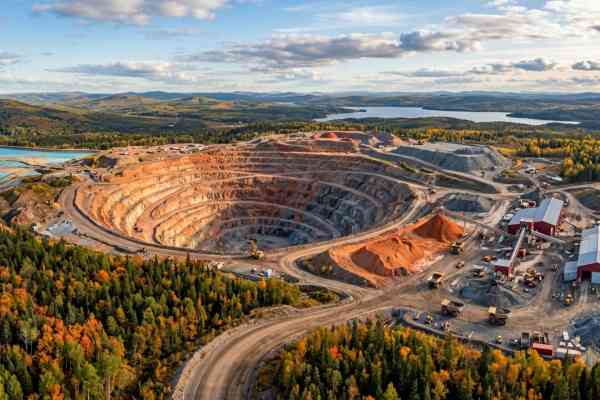
Overall, global production is currently handled by about 10 larger mines and another 20 smaller ones. New copper projects, on the other hand, are rare at the moment. In addition to promising second-tier candidates such as Kodiak Copper or Nevada Copper, the Australian Company QMines, which has focused on the development of copper deposits in addition to the exploration of gold, stands out. The Queensland-based explorer holds the sole rights to a total of 4 projects at an advanced stage of development. The 983 sqm property has excellent infrastructure and is located close to the ports of Gladstone and Brisbane.
Mt. Chalmers stands out as the most important project at the moment, containing a historic mine operated between 1898 and 1982. During this time, around 1.6 million tons of ore were mined there. Today, initial estimates still see an inferred resource of 3.9 million tonnes at grades of 1.15% copper, 0.81 g/t gold, and 8.4 g/t silver. The Company was listed on the ASX in Sydney just a few weeks ago. Due to strong demand from European investors, the stock is now also tradable in Frankfurt.
Share price jumps
Last week, the share price was set ablaze by news of outstanding drilling results at the Mt. Chalmers copper project, well above the mining industry average. Test drilling was carried out in a total of 11 drill holes over 1,587 meters. Maximum values of 13.4% copper, 6.1g/t gold and 31g/t silver were recorded. A further 3000m is now to be drilled. The encouraging drill results are likely to result in an upward revision of the official resource estimates.
The goal of the management of QMines is to expand its resource base, combine the projects in the region, and explore appropriate marketing opportunities. As a result of the announcement, the share price shot up from EUR 0.17 to currently EUR 0.27 last week. The project around Mt. Chalmers is interesting in any case, also given further rising copper prices.
Conflict of interest
Pursuant to §85 of the German Securities Trading Act (WpHG), we point out that Apaton Finance GmbH as well as partners, authors or employees of Apaton Finance GmbH (hereinafter referred to as "Relevant Persons") may in the future hold shares or other financial instruments of the mentioned companies or will bet on rising or falling on rising or falling prices and therefore a conflict of interest may arise in the future. conflict of interest may arise in the future. The Relevant Persons reserve the shares or other financial instruments of the company at any time (hereinafter referred to as the company at any time (hereinafter referred to as a "Transaction"). "Transaction"). Transactions may under certain circumstances influence the respective price of the shares or other financial instruments of the of the Company.
Furthermore, Apaton Finance GmbH reserves the right to enter into future relationships with the company or with third parties in relation to reports on the company. with regard to reports on the company, which are published within the scope of the Apaton Finance GmbH as well as in the social media, on partner sites or in e-mails, on partner sites or in e-mails. The above references to existing conflicts of interest apply apply to all types and forms of publication used by Apaton Finance GmbH uses for publications on companies.
Risk notice
Apaton Finance GmbH offers editors, agencies and companies the opportunity to publish commentaries, interviews, summaries, news and etc. on news.financial. These contents serve information for readers and does not constitute a call to action or recommendations, neither explicitly nor implicitly. implicitly, they are to be understood as an assurance of possible price be understood. The contents do not replace individual professional investment advice and do not constitute an offer to sell the share(s) offer to sell the share(s) or other financial instrument(s) in question, nor is it an nor an invitation to buy or sell such.
The content is expressly not a financial analysis, but rather financial analysis, but rather journalistic or advertising texts. Readers or users who make investment decisions or carry out transactions on the basis decisions or transactions on the basis of the information provided here act completely at their own risk. There is no contractual relationship between between Apaton Finance GmbH and its readers or the users of its offers. users of its offers, as our information only refers to the company and not to the company, but not to the investment decision of the reader or user. or user.
The acquisition of financial instruments entails high risks that can lead to the total loss of the capital invested. The information published by Apaton Finance GmbH and its authors are based on careful research on careful research, nevertheless no liability for financial losses financial losses or a content guarantee for topicality, correctness, adequacy and completeness of the contents offered here. contents offered here. Please also note our Terms of use.