January 6th, 2026 | 07:15 CET
Battery supply on a knife's edge – NEO Battery Materials becomes an established industrial partner
The push for e-mobility and rising demand from defense applications are driving a quantum leap in battery technology. At the same time, China is increasingly putting the brakes on as an industrial partner. Beijing recently imposed export restrictions on high-performance Li-ion aggregates. This makes it a real challenge for manufacturers to equip their products with high-quality energy storage. The latest announcement from NEO Battery Materials is therefore a game-changer! Certification as an OEM supplier has been completed. NEO Battery Materials, a company that is at the beginning of industrial scaling and technical differentiation, presents itself as a specialist in silicon-based anode materials with a secured production hub in South Korea. Particularly relevant for investors: high-performance batteries are increasingly being treated as critical infrastructure in Western industrial and defense policy, meaning they are structurally tied to priority investment areas. Geopolitically motivated trade barriers must be navigated carefully. Time is of the essence.
time to read: 4 minutes | Author: André Will-Laudien
ISIN: NEO BATTERY MATERIALS LTD | CA62908A1003
Table of contents:
Author

André Will-Laudien
Born in Munich, he first studied economics and graduated in business administration at the Ludwig-Maximilians-University in 1995. As he was involved with the stock market at a very early stage, he now has more than 30 years of experience in the capital markets.
Tag cloud
Shares cloud
Silicon as a lever for efficiency and range
The basic thesis is simple: higher energy density means greater range, shorter charging times, and lower operating costs. NEO Battery Materials is developing silicon-reinforced anodes for lithium-ion batteries for this purpose. Depending on the application, the technology enables significantly higher performance parameters than classic graphite, while maintaining competitive cost structures. It is used in industrial electronics, drones, robotics, and increasingly in the automotive sector. While North America is the core market, industrial implementation is taking place in South Korea, one of the world's leading battery locations. This means that NEO is active in a segment where even small efficiency gains have an immediate economic impact for users.
Customer-centric development – the "TSMC principle" in the battery market
NEO pursues an approach that is well known in the semiconductor industry: products are developed and industrialized in close alignment with customer requirements, creating technological added value that goes beyond standard solutions from China. This is crucial for OEMs, because in the field of drones, AI electronics, and new mobility platforms in particular, there is increasing pressure to procure powerful battery systems that are reliable and scalable. NEO is positioning itself as a comprehensive solutions provider and not just a materials supplier. This partnership-oriented development approach simultaneously increases customer loyalty and makes interchangeability more difficult.
From the pilot phase to marketing
The transition from the development phase has now been completed. In South Korea, NEO operates an industrial-grade production line in the megawatt-hour range that is scalable as demand increases. At the same time, the market itself is expanding at double-digit rates: global growth of around 14% per annum is expected for battery electric vehicles over the coming years, with batteries accounting for by far the largest share of value creation. NEO is now positioned in a market phase in which technologically advanced providers can establish structural market share at an early stage.
Defense and technology markets are opening up
The collaboration with the Korea Institute for Defense Industry is highly dynamic, as demand for defense technology is growing. This is moving NEO into security-related applications, particularly in drone and UAS systems. These markets are characterized by difficult-to-overcome barriers to entry and long-term program cycles. This is complemented by growing collaborations with robotics and electronics manufacturers, as well as multi-year supply agreements for silicon anode material. Delivery reliability, security of supply, and quality play a central role, especially in the defense sector - partners who are accredited early on reap the benefits for years before followers can enter the market.
Danny Huh, SVP of Strategy & Operations, explains in an interview with IIF host Lyndsay Malchuk the details of the Company's strategic positioning and its medium-term growth strategy.
The accolade: Official supplier status with a Fortune 500 OEM
NEO Battery Materials has been officially accredited as a direct supplier by an Asian Fortune Global 500 automaker. As part of the customer's supplier onboarding process, NEO successfully met the OEM's technical, compliance, and evaluation requirements. The accreditation serves as formal confirmation of operational readiness and reflects the acceptance of NEO's product quality and manufacturing capability to support ongoing testing and integration activities.
Specifically, this means:
• NEO is now formally integrated into the OEM's procurement processes
• Orders can be processed directly without intermediaries, increasing margins
• Production and quality processes meet the strict audit standards of the automotive industry
• Repeat and follow-up orders become structurally easier as relationships develop
• NEO gains initial access to long-term platform and program awards
• As a certified supplier, international attention increases with regard to new contracts
From an investor's perspective, this is a historic milestone
NEO Battery is transforming from an "innovative developer" to a recognized series production industry partner. The approval that has now been granted assesses the consistency of production, quality systems, compliance, and delivery capability. This status strengthens margin potential, shortens sales cycles, and reduces operational risks. Particularly noteworthy: the recognition shown is based on existing supply relationships. The accreditation now formalizes and expands an existing business model. At the same time, this status sends a strong signal to other OEMs that NEO has measurably overcome the barriers to entry in industry.
Mr. S. J. Youn, Head of Manufacturing and Facility Operations, commented: "Supplying battery products to global automotive customers requires consistent adherence to strict quality, technical, and operational standards from procurement to delivery. Official supplier status demonstrates the consistency and reliability of NEO's battery manufacturing processes and represents an important step toward establishing long-term credibility in the global battery industry."
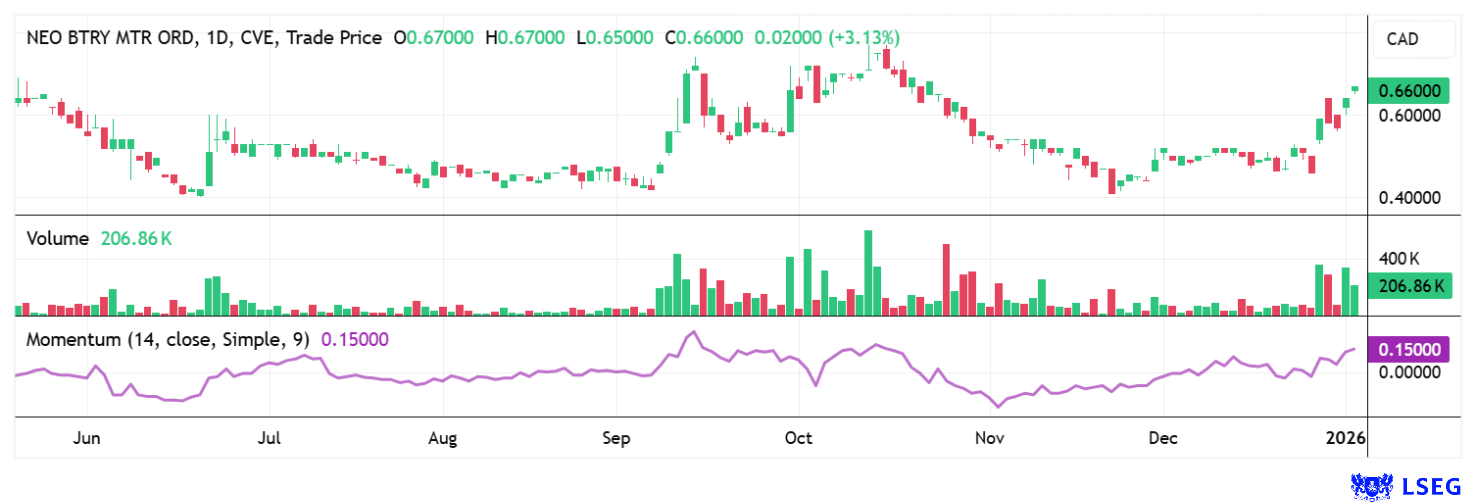
Conclusion for investors: With a market capitalization of around CAD 90 million, the Company is poised for enormous upside potential
With technological differentiation, industrial production readiness, and institutional validation, NEO Battery Materials' profile is shifting significantly. Combined with a still moderate valuation, this creates an investment case that should be closely monitored in 2026. Batteries are becoming strategic infrastructure, and NEO, with its double-digit market capitalization, is becoming part of a multi-billion dollar market. NEO Battery Materials is therefore not a trivial technology speculation, but an industrially sound growth investment.
Conflict of interest
Pursuant to §85 of the German Securities Trading Act (WpHG), we point out that Apaton Finance GmbH as well as partners, authors or employees of Apaton Finance GmbH (hereinafter referred to as "Relevant Persons") currently hold or hold shares or other financial instruments of the aforementioned companies and speculate on their price developments. In this respect, they intend to sell or acquire shares or other financial instruments of the companies (hereinafter each referred to as a "Transaction"). Transactions may thereby influence the respective price of the shares or other financial instruments of the Company.
In this respect, there is a concrete conflict of interest in the reporting on the companies.
In addition, Apaton Finance GmbH is active in the context of the preparation and publication of the reporting in paid contractual relationships.
For this reason, there is also a concrete conflict of interest.
The above information on existing conflicts of interest applies to all types and forms of publication used by Apaton Finance GmbH for publications on companies.
Risk notice
Apaton Finance GmbH offers editors, agencies and companies the opportunity to publish commentaries, interviews, summaries, news and the like on news.financial. These contents are exclusively for the information of the readers and do not represent any call to action or recommendations, neither explicitly nor implicitly they are to be understood as an assurance of possible price developments. The contents do not replace individual expert investment advice and do not constitute an offer to sell the discussed share(s) or other financial instruments, nor an invitation to buy or sell such.
The content is expressly not a financial analysis, but a journalistic or advertising text. Readers or users who make investment decisions or carry out transactions on the basis of the information provided here do so entirely at their own risk. No contractual relationship is established between Apaton Finance GmbH and its readers or the users of its offers, as our information only refers to the company and not to the investment decision of the reader or user.
The acquisition of financial instruments involves high risks, which can lead to the total loss of the invested capital. The information published by Apaton Finance GmbH and its authors is based on careful research. Nevertheless, no liability is assumed for financial losses or a content-related guarantee for the topicality, correctness, appropriateness and completeness of the content provided here. Please also note our Terms of use.