August 5th, 2026 | 07:30 CEST
Battery Revolution: CATL Pulls Further Ahead, SGL Carbon Bows Out, and HPQ Silicon Targets Promising Niches
Faster and, above all, with greater range—whether in electric vehicles or smartphones: performance and endurance are key factors in winning over customers. But the race for the best specs is becoming increasingly fierce, and many details of battery technology play a crucial role. The potential of graphite as an anode material appears to have been exhausted; instead, silicon is gaining ground. We shed light on current trends in battery technology and introduce the companies involved.
time to read: 3 minutes
|
Author:
Nico Popp
ISIN:
CATL CONTEMPORARY AMPEREX TECHNOLOGY CO LTD | CNE100003662 , SGL CARBON SE O.N. | DE0007235301 , HPQ SILICON INC | CA40444L1031 | TSXV: HPQ , OTCQB: HPQFF
Table of contents:
Author

Nico Popp
At home in Southern Germany, the passionate stock exchange expert has been accompanying the capital markets for about twenty years. With a soft spot for smaller companies, he is constantly on the lookout for exciting investment stories.
Tag cloud
Shares cloud
CATL Cements Its Dominance with Gigafactories
Market leader CATL is expanding its global dominance in batteries, primarily thanks to its enormous manufacturing capacity and financial resources. In 2025, the group's revenue climbed to RMB 423.70 billion, while profit after taxes skyrocketed by 42.28% to RMB 72.20 billion. To supply European automakers directly on-site, the industry leader is investing over 90% of the funds from its latest capital increase into expanding its facilities in Hungary—most notably the Gigafactory in Debrecen. In addition, CATL is investing EUR 4.1 billion together with Stellantis in a separate joint-venture plant in Zaragoza, Spain. Thanks to these new plants, CATL will be able to supply BMW, Volkswagen, Stellantis, Mercedes-Benz, and Tesla in Europe over the long term—trade barriers or not. But scale alone does not yet solve the capacity problem within the individual battery cells. This is where CATL's resourceful researchers come in, constantly driving innovation.
SGL Carbon Faces Off Against Asian Margin Pressure
The German company SGL Carbon was once a leader in battery innovation. But the competition from Asia proved too strong. In 2025, SGL Carbon officially ceased all operations in its Battery Solutions division and had already closed its research laboratory in Meitingen the previous year. Because non-integrated Western processors of synthetic graphite had virtually no chance of survival against Asian competition, SGL Carbon withdrew completely from the market for anode materials. This fundamental shift was reflected in the figures. In fiscal year 2025, revenue fell by 17.2% to EUR 850.2 million, while write-downs pushed net income down to EUR -79.2 million. Instead, the Hesse-based company is focusing entirely on profitable niches such as components for silicon carbide semiconductors, brake discs, and specialty graphite for high-temperature nuclear reactors, where it recently secured a three-year contract worth USD 100 million. In the coming years, SGL Carbon is expected to slowly return to growth.
HPQ Silicon Sets New Standards
In contrast, the Canadian company HPQ Silicon aims to take off with a technology that has a promising future and is focusing on silicon anodes. While conventional graphite is limited to a theoretical density of 372 mAh/g, silicon enables theoretical values of up to 4,200 mAh/g. However, in practice, the material's expansion has so far always led to the rapid destruction of the battery cells. Together with specialists from its portfolio company Novacium, HPQ succeeded in creating an artificial protective layer—using a patented chemical surface treatment with fluorine and sulphur compounds—that prevents these problems.
HPQ also scores points when it comes to costs. Instead of using expensive monosilane gas and costly vapour deposition processes, the company relies on the PUREVAP QRR process developed by its partner PyroGenesis to process metallurgical silicon extracted directly from quartz. This synthesis process triples production volume, reduces energy consumption by 20%, and ultimately cuts anode manufacturing costs by 25% to 30%. Test results also show significant progress in performance. While graphite anodes in the 18650 format remain at 2,778 mAh, the development team has gradually increased capacity across generations—from GEN1 at 3,153 mAh to GEN2 at 3,808 mAh. The GEN3 cells have already reached 4,030 mAh and 6,050 mAh in the 21700 format. The high-performance GEN4 cells in the 21700 format ultimately exceeded all expectations. In extensive test series, the GEN4 silicon anodes achieved an average discharge capacity of over 6,600 mAh, with peak values of 6,696 mAh. According to the company, this represents a 45% increase in capacity compared to the best graphite cells on the market.
HPQ Silicon: Additional Projects Focused on Innovative Materials and Sustainability
In addition to silicon battery anodes, HPQ is advancing other sustainable materials technologies in Québec. Through its subsidiary Silica Polvere, the company plans to collaborate with PyroGenesis to commercialize a novel plasma process that directly converts quartz into high-purity silica, all while producing zero CO₂ emissions. Silicic acid is a raw material used in various industries. At the same time, HPQ is working on systems for the autonomous production of high-pressure hydrogen via silicon hydrolysis, as well as on advanced surface coatings for cathodes. Since HPQ protects its technologies, the company holds a broad portfolio of intellectual property.
Conclusion: HPQ Silicon at a Critical Threshold
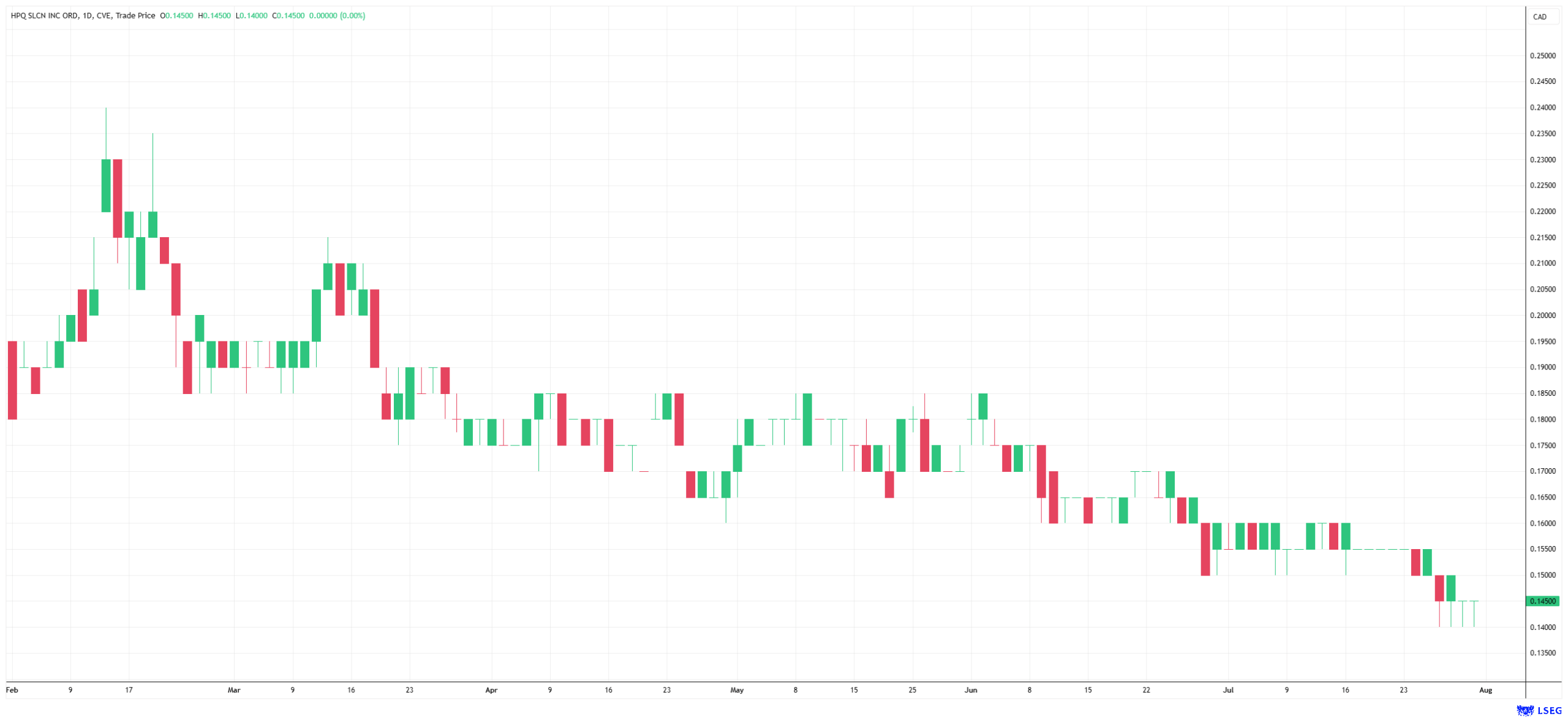
HPQ Silicon operates in exciting niches of the materials industry and, based on the key data available so far, could offer its customers significant advantages. However, the team has yet to take the major step toward commercialization. The transition from successful prototype certification to the first supply contracts with cell manufacturers is considered a crucial catalyst for a future revaluation of the stock. But the other technologies also hold potential—sustainability and cost savings are always in demand. With a market capitalization of approximately CAD 68 million, the stock still has room to grow if the company succeeds.
Conflict of interest
Pursuant to §85 of the German Securities Trading Act (WpHG), we point out that Apaton Finance GmbH as well as partners, authors or employees of Apaton Finance GmbH (hereinafter referred to as "Relevant Persons") may hold shares or other financial instruments of the aforementioned companies in the future or may bet on rising or falling prices and thus a conflict of interest may arise in the future. The Relevant Persons reserve the right to buy or sell shares or other financial instruments of the Company at any time (hereinafter each a "Transaction"). Transactions may, under certain circumstances, influence the respective price of the shares or other financial instruments of the Company.
In addition, Apaton Finance GmbH is active in the context of the preparation and publication of the reporting in paid contractual relationships.
For this reason, there is a concrete conflict of interest.
The above information on existing conflicts of interest applies to all types and forms of publication used by Apaton Finance GmbH for publications on companies.
Risk notice
Apaton Finance GmbH offers editors, agencies and companies the opportunity to publish commentaries, interviews, summaries, news and the like on news.financial. These contents are exclusively for the information of the readers and do not represent any call to action or recommendations, neither explicitly nor implicitly they are to be understood as an assurance of possible price developments. The contents do not replace individual expert investment advice and do not constitute an offer to sell the discussed share(s) or other financial instruments, nor an invitation to buy or sell such.
The content is expressly not a financial analysis, but a journalistic or advertising text. Readers or users who make investment decisions or carry out transactions on the basis of the information provided here do so entirely at their own risk. No contractual relationship is established between Apaton Finance GmbH and its readers or the users of its offers, as our information only refers to the company and not to the investment decision of the reader or user.
The acquisition of financial instruments involves high risks, which can lead to the total loss of the invested capital. The information published by Apaton Finance GmbH and its authors is based on careful research. Nevertheless, no liability is assumed for financial losses or a content-related guarantee for the topicality, correctness, appropriateness and completeness of the content provided here. Please also note our Terms of use.