April 9th, 2026 | 07:25 CEST
Apple is joining the energy transition: OR Royalties as a model, RE Royalties as a beneficiary
Today, the financing of renewable energy increasingly relies on an instrument rooted in traditional mining. While established industry leaders like OR Royalties demonstrate through a diversified portfolio of precious and battery metal licenses how investment models can generate high margins without operational risks, RE Royalties is successfully adapting this concept for the renewable energy sector. The company finances solar, wind, and storage projects and, in return, secures long-term revenue shares, providing a predictable alternative to volatile commodity markets. This offering meets the strategic needs of tech giants like Apple, which, as part of its "Apple 2030" initiative, is investing heavily in clean energy projects to make its entire value chain climate-neutral. For investors, RE Royalties thus combines security and scalability in a unique business model.
time to read: 3 minutes | Author: Nico Popp
ISIN: APPLE INC. | US0378331005 , OR ROYALTIES INC | CA68390D1069 | TSX: OR , RE ROYALTIES LTD | CA75527Q1081 | TSXV: RE , OTCQX: RROYF
Table of contents:
Author

Nico Popp
At home in Southern Germany, the passionate stock exchange expert has been accompanying the capital markets for about twenty years. With a soft spot for smaller companies, he is constantly on the lookout for exciting investment stories.
Tag cloud
Shares cloud
OR Royalties Demonstrates What Is Possible
OR Royalties has established itself as one of the leading companies in the field of precious metal royalties and demonstrates how efficient the royalty business model is. Unlike mining companies with mines that struggle with fluctuating production costs and geological uncertainties, OR Royalties operates as a specialized financial services provider. The company generates its revenue primarily from stakes in top-tier projects in stable jurisdictions such as Canada, Australia, and the US. According to its own figures, the company achieved a cash margin of nearly 97% in fiscal year 2025. This exceptional efficiency stems from the fact that OR Royalties incurs no direct operating costs for the extraction or processing of raw materials. Any increase in gold or silver prices flows almost directly into operating income. A key development project in OR Royalties' portfolio is the Cariboo Gold Project, where activities resumed following a brief hiatus early in the year with an extensive drilling program totaling 160,000 m. Additionally, the company is advancing the Tintic Project with partners, which is already contributing to gold production on a small scale and providing regional diversification. Analysts at major banks such as Barclays and BMO largely rate OR Royalties' stock as promising. With total revenue of USD 277.4 million, OR Royalties was able to fully repay its loans and has been debt-free ever since, which is a clear advantage in times of volatile interest rates.
RE Royalties Applies Royalty Concept to Clean Energy
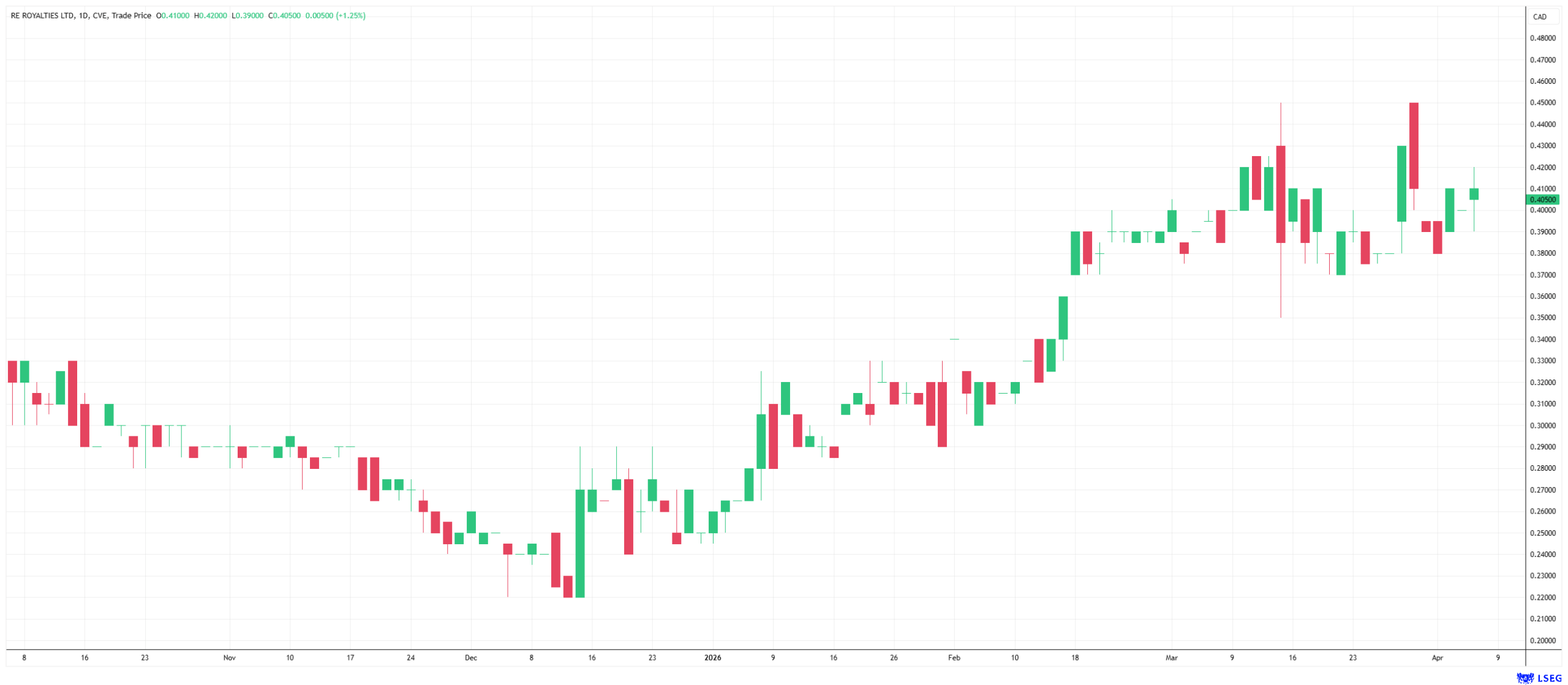
RE Royalties is a pioneer, applying the proven OR Royalties concept to the renewable energy sector. Project developers in solar, wind, and storage often face financing challenges. RE Royalties provides these developers with capital and, in return, receives a contractually fixed share of gross revenue. Since these contracts typically run for periods of 20 to 25 years, they offer long-term stability. The remuneration is linked to revenue rather than profit, which largely shields RE Royalties from increases in the operator's operating costs. The company is currently active in the US market, as evidenced by its recent USD 9 million partnership with Solaris Energy, but has supported projects worldwide, thereby generating revenue streams. To further accelerate its own expansion, RE Royalties utilizes innovative financing instruments and most recently issued so-called green bonds with an attractive interest rate of 9%. To ensure shareholders also benefit, the RE Royalties board, in collaboration with financial advisors from PwC, announced a comprehensive strategic review aimed at making the company attractive to institutional investors.
Apple drives the market with massive energy demand
RE Royalties' business model also benefits from the massive energy demand of corporations like Apple, which, in turn, invests in renewable energy. With its "Apple 2030" goal, the company has committed to being climate-neutral across its entire value chain by the end of the decade. A large portion of Apple's carbon footprint, about 75%, comes from the electricity used to manufacture its products. To address this, Apple launched the Supplier Clean Energy Program. By early 2026, more than 300 suppliers have committed to switching to 100% renewable energy for production. This corresponds to over 17.8 GW of renewable energy capacity that is already online.
Material sourcing also plays an important role here, as the company reports that it aims to one day no longer need to extract resources from the earth. The increased use of disassembly robots like Daisy and Dave, which break down old devices into their individual parts, is expected to significantly reduce the demand for newly mined raw materials in the long term and even alter the supply side of the raw materials markets. When Apple or its suppliers initiate projects, they need partners who can provide capital flexibly and are knowledgeable about the sector. However, RE Royalties also benefits indirectly from this capital inflow, as the growing renewable energy market shines a spotlight on experienced professionals like RE Royalties.
Watch YouTube videoConflict of interest
Pursuant to §85 of the German Securities Trading Act (WpHG), we point out that Apaton Finance GmbH as well as partners, authors or employees of Apaton Finance GmbH (hereinafter referred to as "Relevant Persons") may hold shares or other financial instruments of the aforementioned companies in the future or may bet on rising or falling prices and thus a conflict of interest may arise in the future. The Relevant Persons reserve the right to buy or sell shares or other financial instruments of the Company at any time (hereinafter each a "Transaction"). Transactions may, under certain circumstances, influence the respective price of the shares or other financial instruments of the Company.
In addition, Apaton Finance GmbH is active in the context of the preparation and publication of the reporting in paid contractual relationships.
For this reason, there is a concrete conflict of interest.
The above information on existing conflicts of interest applies to all types and forms of publication used by Apaton Finance GmbH for publications on companies.
Risk notice
Apaton Finance GmbH offers editors, agencies and companies the opportunity to publish commentaries, interviews, summaries, news and the like on news.financial. These contents are exclusively for the information of the readers and do not represent any call to action or recommendations, neither explicitly nor implicitly they are to be understood as an assurance of possible price developments. The contents do not replace individual expert investment advice and do not constitute an offer to sell the discussed share(s) or other financial instruments, nor an invitation to buy or sell such.
The content is expressly not a financial analysis, but a journalistic or advertising text. Readers or users who make investment decisions or carry out transactions on the basis of the information provided here do so entirely at their own risk. No contractual relationship is established between Apaton Finance GmbH and its readers or the users of its offers, as our information only refers to the company and not to the investment decision of the reader or user.
The acquisition of financial instruments involves high risks, which can lead to the total loss of the invested capital. The information published by Apaton Finance GmbH and its authors is based on careful research. Nevertheless, no liability is assumed for financial losses or a content-related guarantee for the topicality, correctness, appropriateness and completeness of the content provided here. Please also note our Terms of use.