May 22nd, 2026 | 07:20 CEST
AI data centers need nuclear power — 70-100% more energy by 2050! Spotlight on American Atomics, SAP, and ServiceNow
The global economy is in the midst of a new infrastructure supercycle, in which the new source of productivity is being sought in the widespread use of digitalization and AI. The physical foundations of extensive AI use are creating unprecedented demand for system components related to energy generation and storage. Electricity, grids, cooling, and raw materials—the demand seems endless. Yet just a few years ago, climate goals were still a major concern. With the explosive growth in demand from data centers, not only are energy sources like nuclear power coming to the fore, but also critical metals for turbines, cables, storage systems, and chips. Goldman Sachs expects data center electricity demand to more than double by the end of the decade—a scenario that makes CO₂-free baseload power a matter of strategic survival. Although nuclear power plants have been largely dismissed in the EU, they are once again moving to the center of the debate as reliable electricity suppliers and are becoming serious partners for tech companies. A deeper look is worthwhile.
time to read: 4 minutes | Author: André Will-Laudien
ISIN: AMERICAN ATOMICS INC | CA0240301089 | CSE: NUKE , SAP SE O.N. | DE0007164600 , SERVICENOW INC. DL-_001 | US81762P1021
Table of contents:
Author

André Will-Laudien
Born in Munich, he first studied economics and graduated in business administration at the Ludwig-Maximilians-University in 1995. As he was involved with the stock market at a very early stage, he now has more than 30 years of experience in the capital markets.
Tag cloud
Shares cloud
AI Boom Meets Uranium Market: American Atomics Positions Itself at the Center of Key Energy Issues
Studies such as the World Nuclear Outlook Report foresee a significant expansion of global nuclear capacity by 2050, which will structurally redefine fuel demand and emphasize the role of uranium as a baseload fuel. At the same time, the World Nuclear Association's (WNA) Nuclear Fuel Report forecasts a nearly 30% increase in global uranium demand by 2030, as more and more countries turn to nuclear energy to meet CO₂ targets. At the center of this demand trend are uranium property operators and power plant designers who would like to synchronize their efforts to finally accelerate progress in this area. The Canadian company American Atomics is pursuing an interesting approach. They have their sights set on the integrated production chain, from raw material to the delivery of megawatts. The company favours an integrated approach that spans from raw material exploration through processing to prospective uranium enrichment, thereby addressing one of the greatest vulnerabilities in Western energy supply. The United States currently produces only a fraction of its own uranium needs, while large parts of the nuclear supply chain remain dependent on foreign sources. The supply of enriched uranium remains particularly critical, as a significant portion of global capacity has historically come from Russia.
At the center of its operational activities is the Big Indian or Lisbon Valley project in the state of Utah, where American Atomics controls a large-scale portfolio of 217 contiguous claims. The region is one of North America's most historically significant uranium districts and has historically produced approximately 78 million pounds of uranium oxide. Previous geophysical data from oil and gas drilling indicate conspicuous radioactive zones that are significantly above natural background levels. Of particular interest is the fact that large parts of the eastern flank have been insufficiently explored to date, suggesting significant discovery potential. In parallel, the company recently strengthened its position in Colorado and, after exercising a second option, acquired all shares in another uranium project. However, the focus on HALEU fuel—considered a key component for the next generation of small modular reactors—could prove even more strategically significant. This highly enriched nuclear fuel is required for numerous modern SMR designs but has so far been available only on a very limited basis outside of Russia. In doing so, American Atomics is addressing not only a raw materials market but also a geopolitical infrastructure issue of growing national significance. With a market cap of CAD 12 million, dynamic investors have not missed out on much yet; the rally is likely to start again soon.
In an interview with IIF host Lyndsay Malchuk, American Atomics co-founder Connor Lynch discussed the company's strategic direction.
High Expectations, Harsh Reaction: Why SAP Was Punished Despite Growth
Many investors are wondering why, of all companies, the German heavyweight SAP has fallen by the wayside in this mixed landscape. Although revenue rose by about 6% to approximately EUR 9.6 billion in Q1, this was apparently no longer enough for many market participants, given the high valuation. The cloud business, in particular, remained the key earnings driver with growth of around 27%; at the same time, the current cloud order backlog climbed by around 20% to just under EUR 22 billion, signalling continued strong visibility for the coming quarters. On the downside, however, rising costs related to AI investments and restructuring weighed on the bottom line, putting the operating margin under pressure at times. Overall, however, the trend points more toward a normalization of expectations than to a fundamental weakness of the group, especially since SAP remains one of the key beneficiaries of global digitalization and AI integration. Analysts' estimates on the LSEG Refinitiv platform are better than the current share price of EUR 151 suggests. 26 out of 35 experts are bullish, resulting in an average price target of EUR 221—nearly 46% above yesterday's closing price. With a 2026 P/E ratio of 18.5, SAP is also trading at a 10-year valuation low.
ServiceNow - Why Bank of America sees a clear AI winner here
ServiceNow has experienced a similar losing streak to SAP. Despite strong fundamentals, the stock is under significant pressure and has lost around 38% this year. In Q1, revenue rose about 22% to USD 3.77 billion, with demand in the enterprise segment a key driver. Experts attribute the price decline less to operational weakness and more to AI systems with their agent architectures, which they view as a medium-term threat to traditional SaaS models.
Bank of America, on the other hand, does not yet see major disruption, but rather an expansion of the company's current market role, as ServiceNow is currently evolving into a key orchestration layer for AI-driven business processes. With a price target of USD 130 (around +37%) and expected revenue growth of 18% to 22%, the growth outlook remains intact. On the LSEG Refinitiv platform, the mood is even celebratory: 45 out of 52 analysts recommend buying and expect a price of approximately USD 144. For dynamic investors, this certainly points to a long-term investment!
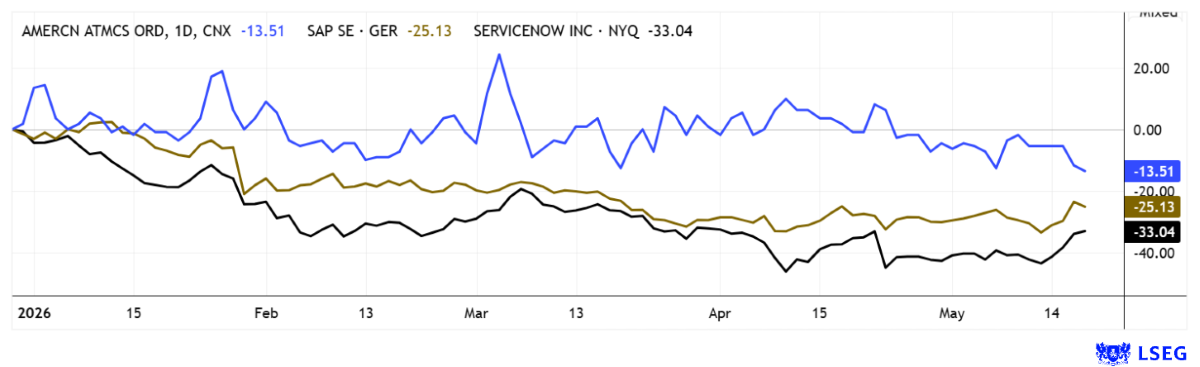
Unlike in the EU, North America clearly prioritizes energy security over ideology, causing baseload technologies such as nuclear power to regain significant political and strategic importance. The expansion of SMRs is increasing the need for stable uranium supply chains and making companies involved early in a Western-controlled nuclear value chain more attractive. American Atomics should therefore be viewed less as a traditional exploration story and more as a direct lever for the renaissance of nuclear power as a strategic energy source. The big picture is this: while SAP, ServiceNow, and other software companies benefit from the AI wave, nuclear power and uranium provide the physical foundation upon which this digital expansion can operate in the first place.
Conflict of interest
Pursuant to §85 of the German Securities Trading Act (WpHG), we point out that Apaton Finance GmbH as well as partners, authors or employees of Apaton Finance GmbH (hereinafter referred to as "Relevant Persons") currently hold or hold shares or other financial instruments of the aforementioned companies and speculate on their price developments. In this respect, they intend to sell or acquire shares or other financial instruments of the companies (hereinafter each referred to as a "Transaction"). Transactions may thereby influence the respective price of the shares or other financial instruments of the Company.
In this respect, there is a concrete conflict of interest in the reporting on the companies.
In addition, Apaton Finance GmbH is active in the context of the preparation and publication of the reporting in paid contractual relationships.
For this reason, there is also a concrete conflict of interest.
The above information on existing conflicts of interest applies to all types and forms of publication used by Apaton Finance GmbH for publications on companies.
Risk notice
Apaton Finance GmbH offers editors, agencies and companies the opportunity to publish commentaries, interviews, summaries, news and the like on news.financial. These contents are exclusively for the information of the readers and do not represent any call to action or recommendations, neither explicitly nor implicitly they are to be understood as an assurance of possible price developments. The contents do not replace individual expert investment advice and do not constitute an offer to sell the discussed share(s) or other financial instruments, nor an invitation to buy or sell such.
The content is expressly not a financial analysis, but a journalistic or advertising text. Readers or users who make investment decisions or carry out transactions on the basis of the information provided here do so entirely at their own risk. No contractual relationship is established between Apaton Finance GmbH and its readers or the users of its offers, as our information only refers to the company and not to the investment decision of the reader or user.
The acquisition of financial instruments involves high risks, which can lead to the total loss of the invested capital. The information published by Apaton Finance GmbH and its authors is based on careful research. Nevertheless, no liability is assumed for financial losses or a content-related guarantee for the topicality, correctness, appropriateness and completeness of the content provided here. Please also note our Terms of use.