Inflationary pressures and geopolitical upheavals are forcing even market leaders in traditional dividend sectors to make structural adjustments. The era of purely volume-driven revenue growth is slowing, which is why companies such as Coca-Cola and Procter & Gamble are required to invest heavily to defend their operating margins. In this volatile market environment, investors are increasingly seeking reliable cash flows and stable dividend profiles. While established dividend aristocrats struggle with digital transformation and the divestment of non-core businesses, agile niche providers are moving into focus. The Canadian company RE Royalties applies a low-risk financing model inspired by the mining sector to the renewable energy industry, thereby generating scalable income streams. We explain how the model works and why investors have several good options with RE Royalties.
time to read: 3 minutes | Author: Nico Popp
ISIN: RE ROYALTIES LTD | CA75527Q1081 | TSXV: RE , OTCQX: RROYF , PROCTER GAMBLE | US7427181091 , COCA-COLA CO. DL-_25 | US1912161007
Table of contents:
Author

Nico Popp
At home in Southern Germany, the passionate stock exchange expert has been accompanying the capital markets for about twenty years. With a soft spot for smaller companies, he is constantly on the lookout for exciting investment stories.
Tag cloud
Shares cloud
Procter & Gamble: Efficiency Programs and Margin Defence
Consumer goods manufacturer Procter & Gamble is responding to intense margin pressure with a far-reaching restructuring program called the "Focused Portfolio, Supply Chain and Productivity Plan." By the end of fiscal year 2027, the company plans to cut up to 7,000 jobs globally in administration and marketing. These measures are intended to reduce costs and are expected to result in pre-tax costs of between USD 1 billion and USD 1.6 billion. Despite 3% organic revenue growth in the third quarter of fiscal year 2026, the group is facing headwinds: tariffs totalling USD 400 million are weighing on it. Nevertheless, the company has increased its dividend for the 70th consecutive year and currently offers investors a dividend yield of 2.99%. That is solid, but too little even for dividend aristocrat P&G, given the growing risks.
Coca-Cola: Operational Realignment and Stagnating Sales
At Coca-Cola, the growing pressure is reflected in an operational realignment under the leadership of new CEO Henrique Braun. To counter dwindling margins on formerly capital-intensive acquisitions, management explored the sale of the Costa Coffee network last year, including a massive discount from the original purchase price of USD 4.9 billion in 2019. However, interested parties offered too little, and Coca-Cola abandoned the plans. A sale in the future remains likely, though. Although net operating revenue rose by 12% to USD 12.47 billion in the first quarter of 2026, the full year 2025 was weaker—the company's global sales volume stagnated. The current quarterly dividend of USD 0.53 per share provides investors with an annualized dividend yield of 2.59%. While that is acceptable, it is not enough for many investors.
RE Royalties: Asset-Light Model for Renewable Energy
The Canadian company RE Royalties capitalizes on existing financing gaps in the renewable energy sector and applies a proven royalty model to completely insulate itself from operating cost risks. The company provides asset-backed loans to project developers and, in return, receives long-term gross revenue shares of between 1% and 2% for periods ranging from 15 to 25 years. In the third quarter of fiscal year 2025, net revenue rose to over CAD 1.56 million, while direct cost of revenue was only CAD 293,420. RE Royalties' portfolio comprises over 100 royalties, including a recent investment in 15 solar projects by Solaris Energy in the US, for which a second tranche of USD 800,000 was disbursed from a total facility of USD 9.0 million. With a confirmed quarterly dividend of CAD 0.01 per share, the company generates an annual dividend yield of around 10%. RE Royalties is a small company and hardly comparable to Coca-Cola and Procter & Gamble. However, the dividend premium is attractive—after all, royalty streams are largely low-risk, and RE Royalties has already established a solid reputation in its sector.
Green Bonds and Strategic Consolidation
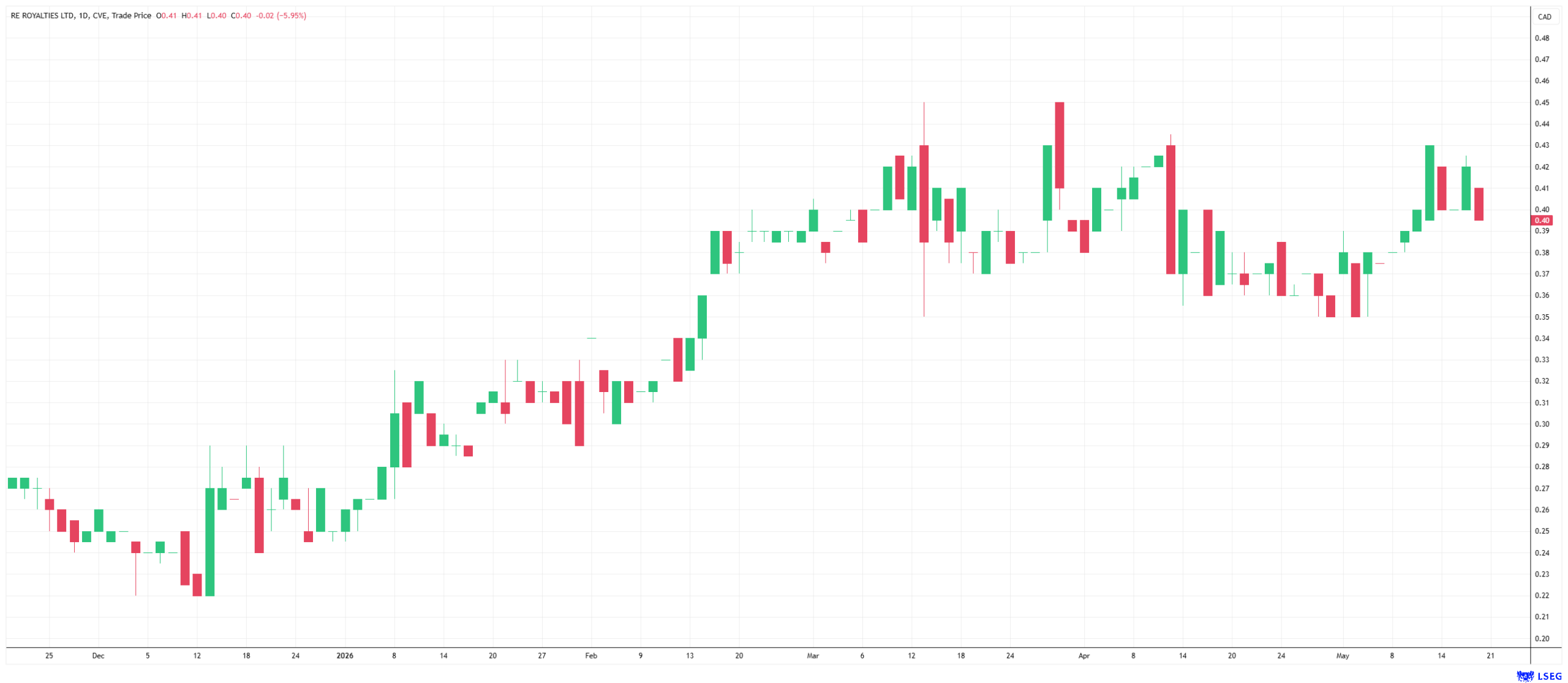
To further expand its portfolio, RE Royalties Ltd. also refinances itself through fixed-income bonds that are strictly structured as green bonds. Following the successful repayment of the first series, RE Royalties placed new secured green bonds with a coupon of 9% p.a. with institutional investors. In parallel, the Executive Board initiated a "Strategic Review" last March to examine options such as a complete sale of the company or far-reaching partnerships, as the company's current market capitalization of approximately CAD 17 million limits its ability to independently finance an exclusive deal pipeline valued at around CAD 50 million. With its key metrics and regular issuances of green bonds offering attractive yields, RE Royalties should be able to identify viable options.
RE Royalties: Market Observers See Potential and Takeover Speculation
The ongoing consolidation in the renewable energy sector is making established royalty portfolios highly sought-after targets. The lithium royalty acquisition by Altius Minerals for CAD 520 million demonstrates that buyers are paying significant premiums for cash flow portfolios. This deal could serve as a blueprint for RE Royalties. Market observers are optimistic about the stock and point to outstanding warrants that could inject additional equity into the company's coffers once certain price levels are reached. For experienced investors, the discrepancy between the low valuation and actual cash flows presents opportunities. The ongoing strategic review offers investors a concrete window of opportunity to participate in a potential revaluation.
Watch YouTube videoConflict of interest
Pursuant to §85 of the German Securities Trading Act (WpHG), we point out that Apaton Finance GmbH as well as partners, authors or employees of Apaton Finance GmbH (hereinafter referred to as "Relevant Persons") may hold shares or other financial instruments of the aforementioned companies in the future or may bet on rising or falling prices and thus a conflict of interest may arise in the future. The Relevant Persons reserve the right to buy or sell shares or other financial instruments of the Company at any time (hereinafter each a "Transaction"). Transactions may, under certain circumstances, influence the respective price of the shares or other financial instruments of the Company.
In addition, Apaton Finance GmbH is active in the context of the preparation and publication of the reporting in paid contractual relationships.
For this reason, there is a concrete conflict of interest.
The above information on existing conflicts of interest applies to all types and forms of publication used by Apaton Finance GmbH for publications on companies.
Risk notice
Apaton Finance GmbH offers editors, agencies and companies the opportunity to publish commentaries, interviews, summaries, news and the like on news.financial. These contents are exclusively for the information of the readers and do not represent any call to action or recommendations, neither explicitly nor implicitly they are to be understood as an assurance of possible price developments. The contents do not replace individual expert investment advice and do not constitute an offer to sell the discussed share(s) or other financial instruments, nor an invitation to buy or sell such.
The content is expressly not a financial analysis, but a journalistic or advertising text. Readers or users who make investment decisions or carry out transactions on the basis of the information provided here do so entirely at their own risk. No contractual relationship is established between Apaton Finance GmbH and its readers or the users of its offers, as our information only refers to the company and not to the investment decision of the reader or user.
The acquisition of financial instruments involves high risks, which can lead to the total loss of the invested capital. The information published by Apaton Finance GmbH and its authors is based on careful research. Nevertheless, no liability is assumed for financial losses or a content-related guarantee for the topicality, correctness, appropriateness and completeness of the content provided here. Please also note our Terms of use.