June 10th, 2026 | 08:25 CEST
Dividend Strategies Put to the Test: Margin Pressure at McDonald's and Johnson & Johnson – RE Royalties Shows Resilience in a Crisis
Global capital markets are undergoing a significant transformation. What generated returns yesterday may already be risky today. For decades, established consumer goods brands and research-intensive pharmaceutical companies were considered the robust cornerstones of dividend strategies. But this paradigm is coming under increasing pressure. Rising operating costs, regulatory interventions, and the relentless cycle of patent expirations are challenging even the most resilient market leaders. In this market environment, alternative financing models with an asset-light approach are gaining importance. Natural energy sources such as wind and solar power offer the opportunity for stable, recurring, and above all inflation-protected revenue streams through innovative royalty structures. That is exactly what investors are looking for right now. We provide an overview.
time to read: 3 minutes | Author: Nico Popp
ISIN: RE ROYALTIES LTD | CA75527Q1081 | TSXV: RE , OTCQX: RROYF , JOHNSON + JOHNSON DL 1 | US4781601046 , MCDONALDS CORP. DL-_01 | US5801351017
Table of contents:
Author

Nico Popp
At home in Southern Germany, the passionate stock exchange expert has been accompanying the capital markets for about twenty years. With a soft spot for smaller companies, he is constantly on the lookout for exciting investment stories.
Tag cloud
Shares cloud
McDonald's: Substantial Cash Flows and Real Estate
Contrary to common perception, McDonald's business model relies only to a small extent on the direct sale of food. Under the leadership of then-President and CEO Harry J. Sonneborn, the company underwent a strategic pivot as early as the 1950s, transforming it into one of the world's largest owners of commercial real estate. McDonald's operates as a hybrid franchisor and landlord by strategically acquiring prime real estate and subleasing it to franchise partners at a substantial markup.
Within this structure, franchisees bear 100% of the costs of restaurant operations, staffing, and local expansion, while the parent company collects a revenue-based franchise fee and a variable rent equal to 8 to 15% of gross revenue. On the New York Stock Exchange, the company is valued at a whopping USD 197 billion. Revenue for the 2025 fiscal year amounts to USD 26.89 billion, with a net profit of a generous USD 8.56 billion. Franchise restaurants have historically generated a segment margin of around 82% for McDonald's, while company-owned restaurants operate with significantly lower margins—a structural feature of the hybrid model. Nevertheless, the system is not entirely crisis-free, as local franchisees are suffering from inflation and rising minimum wages. McDonald's dividend yield is around 2.7%.
Johnson & Johnson and the Battle at the Patent Cliff
Johnson & Johnson maintains its leading market position through a broadly diversified healthcare portfolio, which, following the spin-off of the consumer business, consists of the two operating segments Innovative Medicine and MedTech. The stock is trading near its all-time high and reflects a market capitalization of around USD 558 billion. In fiscal year 2025, the company generated revenue of USD 94.193 billion and net income of around USD 26 billion. The dividend yield stands at a solid 2.30%.
Johnson & Johnson's fundamental challenge is to protect its portfolio against the natural expiration of patent protection—the pharmaceutical industry faces a revenue loss of approximately USD 300 billion by 2030 due to an unprecedented patent cliff. Stelara achieved record revenue of approximately USD 10.9 billion in 2023 but began losing market share in 2024 amid emerging biosimilar competition, resulting in a significant revenue decline. To halt this erosion, management is accelerating research into new potential blockbusters in the clinical pipeline. Examples include the active ingredients nipocalimab and rybrevant.
RE Royalties: Non-Dilutive Financing for the Energy Transition
The Canadian growth company RE Royalties has applied the proven principle of royalty financing from the commodities sector to the renewable energy market. The company acts as a financing partner for small to medium-sized developers of infrastructure projects, which are often largely overlooked by traditional banks. RE Royalties provides developers with non-dilutive capital and, in return, receives a contractually fixed stake of typically 1% to 2% of the facilities' gross revenue over terms of 15 to 25 years.
Thanks to these equity stakes, RE Royalties is completely insulated from increases in operating costs, wage inflation, or operational risks and, based on the current share price and minimal fixed costs, generates a forward dividend yield of approximately 10%. The diversified overall portfolio comprises more than 120 active royalties totalling 492 MW, distributed across solar projects, battery storage systems, wind farms, hydroelectric power plants, energy efficiency projects, and a biogas plant. These projects are backed by long-term contracts with energy utilities, which ensure predictable returns due to their business models.
Unorthodox Insider Purchases and a Strategic Review Process That Could Change Everything
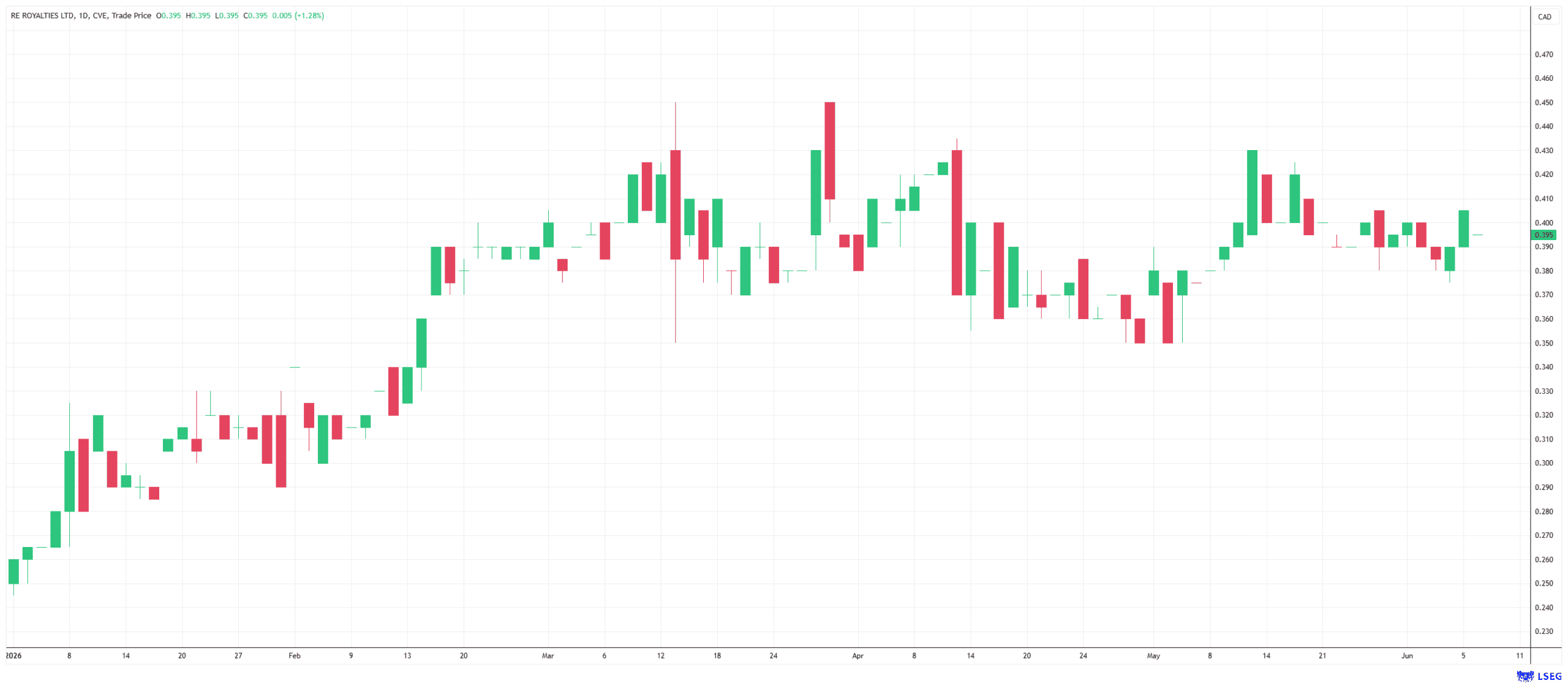
The management of RE Royalties, led by CEO Bernard Tan and COO Peter Leighton, is itself heavily invested in the company. In the fall of 2025, several insiders purchased shares on the open market, bringing the management's stake to approximately 24% of all outstanding shares. To resolve the glaring discrepancy between the current market capitalization of only about CAD 17 million and the portfolio's actual intrinsic value, the board announced a strategic review by PricewaterhouseCoopers in March. RE Royalties has a pipeline of approximately CAD 20 million in binding letters of intent, as well as an additional CAD 200 million in projects under active review, for which independent financing via the regular capital market is virtually impossible. RE Royalties is therefore the go-to choice and is likely to benefit.
Conclusion: RE Royalties is Perfectly Timed
RE Royalties' business model is considered crisis-resistant in times of inflation and is likely to outperform many traditional dividend aristocrats. While McDonald's is constrained by margin pressure from its franchisees and Johnson & Johnson must continually invest billions to develop new active ingredients, RE Royalties remains largely unaffected by operational risks. Given the ongoing strategic review by PricewaterhouseCoopers, the stock, at its current price level of around CAD 0.39, could represent a potential acquisition target for larger infrastructure and ESG funds.
Watch YouTube videoConflict of interest
Pursuant to §85 of the German Securities Trading Act (WpHG), we point out that Apaton Finance GmbH as well as partners, authors or employees of Apaton Finance GmbH (hereinafter referred to as "Relevant Persons") may hold shares or other financial instruments of the aforementioned companies in the future or may bet on rising or falling prices and thus a conflict of interest may arise in the future. The Relevant Persons reserve the right to buy or sell shares or other financial instruments of the Company at any time (hereinafter each a "Transaction"). Transactions may, under certain circumstances, influence the respective price of the shares or other financial instruments of the Company.
In addition, Apaton Finance GmbH is active in the context of the preparation and publication of the reporting in paid contractual relationships.
For this reason, there is a concrete conflict of interest.
The above information on existing conflicts of interest applies to all types and forms of publication used by Apaton Finance GmbH for publications on companies.
Risk notice
Apaton Finance GmbH offers editors, agencies and companies the opportunity to publish commentaries, interviews, summaries, news and the like on news.financial. These contents are exclusively for the information of the readers and do not represent any call to action or recommendations, neither explicitly nor implicitly they are to be understood as an assurance of possible price developments. The contents do not replace individual expert investment advice and do not constitute an offer to sell the discussed share(s) or other financial instruments, nor an invitation to buy or sell such.
The content is expressly not a financial analysis, but a journalistic or advertising text. Readers or users who make investment decisions or carry out transactions on the basis of the information provided here do so entirely at their own risk. No contractual relationship is established between Apaton Finance GmbH and its readers or the users of its offers, as our information only refers to the company and not to the investment decision of the reader or user.
The acquisition of financial instruments involves high risks, which can lead to the total loss of the invested capital. The information published by Apaton Finance GmbH and its authors is based on careful research. Nevertheless, no liability is assumed for financial losses or a content-related guarantee for the topicality, correctness, appropriateness and completeness of the content provided here. Please also note our Terms of use.