January 20th, 2026 | 07:05 CET
Antimony shock for Airbus and BASF: China's export restrictions make Antimony Resources a strategic winner
2025 will go down in economic history as the year when a largely unknown semi-metal sent global industry into a state of alert. Antimony, long overshadowed by popular battery metals such as lithium and cobalt, suddenly emerged as one of the most strategically critical and supply-constrained metals. Aggressive export restrictions imposed by China, which historically controlled over 80% of global processing capacity, have put Western supply chains under significant pressure. What market observers refer to as the "antimony shock" is no longer a theoretical threat, but a harsh economic reality. According to industry analyses, market participants were already talking about significant supply deficits in 2025 – estimates are in the high five-digit ton range. We analyze the market and present a potential beneficiary.
time to read: 3 minutes | Author: Nico Popp
ISIN: ANTIMONY RESOURCES CORP | CA0369271014 , AIRBUS | NL0000235190 , BASF SE NA O.N. | DE000BASF111
Table of contents:
Author

Nico Popp
At home in Southern Germany, the passionate stock exchange expert has been accompanying the capital markets for about twenty years. With a soft spot for smaller companies, he is constantly on the lookout for exciting investment stories.
Tag cloud
Shares cloud
The end of availability: A market is drying up
The exact extent of the supply deficit remains controversial due to a lack of transparency in antimony statistics, but the structural undersupply is real. In this geopolitical vacuum, where physical availability is more important than price, the explorer Antimony Resources is emerging as a key strategic player for Western supply security, while industrial giants tremble for their supply chains. Market data paints a bleak picture for consumers. As investment magazine Mugglehead reports in a recent summary, antimony is the "invisible element" without which large parts of modern life would come to a standstill. It is essential for fire protection in plastics, textiles, and electronics, and indispensable for the defense industry. But China is mercilessly exploiting its monopoly position: officially justified on national security grounds, export restrictions have effectively brought global supplies of the metal to a standstill.
The result is panic on the spot markets. More and more observers are analyzing that we are not dealing with a cyclical fluctuation, but with a structural disruption. With Russia largely out of the picture as an alternative supplier for many Western customers due to sanctions, and projects in Central Asia often under Chinese influence, the West is facing empty warehouses. Voices from industry are becoming louder and more alarming: it is no longer a question of how much the material costs, but whether it can still be delivered at all. In a world where fire safety regulations are non-negotiable, no antimony simply means no production.
BASF and Airbus: Giants in search of security
The significance of this crisis is clear when looking at the largest industrial customers. For corporations such as Airbus and BASF, antimony is not an optional additive, but a critical component. Airbus, which, according to AirInsight, is already struggling with supply problems, requires antimony-containing flame retardants for the interior trim and wiring of its aircraft in order to meet strict FAA and EASA safety standards. Without these certificates, no aircraft can take off. The situation is similarly dramatic for chemical giant BASF, which processes antimony as a catalyst and additive in complex value chains. Both companies are examples of the vulnerability of Western industry: they are technological leaders, but at the beginning of their supply chain, they are completely dependent on a power that uses raw materials as a geopolitical weapon.
Antimony Resources as a response to the "friend-shoring doctrine"
Antimony Resources is stepping into this supply vacuum. The Canadian company is benefiting like no other from the reorganization of US supply chain policy. The government in Washington and the Pentagon have recognized that dependence on China for a material that is also essential for ammunition and night vision devices poses an unacceptable security risk. Antimony Resources is positioning itself as the solution to the "friend-shoring strategy" and is developing deposits in secure Western jurisdictions. Antimony's Bald Hill project in New Brunswick, Canada, is considered promising and scores highly in its early stages with high grades.
Investors are increasingly recognizing the value of this potential and the strategic independence that Antimony Resources stands for. With Bald Hill, Antimony Resources owns an asset that could fill the gap left by China. Investors are increasingly beginning to price in a security premium for North American antimony exploration projects. An ounce of antimony from secure Western production could justify a multiple of the Shanghai spot price for strategic buyers such as the US Department of Defense or industrial groups – a scenario that market observers are discussing.
Antimony Resources fits the spirit of the times
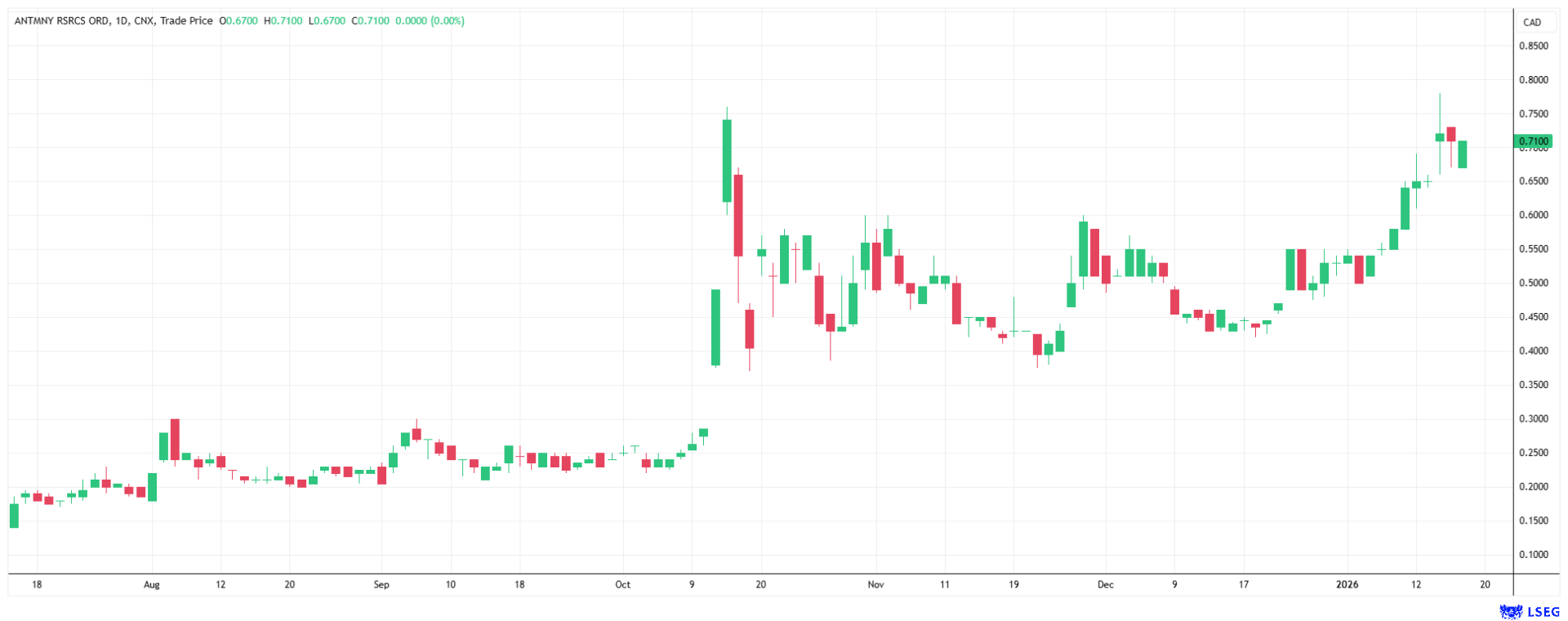
The Company is thus transforming itself from a pure commodity explorer into a geopolitical asset. In an environment where analysts are forecasting persistently high deficits, Antimony Resources offers a rare opportunity to benefit directly from this unique market situation. While the industry is desperately searching for material, Antimony Resources is sitting on the potential solution. The stock is therefore perfectly in tune with the spirit of the times and has already shown dynamic performance. Given its market capitalization in the mid double-digit range, there should be further potential for success.
Conflict of interest
Pursuant to §85 of the German Securities Trading Act (WpHG), we point out that Apaton Finance GmbH as well as partners, authors or employees of Apaton Finance GmbH (hereinafter referred to as "Relevant Persons") currently hold or hold shares or other financial instruments of the aforementioned companies and speculate on their price developments. In this respect, they intend to sell or acquire shares or other financial instruments of the companies (hereinafter each referred to as a "Transaction"). Transactions may thereby influence the respective price of the shares or other financial instruments of the Company.
In this respect, there is a concrete conflict of interest in the reporting on the companies.
In addition, Apaton Finance GmbH is active in the context of the preparation and publication of the reporting in paid contractual relationships.
For this reason, there is also a concrete conflict of interest.
The above information on existing conflicts of interest applies to all types and forms of publication used by Apaton Finance GmbH for publications on companies.
Risk notice
Apaton Finance GmbH offers editors, agencies and companies the opportunity to publish commentaries, interviews, summaries, news and the like on news.financial. These contents are exclusively for the information of the readers and do not represent any call to action or recommendations, neither explicitly nor implicitly they are to be understood as an assurance of possible price developments. The contents do not replace individual expert investment advice and do not constitute an offer to sell the discussed share(s) or other financial instruments, nor an invitation to buy or sell such.
The content is expressly not a financial analysis, but a journalistic or advertising text. Readers or users who make investment decisions or carry out transactions on the basis of the information provided here do so entirely at their own risk. No contractual relationship is established between Apaton Finance GmbH and its readers or the users of its offers, as our information only refers to the company and not to the investment decision of the reader or user.
The acquisition of financial instruments involves high risks, which can lead to the total loss of the invested capital. The information published by Apaton Finance GmbH and its authors is based on careful research. Nevertheless, no liability is assumed for financial losses or a content-related guarantee for the topicality, correctness, appropriateness and completeness of the content provided here. Please also note our Terms of use.