December 29th, 2025 | 07:40 CET
Alternative to DroneShield and Standard Lithium! NEO Battery Materials set to take off in 2026! Drones, robotics, and more in one stock
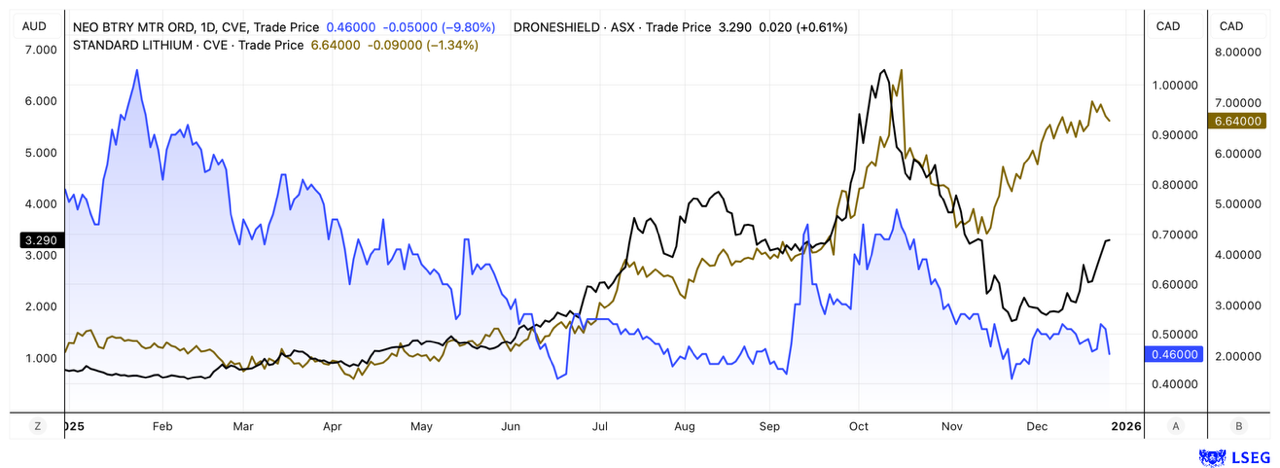
Drones, robotics, and electromobility are megatrends. Billions of dollars in capital are flowing into these industries. As a result, DroneShield and Standard Lithium were among the high flyers of the year. However, after share price gains of 330% and 170% respectively, they are anything but cheap. NEO Battery Materials has what it takes to become a price rocket in 2026. The Canadian company has developed more cost-effective, silicon-reinforced batteries that offer higher storage capacity and faster charging. Very importantly, commercialization is set to begin in 2026 at a factory in South Korea. Orders are already in place, and shortly before Christmas, NEO Battery became part of South Korea's defense industry ecosystem.
time to read: 4 minutes | Author: Fabian Lorenz
ISIN: NEO BATTERY MATERIALS LTD | CA62908A1003
Table of contents:
Author

Fabian Lorenz
For more than twenty years, the Cologne native has been intensively involved with the stock market, both professionally and privately. He is particularly passionate about national and international small and micro caps.
Tag cloud
Shares cloud
Accelerated entry into the South Korean defense industry
2026 could be the year of NEO Battery Materials stock. The revolutionary battery technology is ready for the market, mass production in South Korea can begin, and there are already strong partners and customers. The day before Christmas, the next bombshell dropped. NEO Battery entered into a partnership with the Korea Institute for Defense Industry ("KOIDI"). This is an organization approved by the Ministry of Defense that is dedicated to promoting South Korea's defense sector and defense capabilities.
This makes NEO part of South Korea's defense industry ecosystem of companies, the military, academia, research institutions, and government. This milestone cannot be overestimated, because, as we know from Europe, getting approved or certified is likely the biggest hurdle for smaller companies to achieve economic success in the defense sector. To kick off the collaboration, NEO and KOIDI will establish a joint task force focused on defense drones and unmanned applications. The JTF will technically classify NEO's silicon-reinforced batteries and promote their use in drones and UAS.
High-performance batteries for drones, robotics, and more
NEO Battery's high-performance batteries are based on proprietary and patented silicon anodes. The competitive advantages are striking. NEO technology enables up to 10 times the capacity of graphite anodes and is more than 40% ahead of its direct competitors. At the same time, production costs can be reduced by up to 60%, and the charging process accelerated.
In an interview with Lyndsay Malchuk from the IIF, NEO SVP of Strategy & Operations, Danny Huh, impressively describes how the Company has developed technologically in recent years and adapted to customer requirements. Due to the complex manufacturing process involved in producing batteries, NEO now offers not only silicon anodes, but also complete batteries. The Company focuses on customized products in large quantities for drones, robotics, AI electronics, energy storage, e-mobility, and much more.
https://youtu.be/w4wv-LqCFIs?si=VGJmG2JdEH4K4dz8
In order to be able to start production quickly, the technology company has signed a long-term lease for an already operational factory with a production capacity in the megawatt-hour range in South Korea. By extending shift times and adding automation, the Company aims to roughly double capacity in the coming months, positioning itself for accelerated scaling of its products. By leasing the facility, NEO saves the otherwise high upfront costs of a new building, reduces construction and commissioning risks, and can immediately deploy its own technology on an industrial scale.
Orders and partners in place
NEO Battery has already secured utilization of its production capacity for the current year. Orders and partnerships across multiple target markets have been announced repeatedly, underscoring strong commercial traction. These include a million-dollar order from an Asian drone manufacturer, which will deploy NEO batteries in its cargo drone fleet. In addition, NEO Battery has signed a development agreement with a South Korean industrial robotics company supplying automation solutions for logistics centers and manufacturing facilities, including humanoid robotics. Under this agreement, NEO will provide lithium-silicon battery cells and packs.
A buyer has also already been found for NEO's silicon anodes. A battery manufacturer specializing in power-intensive special applications such as unmanned aerial systems (UAS), drones, and defense-related mobile systems has committed to purchasing 50 tons of silicon anodes over the next four years.
In the field of electromobility, NEO has also been able to secure its first customers, and not just any. In mid-December, a Fortune 500 automotive manufacturer from North America placed an order and will initially test NEO batteries in a pilot project. About a week earlier, a South Korean automotive supplier, also among the world's 500 largest corporations (Fortune 500), had already placed an order with NEO. Both orders are scheduled for delivery in the coming months and are therefore expected to contribute to revenue. In addition, they provide the Company the opportunity to demonstrate its manufacturing capabilities in the production of industrial-grade battery components and cells.
The Share
Despite the numerous exciting areas of application for NEO batteries, the revolutionary technology, and the announcements of orders and partnerships, the share price has struggled in 2025. At a price of CAD 0.46, the market capitalization stands at around CAD 65 million. At the same time, commercialization is starting these days, paving the way for tangible revenue growth.
Conclusion: There is much to suggest a successful 2026
Overall, NEO Battery Materials offers investors an attractive investment case. The Western world needs high-performance batteries without the risk of China. NEO appears to be excellently positioned to provide this. The battery technology has been developed, and commercialization is underway. If the positive news flow continues, it can only be a matter of time before the stock is discovered.
Conflict of interest
Pursuant to §85 of the German Securities Trading Act (WpHG), we point out that Apaton Finance GmbH as well as partners, authors or employees of Apaton Finance GmbH (hereinafter referred to as "Relevant Persons") may hold shares or other financial instruments of the aforementioned companies in the future or may bet on rising or falling prices and thus a conflict of interest may arise in the future. The Relevant Persons reserve the right to buy or sell shares or other financial instruments of the Company at any time (hereinafter each a "Transaction"). Transactions may, under certain circumstances, influence the respective price of the shares or other financial instruments of the Company.
In addition, Apaton Finance GmbH is active in the context of the preparation and publication of the reporting in paid contractual relationships.
For this reason, there is a concrete conflict of interest.
The above information on existing conflicts of interest applies to all types and forms of publication used by Apaton Finance GmbH for publications on companies.
Risk notice
Apaton Finance GmbH offers editors, agencies and companies the opportunity to publish commentaries, interviews, summaries, news and the like on news.financial. These contents are exclusively for the information of the readers and do not represent any call to action or recommendations, neither explicitly nor implicitly they are to be understood as an assurance of possible price developments. The contents do not replace individual expert investment advice and do not constitute an offer to sell the discussed share(s) or other financial instruments, nor an invitation to buy or sell such.
The content is expressly not a financial analysis, but a journalistic or advertising text. Readers or users who make investment decisions or carry out transactions on the basis of the information provided here do so entirely at their own risk. No contractual relationship is established between Apaton Finance GmbH and its readers or the users of its offers, as our information only refers to the company and not to the investment decision of the reader or user.
The acquisition of financial instruments involves high risks, which can lead to the total loss of the invested capital. The information published by Apaton Finance GmbH and its authors is based on careful research. Nevertheless, no liability is assumed for financial losses or a content-related guarantee for the topicality, correctness, appropriateness and completeness of the content provided here. Please also note our Terms of use.