March 6th, 2026 | 07:30 CET
Billion-Dollar Opportunity from the NDAA: NEO Battery Materials benefits from the US shift away from Chinese supply chains
In the world of battery startups, the path from promising laboratory formula to a delivered product is fraught with pitfalls. Technology promises fizzle out, production ramp-ups stall, and customers walk away. It is a business where confidence can quickly evaporate. This makes the development of a Canadian company based in Toronto over the past few months all the more remarkable. NEO Battery Materials appears to be systematically working through the usual list of pitfalls, gradually turning its research results into tangible substance. Anyone following the latest announcements can see that management is pursuing a clear strategy while steadily reducing the risk for shareholders.
time to read: 5 minutes | Author: Armin Schulz
ISIN: NEO BATTERY MATERIALS LTD | CA62908A1003 | TSXV: NBM , OTC: NBMFF
Table of contents:
Author

Armin Schulz
Born in Mönchengladbach, he studied business administration in the Netherlands. In the course of his studies he came into contact with the stock exchange for the first time. He has more than 25 years of experience in stock market business.
Tag cloud
Shares cloud
The first milestone: From the lab to the air
The biggest hurdle for any new battery technology is the gap between the controlled environment of the laboratory and real-world conditions. Many promising approaches fail precisely here. NEO passed this test with flying colors in February 2026. The company demonstrated its newly developed cell in a live field test with a commercial surveillance drone from a South Korean customer.
The result was impressive. Under realistic conditions, in freezing temperatures and at an altitude of about 20 m, the NEO drone cell almost doubled the flight time compared to the standard Chinese benchmark on the market. It went from just under 30 minutes to almost 60 minutes. A spokesperson for the South Korean drone manufacturer commented: "This live field test exceeded our internal expectations and measurements regarding the benefits of high-performance customization for drone products." This means that the most important test of all has been completed.
The production base: From field test performance to series production
An outstanding cell in testing is one thing. Manufacturing it at scale and with consistent quality is the next crucial hurdle. Here, too, NEO has made a huge leap forward in the same period. The impressive doubling of flight time, which was demonstrated live in February, is no longer a one-off laboratory curiosity. It can now be produced in series.
The company laid the foundation for this back in November 2025 with a lease agreement for a fully equipped battery electrode production facility in Gimje, South Korea. Instead of wasting years building its own factory, NEO was able to start production immediately. The first commercial orders from two different Fortune 500 automotive groups were received in December. This was the first tangible proof of the viability of production. In January, the company even received official supplier status from the Asian Fortune 500 group.
The preliminary highlight of this scaling strategy was the announcement in early March 2026. NEO acquired a 3.2-hectare site for the construction of its own dedicated factory for drone and robot cells. With a planned annual capacity of 500 megawatt hours, the aim is to produce enough cells here in the future to equip around 66,000 reconnaissance drones or over 300,000 so-called loitering munitions packages. Until this new factory begins operations at the end of the year, the first orders and current customer orders will continue to be manufactured at the existing production facility in Gimje. This marks the completion of the transition from using third-party facilities to operating its own capacity.
Strategic prioritization: Pouch cells first
What is remarkable about the facility strategy is its clear prioritization. Instead of trying to serve all cell formats simultaneously from the outset, NEO is initially focusing on the segment with the strongest and most urgent demand: pouch cells for drones and defense applications. It is precisely these customers who are already actively moving away from Chinese supply chains and looking for reliable alternatives. The planned lines for cylindrical and prismatic cells will only be installed later, based on specific orders. This is not a technical gimmick, but rather disciplined capital allocation in practice. Every dollar invested goes where it finds the fastest and surest path to the customer.
Market access: Strategic personnel and the key to the military
However, technology and production alone do not open the heaviest doors, especially those of the defense sector. Here, too, NEO set a decisive course in the first quarter of 2026. The appointment of General Chang-Jun Ko to the board of directors is a strategic coup. The four-star general was deputy chief of staff of the South Korean army and brings 36 years of experience in the military and procurement to the table.
Shortly before announcing the new factory, NEO reinforced this step with a memorandum of understanding with the Korea Institute for Defense Industry (KOIDI), an organization recognized by the Ministry of Defense. A joint task force will now drive forward the introduction of NEO batteries in South Korean military drones. The strategy follows a proven pattern. First, training and testing with the company's own armed forces, then operational introduction, and finally using this reference project as a door opener for the much larger markets in the US and among NATO partners.
In addition, the company announced a strategic partnership with South Korean robotics provider Zio Robot. The focus is on developing powerful lithium-ion batteries for autonomous transport robots that can move loads of up to 6,000 kg. Zio Robot is supported by Samsung Electronics through its startup program and works closely with the electronics group. The collaboration aims to replace the Chinese batteries used to date with better high-performance cells. This could open up new fields of application.
Regulatory tailwind: The NDAA advantage
This focus on defense and non-Chinese supply chains is no coincidence, but rather a response to a massive regulatory shift. Section 842 of the recently passed US budget for fiscal year 2026 contains a clear requirement. Starting in January 2028, Chinese batteries and components will be phased out of US defense procurement, leading to a complete ban by January 2031. NEO explicitly sources its raw materials and components outside of China and other countries classified as "Foreign Entities of Concern" (FEOC). This positions NEO as one of the very few manufacturers that can legally and reliably supply Western and allied armed forces. What appears to be a technological niche is in fact the answer to a strategic problem worth billions.
The financial basis: Capital for the next phase
All these steps cost money. The financing round completed in January shows that NEO is also pursuing a clear plan here. Institutional investors subscribed to a placement with a volume of CAD 7 million. The fresh money is being channeled specifically into the expansion of production, equipment for the new factory, and the subsequent lines for cylindrical and prismatic cells.
The share is currently trading at CAD 0.70, well above the price of the last private placement, which closed at CAD 0.60. This can be seen as a good sign.
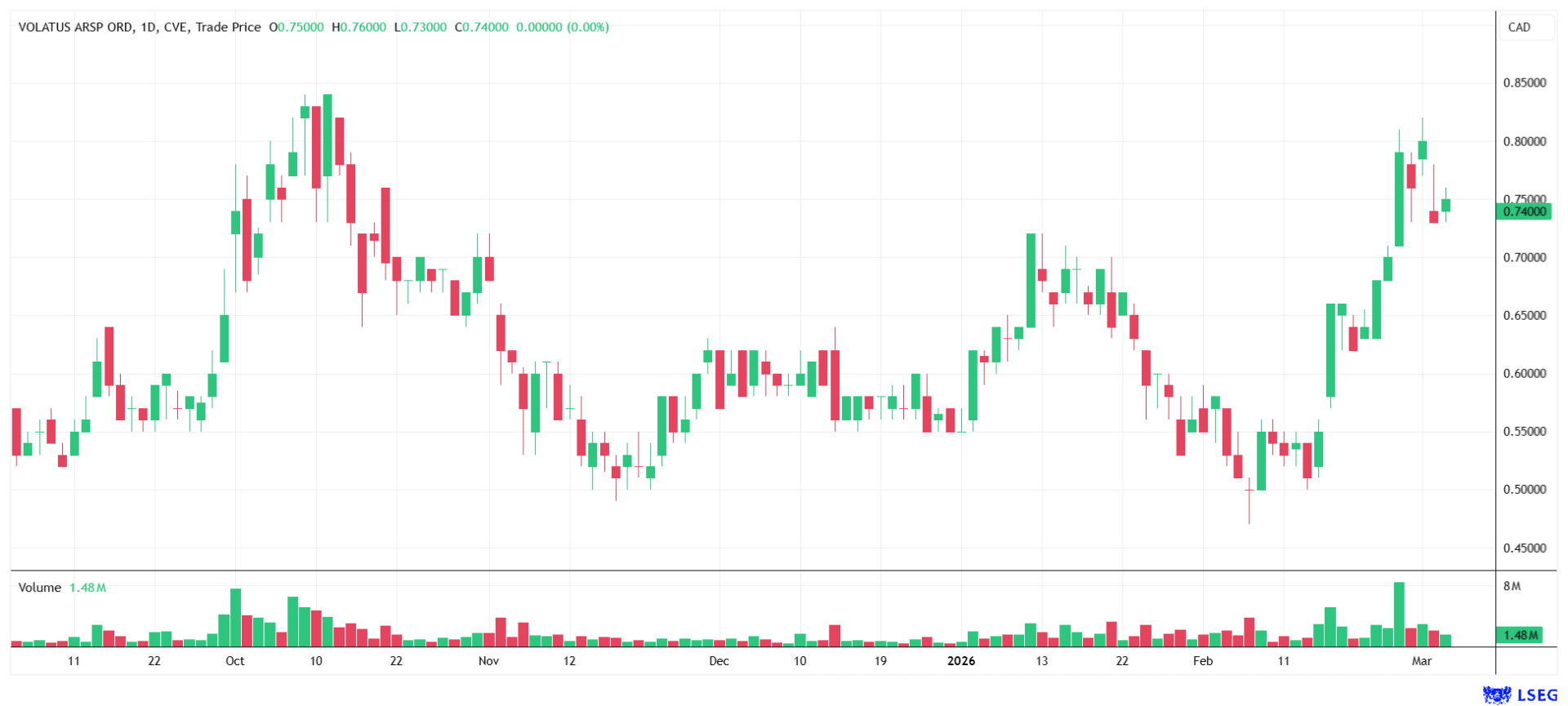
Looking at the chain of events over the past few months, the picture that emerges is of a company that has done its homework. The technology has been field-tested, production is ready for series production of the record-breaking cell, the first customers are on board, access to strategic markets has been paved by high-caliber personnel, and the regulatory course is playing directly into the hands of the company's own strategy. NEO Battery Materials has transformed itself at a breathtaking pace from a developer to a manufacturing company with a clear, positive outlook. The risks typically associated with an investment at this stage have been addressed one by one. What remains is the opportunity to witness the rise of a new, strategically essential player in one of the most exciting industrial sectors of our time - from a front-row seat.
Conflict of interest
Pursuant to §85 of the German Securities Trading Act (WpHG), we point out that Apaton Finance GmbH as well as partners, authors or employees of Apaton Finance GmbH (hereinafter referred to as "Relevant Persons") currently hold or hold shares or other financial instruments of the aforementioned companies and speculate on their price developments. In this respect, they intend to sell or acquire shares or other financial instruments of the companies (hereinafter each referred to as a "Transaction"). Transactions may thereby influence the respective price of the shares or other financial instruments of the Company.
In this respect, there is a concrete conflict of interest in the reporting on the companies.
In addition, Apaton Finance GmbH is active in the context of the preparation and publication of the reporting in paid contractual relationships.
For this reason, there is also a concrete conflict of interest.
The above information on existing conflicts of interest applies to all types and forms of publication used by Apaton Finance GmbH for publications on companies.
Risk notice
Apaton Finance GmbH offers editors, agencies and companies the opportunity to publish commentaries, interviews, summaries, news and the like on news.financial. These contents are exclusively for the information of the readers and do not represent any call to action or recommendations, neither explicitly nor implicitly they are to be understood as an assurance of possible price developments. The contents do not replace individual expert investment advice and do not constitute an offer to sell the discussed share(s) or other financial instruments, nor an invitation to buy or sell such.
The content is expressly not a financial analysis, but a journalistic or advertising text. Readers or users who make investment decisions or carry out transactions on the basis of the information provided here do so entirely at their own risk. No contractual relationship is established between Apaton Finance GmbH and its readers or the users of its offers, as our information only refers to the company and not to the investment decision of the reader or user.
The acquisition of financial instruments involves high risks, which can lead to the total loss of the invested capital. The information published by Apaton Finance GmbH and its authors is based on careful research. Nevertheless, no liability is assumed for financial losses or a content-related guarantee for the topicality, correctness, appropriateness and completeness of the content provided here. Please also note our Terms of use.