September 7th, 2026 | 08:20 CEST
Almonty: Analysts Speak Out – Airbus and Sandvik Need to Diversify Their Tungsten Supply
When huge turbines roar on the tarmac and passenger jets weighing several tonnes take off, few people think about how modern aeroplanes are manufactured and what is crucial to the process. Yet one extremely durable metal can determine the pace of modern aviation: tungsten. Without tungsten, the aviation industry's assembly lines could grind to a sudden halt. With a density close to that of gold and the highest melting point of any element, this critical metal can withstand extreme conditions. It is therefore essential not only in aerospace but also in a range of other future technologies, including fusion energy. Yet while the West is developing and building the latest-generation aircraft, China controls more than 80% of global tungsten production. This concentration of supply represents a highly dangerous strategic risk—but there is a solution.
time to read: 5 minutes | Author: Nico Popp
ISIN: ALMONTY INDUSTRIES INC. | CA0203987072 | TSX: AII , NASDAQ: ALM , ASX: AII , AIRBUS | NL0000235190 , SANDVIK AB | SE0000667891
Table of contents:
Author

Nico Popp
At home in Southern Germany, the passionate stock exchange expert has been accompanying the capital markets for about twenty years. With a soft spot for smaller companies, he is constantly on the lookout for exciting investment stories.
Tag cloud
Shares cloud
Airbus Feels the Supply Squeeze on the Production Lines
The European aircraft manufacturer Airbus has a commercial aircraft order book that is full to bursting, keeping its factories busy for years to come. However, the production of models such as the A350 or narrow-body jets from the A320neo family is reaching the limits of what is technically possible with current materials. To guarantee maximum aerodynamic efficiency, designers rely on high-strength titanium- and nickel-based alloys. However, these heat-resistant materials can only be machined with tools made primarily of ultra-hard tungsten carbide. At cutting-edge temperatures exceeding 800 °C, ordinary steel would fail immediately. In addition to indirect manufacturing requirements, aircraft manufacturers such as Airbus also require the heavy metal directly on board. Tungsten heavy-metal alloys such as Wolfmet serve as trim weights to dampen vibrations in control surfaces, while high-purity tungsten protects sensitive flight control computers from cosmic radiation. Although the proportion of tungsten in a wide-body jet is negligible, a shortage would quickly bring production to a standstill. New European regulations are now forcing aircraft manufacturers to diversify their supply chains in order to keep risks manageable.
Sandvik Faces Material Wear Challenges
Through its core division, Sandvik Coromant, Sandvik dominates the market for cutting tools and high-performance tools. With the Mittersill scheelite mine in the Salzburg region and the modern smelter in St. Martin, Styria, the group already has its own processing capacity through its subsidiary Wolfram Bergbau und Hütten. There, the Styrian-based company transforms primary ores and scrap metal using green hydrogen into chemically pure ammonium paratungstate and the finest tungsten carbide powder. However, the tooling giant is faced with an insurmountable physical dilemma: the virtually unavoidable problem of wear and tear. According to the industry association ITIA, an estimated 70% of the tungsten used industrially worldwide is permanently lost – through wear and tear, dissipative applications and non-functional recycling. In the case of cutting tools themselves, however, the return rate is already over 95%. Even if management were to push for a complete take-back rate for end-of-life tool heads, the constant loss cannot be offset by scrap recycling. Added to this are the restrictive US export controls on tungsten scrap, which are reducing supply on the secondary market.
Almonty and the Tungsten Breakthrough in South Korea
This is precisely where the Western tungsten alternative, Almonty Industries, comes into play. The company's flagship project is located in South Korea's Gangwon mining region: the historic Sangdong Mine, whose processing facilities have been ramping up for months. Geologically, the property is in a league of its own. While mine operators worldwide are struggling with low grades, Sangdong offers proven reserves of 7.90 million tonnes of ore with an outstanding grade of 0.45% tungsten oxide. Even the lower-grade development ore from the start-up phase, with a grade of 0.25% tungsten oxide, significantly exceeds the international industry average. In addition to the high ore grades, the deposit stands out for its purity, as interfering associated elements such as arsenic, phosphorus or uranium are almost entirely absent. This simplifies the chemical processing into marketable tungsten oxide concentrate. In Phase 1, which is currently underway, the mine is set to process 640,000 tonnes of raw ore annually, producing around 2,300 tonnes of pure tungsten oxide concentrate. For Phase 2, planned to commence in 2027, management aims to double throughput to 1.2 million tonnes of ore. Thanks to operating cash costs of just around USD 110 per MTU (metric tonne unit), Sangdong is positioned as one of the world's most cost-effective mining sites. These key figures attracted international financial partners years ago: the German KfW IPEX-Bank supported the project with a robust loan package of USD 75.1 million, backed by direct investments from the Austrian Plansee Group.
Portuguese Treasures and Billion-Dollar Long-Term Contracts
In addition to its main deposit in Asia, Almonty has further projects in Europe and the US. The long-established Panasqueira underground mine in Portugal has been continuously producing high-quality tungsten and tin ore for decades. The team on site is currently pushing ahead with a comprehensive deep exploration program aimed at producing around 124,000 MTU of tungsten oxide annually following successful modernization. The proximity to European customers is becoming increasingly significant in light of the European Raw Materials Act. The legislation stipulates that, by 2030, the EU must extract at least 10% of its strategic raw materials itself and refine 40% within the single market, while dependence on any single country must be reduced to a maximum of 65%. In January of this year, Almonty's Portuguese subsidiary signed a long-term supply contract with Sandvik's metallurgical subsidiary. This contract secures the Swedish tool manufacturer direct access to Portuguese concentrate and ensures long-term utilization of the smelter in St. Martin. At the same time, Almonty secured a 21-year offtake agreement with Global Tungsten & Powders. The terms provide for fixed price floors and stand to benefit from rising prices on the global market. One MTU of tungsten concentrate currently costs around USD 3,000.
Jefferies Analysts Give Almonty the Thumbs-Up
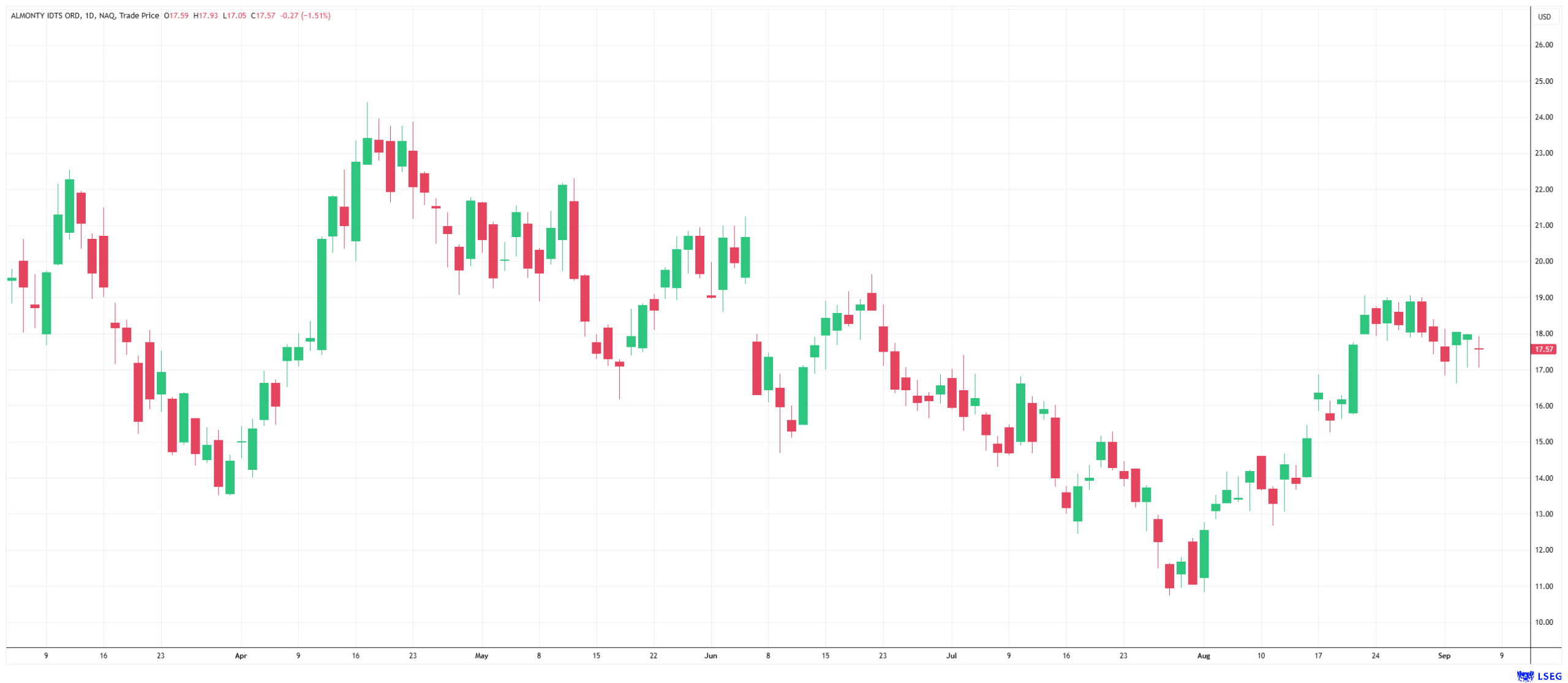
From 1 January 2027, the US Defence Procurement Act will come into force, completely banning the use of Chinese, North Korean, Russian or Iranian tungsten in military systems. In the coming months, Almonty plans to gradually bring its Gentung Browns project in the US state of Montana into production – another detail that shows Almonty is one of the companies of the moment. As recently as early September, the US research firm Jefferies issued a "Buy" recommendation for Almonty shares with a target price of USD 26.25. The analysts at Jefferies argue that Almonty stands to benefit from Western efforts to secure tungsten supply chains, as China controls around 80% of global tungsten supply and restrictions on US defence procurement will take effect from 2027. With the ramp-up of the Sangdong mine in South Korea, the company has one of the world's largest and highest-grade deposits outside China, which could meet around 40% of demand outside China following Phase II. Long-term offtake agreements with binding minimum prices and the planned vertical integration into the downstream sector would also offer a level of revenue and margin security rarely seen in the commodities sector, according to the experts at Jefferies.
Watch YouTube videoConflict of interest
Pursuant to §85 of the German Securities Trading Act (WpHG), we point out that Apaton Finance GmbH as well as partners, authors or employees of Apaton Finance GmbH (hereinafter referred to as "Relevant Persons") currently hold or hold shares or other financial instruments of the aforementioned companies and speculate on their price developments. In this respect, they intend to sell or acquire shares or other financial instruments of the companies (hereinafter each referred to as a "Transaction"). Transactions may thereby influence the respective price of the shares or other financial instruments of the Company.
In this respect, there is a concrete conflict of interest in the reporting on the companies.
In addition, Apaton Finance GmbH is active in the context of the preparation and publication of the reporting in paid contractual relationships.
For this reason, there is also a concrete conflict of interest.
The above information on existing conflicts of interest applies to all types and forms of publication used by Apaton Finance GmbH for publications on companies.
Risk notice
Apaton Finance GmbH offers editors, agencies and companies the opportunity to publish commentaries, interviews, summaries, news and the like on news.financial. These contents are exclusively for the information of the readers and do not represent any call to action or recommendations, neither explicitly nor implicitly they are to be understood as an assurance of possible price developments. The contents do not replace individual expert investment advice and do not constitute an offer to sell the discussed share(s) or other financial instruments, nor an invitation to buy or sell such.
The content is expressly not a financial analysis, but a journalistic or advertising text. Readers or users who make investment decisions or carry out transactions on the basis of the information provided here do so entirely at their own risk. No contractual relationship is established between Apaton Finance GmbH and its readers or the users of its offers, as our information only refers to the company and not to the investment decision of the reader or user.
The acquisition of financial instruments involves high risks, which can lead to the total loss of the invested capital. The information published by Apaton Finance GmbH and its authors is based on careful research. Nevertheless, no liability is assumed for financial losses or a content-related guarantee for the topicality, correctness, appropriateness and completeness of the content provided here. Please also note our Terms of use.