May 29th, 2026 | 09:00 CEST
VOLATUS AEROSPACE: THE DIGITAL BRAIN OF THE DRONE AGE
Forget everything you know about drone manufacturers. In the future, the big money in unmanned aerial vehicles will no longer be made by building chassis and rotors. The key to success lies at the heart of the system: in the software and intelligent control programs. The Canadian company Volatus Aerospace impressively demonstrates how a traditional service provider and hardware supplier is transforming itself into a highly innovative technology powerhouse. The market has not yet fully grasped the company's full potential.
time to read: 6 minutes | Author: Jens Castner
ISIN: VOLATUS AEROSPACE INC | CA92865M1023 | TSXV: FLT , OTCQB: TAKOF
Table of contents:
Author

Jens Castner
The Nuremberg native brings over three decades of capital markets experience, backed by a career shaped by deep market insight and a genuine passion for investing. His journey began in 1994 through an investment club among colleagues – a formative experience that sparked a lifelong dedication to identifying compelling investment opportunities.
Following senior editorial roles at Nürnberger Nachrichten, €uro am Sonntag, and €uro, he went on to serve as Editor-in-Chief of the renowned investor magazine Börse Online from 2014, where he played a key role in shaping high-quality financial journalism for a broad investor audience.
Tag cloud
Shares cloud
FROM AIRCRAFT MANUFACTURER TO SOFTWARE PIONEER
So far, Volatus Aerospace is still perceived as a purely industrial company. But that is an oversimplification, as the company is purposefully building a digital foothold. Instead of just selling aircraft as one-time purchases, the Canadian company is increasingly focusing on recurring revenue through software licenses and subscription models. This strategy makes growth less dependent on physical factory capacity. A key aspect of this is that, in this model, every drone built by a competitor is no longer a rival but a potential customer for Volatus' software.
However, the Québec-based company is not a theoretical software developer operating in an ivory tower. Volatus operates its own fleet of approximately 28 manned aircraft and over 100 drones in Canada, the US, the UK, and South America. Every year, the team monitors approximately 1.7 million km of pipelines and inspects tens of thousands of utility facilities. These daily flights generate massive amounts of real-world data. With the practical knowledge gained this way, Volatus developers can train and test their programs with a precision that pure hardware manufacturers could never achieve. Volatus therefore sells only software that has proven itself in real-world use.
V-CORTEX™: THE DIGITAL HEART
A decisive milestone was Canada's largest defence trade show, CANSEC, in Ottawa. There, Volatus recently presented a system called V-Cortex™. The message behind this new development is clear: the company is no longer just building aircraft, but is now developing the operating system for the autonomous aviation of the future. The heart of V-Cortex is a tiny box measuring just 3.5 x 3.5 cm and weighing less than 15 grams. But it packs a punch: it makes existing aircraft intelligent in the blink of an eye.
A key advantage of V-Cortex™ lies in its independence from specific aircraft models. The system is designed to integrate into drones from a wide variety of manufacturers. In a sense, Volatus provides the artificial intelligence for devices built by others. While the housing and rotors are interchangeable, the control software remains the crucial component. Here, the difference between a pure hardware manufacturer and a software provider becomes clear: aircraft can be replicated once the necessary factories are in place. Intelligent flight controls and programs that function even without a GPS signal, on the other hand, gain value with every hour of flight, as they continuously collect data and learn. Supported by government funding in Canada, the system is now set to be used in both the company's own products and those of third-party providers.
SKYDRA™: ENTERING THE DRONE DEFENSE MARKET
In March, Volatus launched SKYDRA, another system that sets the direction for its new strategic focus. It is a platform for detecting, tracking, and countering unauthorized drones, offered to customers via a subscription model (Software as a Service, or SaaS). Demand is growing significantly. Current conflicts, such as those in the Middle East and Ukraine, demonstrate that defending against hostile drones is becoming increasingly important for armed forces and security agencies. It is no longer sufficient to simply fly one's own drones; the ability to detect and neutralize foreign aircraft at an early stage is crucial. SKYDRA is therefore aimed not only at the military but also at operators of critical infrastructure, such as airports or power plants.
The current global political situation is significantly impacting demand for Volatus' technologies. The company is currently operating in an environment shaped by three key political developments: the advantage of secure supply chains.
- Canada's new defence strategy: In February 2026, the Canadian government adopted a new strategy for the domestic defence industry. The goal is to award 70% of defence contracts to domestic companies in the future. Unmanned and autonomous systems were explicitly classified as key technologies. With contracts and a local presence, Volatus is ideally positioned to benefit from these orders.
- Contracts in the NATO Context: The company has secured several contracts to train drone pilots for reconnaissance and emergency missions. In addition to a training contract directly for NATO, contracts with individual member states totalling several million CAD have been signed, and implementation has already begun.
- The US Drone Program: With the "Drone Dominance Program," the US government aims to establish a reliable Western supply chain for over 300,000 drone units. Volatus was recently selected for the next phase of this program. The company is bidding to develop systems for long-range reconnaissance and operations under electronic jamming conditions.
A key factor in government contracts is the tightening of security regulations for components. The US Department of Defence is increasingly requiring that critical components such as batteries and motors not originate from sanctioned countries. Since Volatus manufactures primarily in Canada, the company meets these strict origin requirements. The technologies developed can also be used in the civilian sector beyond the military. For example, in early 2026, Volatus agreed with an offshore wind farm operator to transport heavy loads by drone between ships and wind turbines.
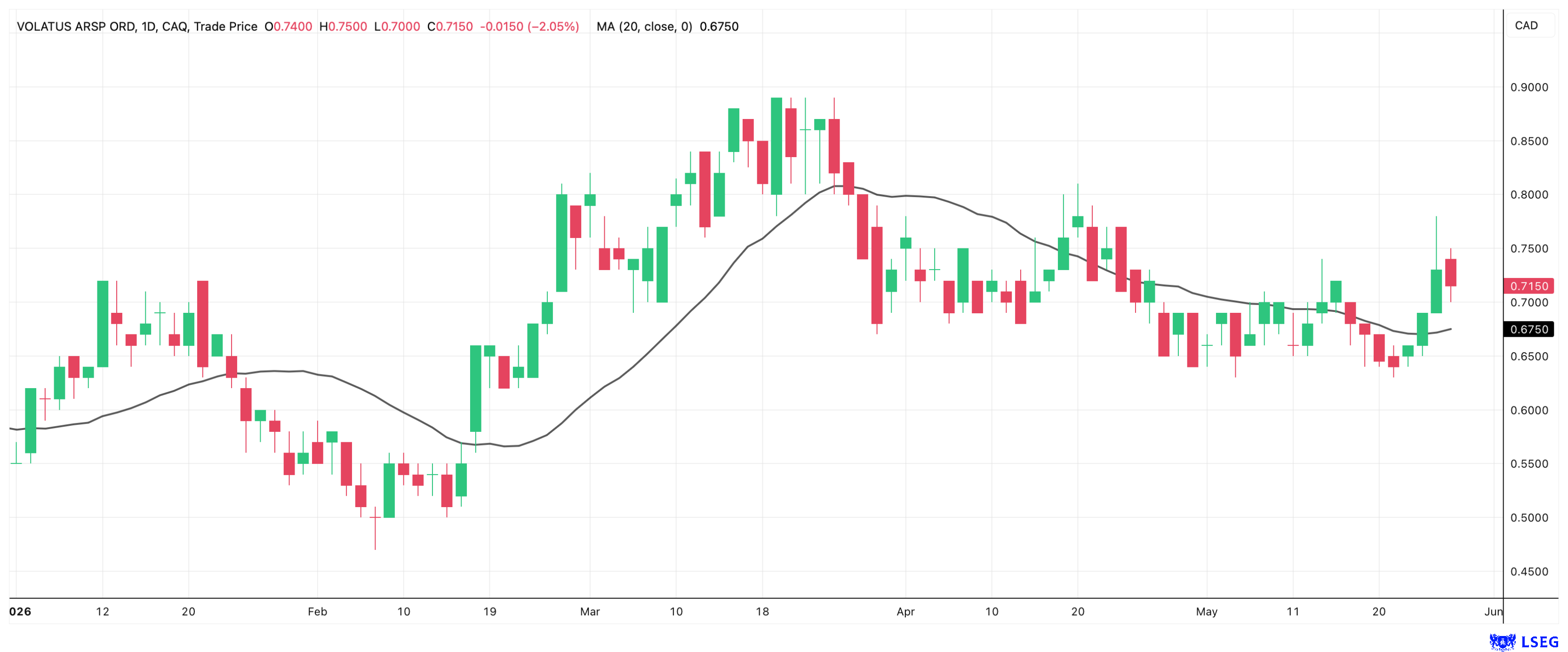
The company's balance sheet provides a stable foundation for its current growth phase. At the end of the first quarter of 2026, cash on hand stood at just under CAD 32 million. Additionally, short-term credit agreements were successfully converted into long-term liabilities, which alleviates immediate financial pressure. Revenue in the first quarter of 2026, at CAD 5.6 million, was seasonally weaker than in previous quarters. However, for the full fiscal year 2026, management and analysts expect revenue growth of around 45% to nearly CAD 50 million. Various investment firms currently see significant potential for the company's stock. The price targets set by analysts such as Stifel, Canaccord, and Desjardins for the coming twelve months range from CAD 0.95 to CAD 1.25. At the current share price of CAD 0.71, this corresponds to a theoretical upside potential of approximately 30% to 70%.
From a financial perspective, the software model differs significantly from the traditional hardware sale model. While the production and maintenance of hardware naturally incur higher costs for materials and personnel, software incurs virtually no additional costs for each additional user after development. This leads to significantly higher profit margins in the digital business. Once the market perceives Volatus not merely as a traditional drone manufacturer but increasingly as a provider of software platforms, this is typically reflected in a higher valuation.
OPPORTUNITIES AND RISKS
Despite the excellent growth prospects, the stock is not without risks. The company is still in the red: in the first quarter of 2026, the bottom line was a net loss of CAD 6.6 million. The path to profitability depends largely on whether defence contracts are implemented as planned and whether the new software platforms gain a lasting foothold in the market. Furthermore, competition in the drone defence software sector is intense. Here, the company competes for the same government budgets with both established US defence contractors and well-funded startups.
Volatus Aerospace is undergoing a profound transformation from a traditional industrial service provider toward a technology-driven company. While its operational fleet services and exposure to geopolitical defence programs provide solid tailwinds, the long-term profitability will be materially influenced by the success of its software platforms V-Cortex and SKYDRA. For investors, the stock offers the potential for a re-rating, although this remains closely tied to the execution of key business milestones and the path toward break-even.
IIF host Lyndsay Malchuk sits down with Volatus CEO Glen Lynch:
Conflict of interest
Pursuant to §85 of the German Securities Trading Act (WpHG), we point out that Apaton Finance GmbH as well as partners, authors or employees of Apaton Finance GmbH (hereinafter referred to as "Relevant Persons") may hold shares or other financial instruments of the aforementioned companies in the future or may bet on rising or falling prices and thus a conflict of interest may arise in the future. The Relevant Persons reserve the right to buy or sell shares or other financial instruments of the Company at any time (hereinafter each a "Transaction"). Transactions may, under certain circumstances, influence the respective price of the shares or other financial instruments of the Company.
In addition, Apaton Finance GmbH is active in the context of the preparation and publication of the reporting in paid contractual relationships.
For this reason, there is a concrete conflict of interest.
The above information on existing conflicts of interest applies to all types and forms of publication used by Apaton Finance GmbH for publications on companies.
Risk notice
Apaton Finance GmbH offers editors, agencies and companies the opportunity to publish commentaries, interviews, summaries, news and the like on news.financial. These contents are exclusively for the information of the readers and do not represent any call to action or recommendations, neither explicitly nor implicitly they are to be understood as an assurance of possible price developments. The contents do not replace individual expert investment advice and do not constitute an offer to sell the discussed share(s) or other financial instruments, nor an invitation to buy or sell such.
The content is expressly not a financial analysis, but a journalistic or advertising text. Readers or users who make investment decisions or carry out transactions on the basis of the information provided here do so entirely at their own risk. No contractual relationship is established between Apaton Finance GmbH and its readers or the users of its offers, as our information only refers to the company and not to the investment decision of the reader or user.
The acquisition of financial instruments involves high risks, which can lead to the total loss of the invested capital. The information published by Apaton Finance GmbH and its authors is based on careful research. Nevertheless, no liability is assumed for financial losses or a content-related guarantee for the topicality, correctness, appropriateness and completeness of the content provided here. Please also note our Terms of use.