May 28th, 2026 | 07:10 CEST
Volatus Aerospace: A Quiet Beneficiary of the Drone Boom with a USD 1.1 Billion Opportunity
The drone industry suffers from a structural problem. While there are many manufacturers, hardly any offer a complete package of hardware, operation, and maintenance from a single source. Volatus Aerospace has positioned itself precisely in this niche. From a commercial service provider for pipeline inspections and offshore logistics, it has grown into a provider increasingly relevant in the defence sector as well. With its own production facility in Mirabel, autonomous software, and recent successes in US and NATO programs, the company is demonstrating that the scaling phase has begun.
time to read: 5 minutes | Author: Armin Schulz
ISIN: VOLATUS AEROSPACE INC | CA92865M1023 | TSXV: FLT , OTCQB: TAKOF
Table of contents:
Author

Armin Schulz
Born in Mönchengladbach, he studied business administration in the Netherlands. In the course of his studies he came into contact with the stock exchange for the first time. He has more than 25 years of experience in stock market business.
Tag cloud
Shares cloud
The Company
Anyone browsing through the ranks of smaller aviation companies today will quickly come across drone manufacturers with impressive visualizations. Rarely does one find a company already operating at commercial scale. Even more rarely, one that simultaneously develops, manufactures, and deploys its own aircraft in real-world operations. That is exactly the gap Volatus Aerospace is filling.
The Canadian group is not a traditional hardware vendor. Management speaks of an integrated platform, and the numbers back that up. Around 28 manned aircraft and over 100 drones are in operation across Canada, the US, the UK, and South America. This amounts to approximately 1.7 million km of pipeline monitoring annually, plus tens of thousands of inspections of utility infrastructure. These commercial activities are not merely a cash cow; they provide real-world operational data and continuous field validation for the company's own systems. This is an advantage that many competitors cannot claim.
The Natural Step into Defence
Remarkably, Volatus Aerospace never started out as a traditional defence contractor. The defence division grew organically out of the civilian business. As demand for reconnaissance drones and training solutions rose, the company drew on existing operational structures. Today, the defence segment's share of revenue remains modest but is growing rapidly. Europe and the UK recently recorded a 150% year-over-year increase in revenue. NATO countries are increasing their defence spending, and drones have established themselves as a modern tool of war.
Canada itself is driving the transformation with a new defence industry strategy. Approximately 70% of procurement contracts are expected to go to domestic firms in the future; a total of roughly CAD 70 billion is budgeted over the next 10 years. Unmanned and autonomous systems have been officially classified as a core strategic capability. With its production facility in Mirabel, Quebec, Volatus is right at the center of this development.
Technological Foundation and Current Breakthroughs
Technologically, the so-called V-Cortex AI is at the center—an autonomy and control layer that integrates aircraft sensors, remote control, and mission execution. Crucially, from a strategic perspective, V-Cortex is not tied to proprietary hardware but can also be integrated with third-party technologies. The system is tiny, measuring about 3.5 by 3.5 cm and weighing less than 15 g, and is capable of, among other things, GPS-free navigation, on-board decision-making, and multi-domain operations. In May 2026, the platform was unveiled to the public at the CANSEC trade show, a clear signal that the development phase is complete.
The Big Break: The US Drone Dominance Program
At the same time, Volatus received news of such significance for investors that it can hardly be overstated. The company was selected for the next round of the US Drone Dominance Program (DDP). This program is no ordinary procurement process. Launched following a memorandum from Secretary of Defence Hegseth in July 2025 titled "Unleashing US Military Drone Dominance," it aims to establish a domestic supply chain capable of producing more than 200,000 low-cost drones by 2027. The total volume across four phases amounts to approximately USD 1.1 billion.
Instead of paper proposals, live flight competitions—so-called "Gauntlets"—are used to determine the winner, evaluated by military pilots under real-world conditions. The first round, Gauntlet I, took place in February 2026 at Fort Benning with 25 bidders and resulted in contracts worth approximately USD 150 million.
Now Phase II is underway: Gauntlet II. At least USD 300 million in prototype contracts will be awarded here. The goal is 30,000 drones at fixed prices, with USD 4,500 per unit allocated for long-range models, USD 3,500 for short-range variants, and USD 3,250 per kamikaze drone. After Gauntlet II, Phase 4, approximately 5 bidders per mission area will receive contracts. The top-ranked bidder can deliver up to 8,000 units, while the last bidder to advance can still deliver 4,000 units.
Volatus is applying for "Mission Area A – Long Range Strike." This entails reconnaissance and target engagement over 5–20 km, beyond-visual-line-of-sight (BVLOS) flights, and a payload of at least 2 kg. Additional requirements include all-weather, low-light, and electronic warfare capabilities—that is, operation under radio and GPS jamming.
The path to these contracts is clearly structured. A successful application (Phase 1) is followed by qualification (Phase 2). This is exactly what lies ahead for Volatus. From June 8 to 20, 2026, the so-called Qualifier will take place at Camp Grayling in Michigan. Approximately 10 bidders per mission area will then advance to the next round. Those who advance will receive a fixed-price contract for 120 drones (Phase 3), with on-time delivery mandatory. The final decision will be made in late August 2026 at Gauntlet II, where unscripted scenarios will be flown by trained soldiers. Flight performance, operator feedback, and production capability will be evaluated.
A crucial factor for Volatus is the tightening of supply chain regulations. Batteries and motors must come from allied countries that are not subject to sanctions. Volatus' footprint in Canada, the UK, and Norway meets these requirements. This is an advantage that many purely US-based manufacturers cannot offer.
Financial Foundation and Pipeline
Despite these ambitions, the company is on solid footing. The 2025 fiscal year generated CAD 34 million in revenue, representing 26% growth. The gross margin improved from 26% to 32%.
In Q1 2026, the company achieved the highest Q1 margin in its history at 35%, with revenue of CAD 5.6 million. It is important to note that revenue is typically weaker in the first quarter due to seasonal factors. The mix of hardware (46%) and services (54%) is well-balanced.
With CAD 31.7 million in cash, the cash position is healthy, and working capital stands at CAD 36.4 million. Management and insiders hold approximately 21% of the shares, and no insider has sold any shares since the company's founding six years ago. This creates a different form of accountability.
Medium-term prospects are dominated by an order pipeline that analysts estimate at over CAD 600 million. The Canadian government's CAD 70 million Borealis project for Arctic drones alone, as well as ongoing NATO training and ISR programs, underscore the potential.
The stock is currently trading at around CAD 0.73.
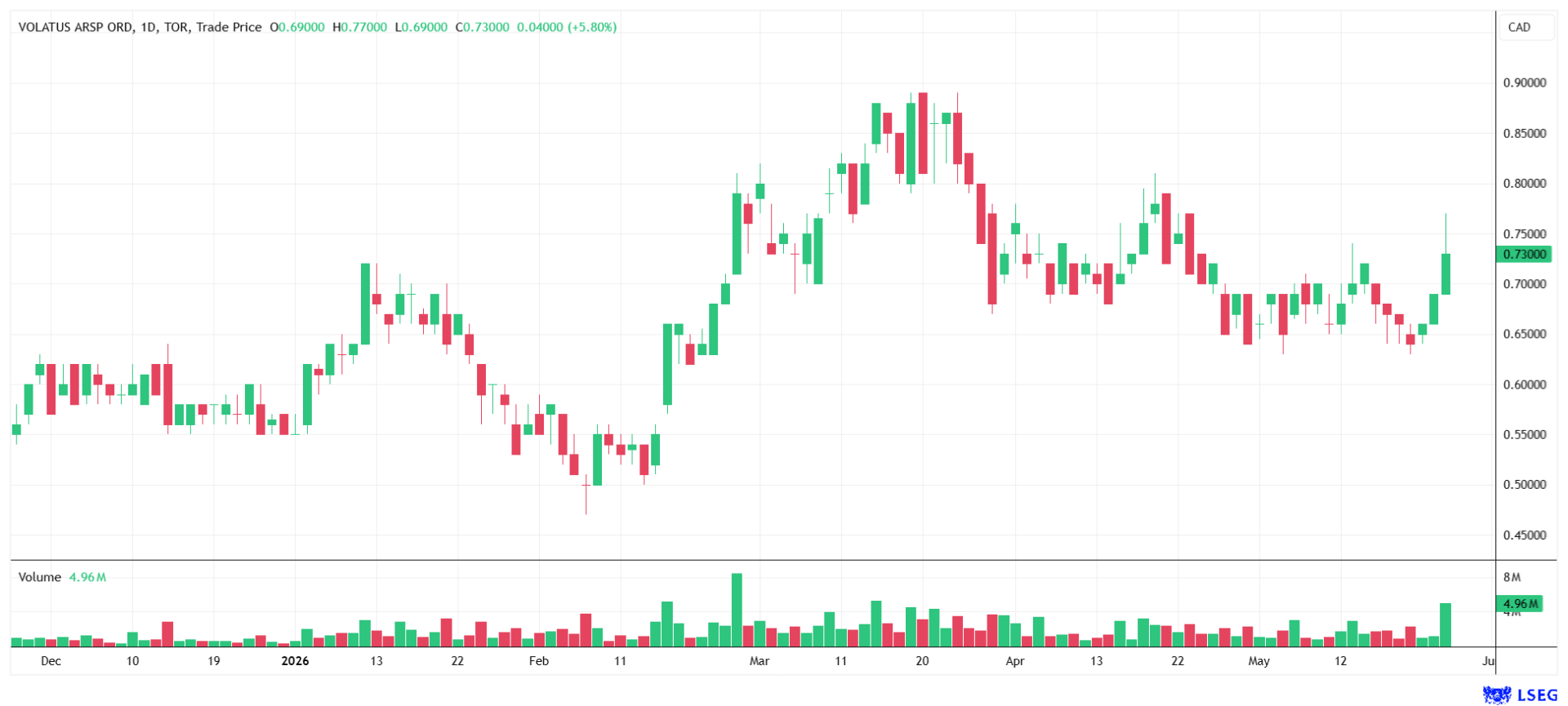
Volatus Aerospace is on the cusp of a new growth phase. The company has evolved from a pure service provider into an integrated supplier, gaining traction in both the civilian and military drone sectors. With the V-Cortex system and participation in the US Drone Dominance Program, including the upcoming qualifier at Camp Grayling, the stage is set for potentially multi-million-dollar framework contracts. Analysts see upside potential. Stifel and Canaccord Genuity each cite CAD 1.00, Ventum Capital Markets CAD 0.95, Desjardins CAD 1.10 to 1.25, and Maxim Group CAD 1.25. The coming weeks could be decisive.
Conflict of interest
Pursuant to §85 of the German Securities Trading Act (WpHG), we point out that Apaton Finance GmbH as well as partners, authors or employees of Apaton Finance GmbH (hereinafter referred to as "Relevant Persons") currently hold or hold shares or other financial instruments of the aforementioned companies and speculate on their price developments. In this respect, they intend to sell or acquire shares or other financial instruments of the companies (hereinafter each referred to as a "Transaction"). Transactions may thereby influence the respective price of the shares or other financial instruments of the Company.
In this respect, there is a concrete conflict of interest in the reporting on the companies.
In addition, Apaton Finance GmbH is active in the context of the preparation and publication of the reporting in paid contractual relationships.
For this reason, there is also a concrete conflict of interest.
The above information on existing conflicts of interest applies to all types and forms of publication used by Apaton Finance GmbH for publications on companies.
Risk notice
Apaton Finance GmbH offers editors, agencies and companies the opportunity to publish commentaries, interviews, summaries, news and the like on news.financial. These contents are exclusively for the information of the readers and do not represent any call to action or recommendations, neither explicitly nor implicitly they are to be understood as an assurance of possible price developments. The contents do not replace individual expert investment advice and do not constitute an offer to sell the discussed share(s) or other financial instruments, nor an invitation to buy or sell such.
The content is expressly not a financial analysis, but a journalistic or advertising text. Readers or users who make investment decisions or carry out transactions on the basis of the information provided here do so entirely at their own risk. No contractual relationship is established between Apaton Finance GmbH and its readers or the users of its offers, as our information only refers to the company and not to the investment decision of the reader or user.
The acquisition of financial instruments involves high risks, which can lead to the total loss of the invested capital. The information published by Apaton Finance GmbH and its authors is based on careful research. Nevertheless, no liability is assumed for financial losses or a content-related guarantee for the topicality, correctness, appropriateness and completeness of the content provided here. Please also note our Terms of use.