June 22nd, 2026 | 06:35 CEST
Verbio, E.ON, and A.H.T. Syngas: Market Leaders and Challengers
The recent energy price shock and regulatory requirements are accelerating the transition to low-carbon alternatives to fossil fuels. As a result, the energy industry is transforming. To achieve the industry's ambitious decarbonization goals, energy providers are increasingly focusing on modular systems for utilizing biogenic residues. Major market leaders are increasingly securing technological scalability through acquisitions, as building green business models organically is a lengthy and risky process. Multi-billion-dollar acquisitions in the biomass and biogas sectors are driving a wave of consolidation. Decentralized solutions for generating baseload electricity and hydrogen have long been a key pillar of the energy transition. We highlight three companies.
time to read: 3 minutes | Author: Nico Popp
ISIN: A.H.T. SYNGAS TECH. EO 1 | NL0010872388 , VERBIO VER.BIOENERGIE ON | DE000A0JL9W6 , E.ON SE NA O.N. | DE000ENAG999
Table of contents:
Author

Nico Popp
At home in Southern Germany, the passionate stock exchange expert has been accompanying the capital markets for about twenty years. With a soft spot for smaller companies, he is constantly on the lookout for exciting investment stories.
Tag cloud
Shares cloud
Verbio: Tax Credits Drive Growth in North America
Verbio, an integrated bioenergy producer, uses regional agricultural raw materials and residues to produce biodiesel, bioethanol, and biomethane. The circular economy model ferments the resulting distillers' grains into biomethane, while the organic residues are returned to agriculture as biofertilizer. In addition, monetizing emissions savings supplements revenue from the core business. To benefit from the extensive US tax credits under the Inflation Reduction Act, Verbio is systematically expanding its production capacity in the North American market.
The company is retrofitting the South Bend biorefinery in Indiana at a cost of approximately USD 230 million to produce up to 250,000 metric tons of bioethanol and approximately 850,000 MWh of biomethane annually, following the commissioning originally scheduled for 2026. According to the latest annual report, Verbio is continuing its investments in South Bend in stages. In the first nine months of fiscal year 2025/26, Verbio increased biomethane production by 20.2% to 1,040 GWh, driven by the ramp-up of the Nevada plant. In the most recent fiscal year 2024/25, the group posted a net loss of EUR 138 million on revenue of EUR 1.58 billion. Looking ahead, however, the figures are expected to improve again. As a signal to the market, several members of the Executive Board received bonuses in the form of shares rather than cash payments in May.
E.ON: Government-Guaranteed Return on Equity Ensures Stable Grid Revenues
As one of Europe's largest energy infrastructure operators, E.ON focuses on the regulated grid business as well as decentralized customer and decarbonization solutions. In the grid segment, the Group's revenue model is based on government-guaranteed returns on equity and regulated grid usage fees, which are largely independent of economic fluctuations. In fiscal year 2025, the Group invested a record EUR 8.5 billion primarily in new connections and grid capacity to further expand renewable energy. The trend is already well established. Around 70% of Germany's onshore wind power capacity and nearly 50% of its photovoltaic capacity now flows through the E.ON grid.
A.H.T. Syngas: Strategic Shift to the Contracting Model
The cleantech company A.H.T. Syngas Technology builds, plans, and manages decentralized energy plants worldwide. The technological foundation is the patented dual-combustion process, which converts biogenic waste, wood residues, or sewage sludge into high-quality, virtually tar-free synthesis gas. To mitigate the high volatility of the pure project business, the management team led by CEO Gero Bernhard Ferges is transitioning to a long-term contracting model as an independent power producer.
Going forward, the company will operate plants itself and generate recurring revenue from the sale of electricity, heat, and gas, which is expected to raise gross margins from a historical average of around 10% in plant construction to a projected 18% in contracting. In May of this year, A.H.T. strengthened its position in the Polish market with the entry of its partner INNOTEC Energy as a strategic shareholder. Together with INNOTEC, A.H.T. is working on a pipeline of 17 projects in Poland, from which management estimates a realizable total volume at the corporate level of over EUR 30 million. According to management, the Polish business alone could generate a short-term realizable order volume of at least EUR 10 million in fiscal year 2026.
Convertible Bond and Restructuring of the Japan Business
To secure liquidity for the construction of the Polish projects, the Executive Board announced in early January 2026 the full placement of a convertible bond with a total nominal value of up to EUR 2 million, excluding statutory subscription rights. This three-year convertible bond bears interest at 5% p.a. and guarantees creditors a conversion price of EUR 1.25 per share. The capital injection also helped offset operational delays in Japan.
Conclusion: Undervaluation Points to High Comeback Potential
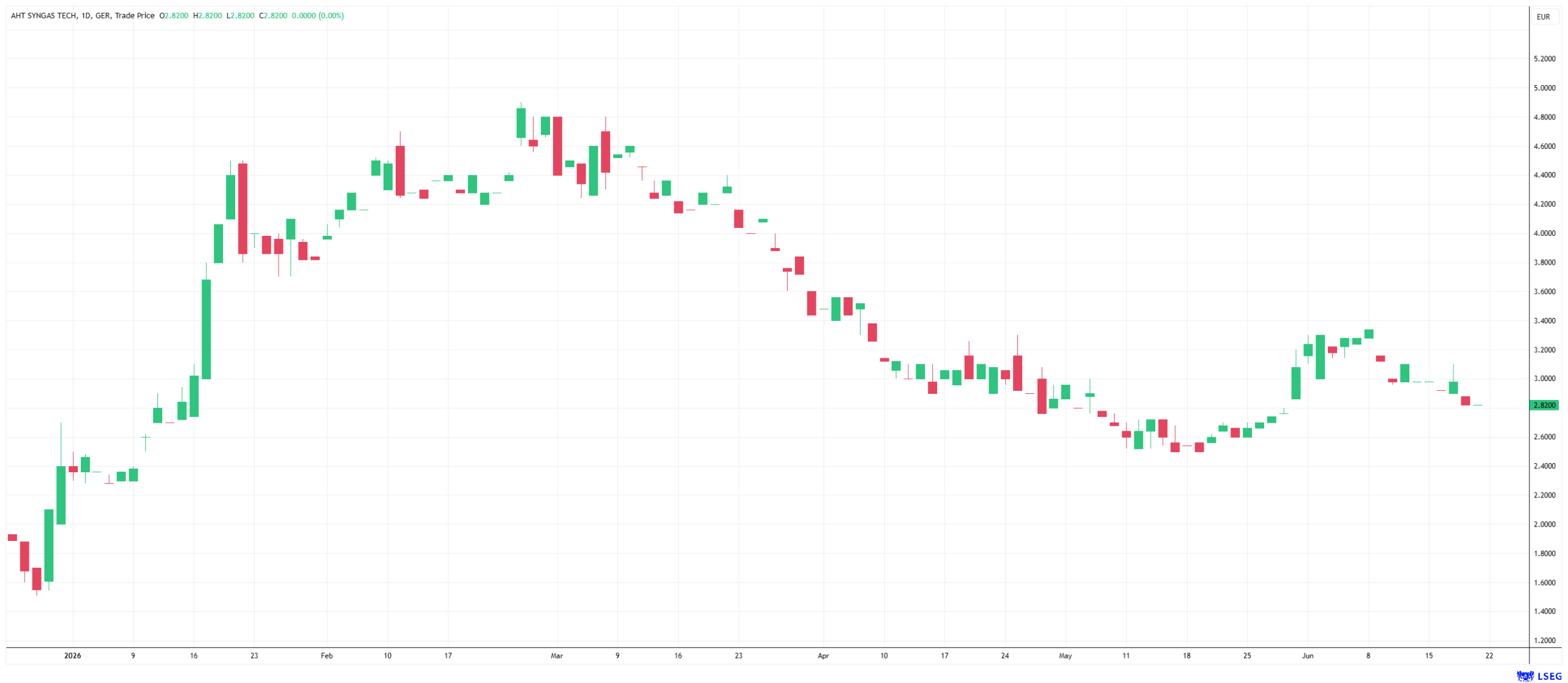
Billion-dollar acquisitions by major corporations—such as Shell's purchase of the Danish company Nature Energy for just under USD 2 billion or BP's acquisition of Archaea Energy for USD 4.1 billion—demonstrate the industry's strong willingness to make acquisitions in the biomass sector. While E.ON stands out as a defensive core investment with a stable dividend and Verbio aims to expand its margins, A.H.T. Syngas offers the most dynamic turnaround profile. Last December, the research firm GBC AG rated the stock as a clear "Buy" with a fair price target of EUR 8.50. With a share price around EUR 3 and a single-digit market capitalization, the valuation does not even begin to reflect the company's recent operational successes. Although investors must take into account the risk of dilution in the event of a full conversion of the bond, the transition to contracting and the successes in Poland show that A.H.T. is on the right track.
Watch YouTube videoConflict of interest
Pursuant to §85 of the German Securities Trading Act (WpHG), we point out that Apaton Finance GmbH as well as partners, authors or employees of Apaton Finance GmbH (hereinafter referred to as "Relevant Persons") may hold shares or other financial instruments of the aforementioned companies in the future or may bet on rising or falling prices and thus a conflict of interest may arise in the future. The Relevant Persons reserve the right to buy or sell shares or other financial instruments of the Company at any time (hereinafter each a "Transaction"). Transactions may, under certain circumstances, influence the respective price of the shares or other financial instruments of the Company.
In addition, Apaton Finance GmbH is active in the context of the preparation and publication of the reporting in paid contractual relationships.
For this reason, there is a concrete conflict of interest.
The above information on existing conflicts of interest applies to all types and forms of publication used by Apaton Finance GmbH for publications on companies.
Risk notice
Apaton Finance GmbH offers editors, agencies and companies the opportunity to publish commentaries, interviews, summaries, news and the like on news.financial. These contents are exclusively for the information of the readers and do not represent any call to action or recommendations, neither explicitly nor implicitly they are to be understood as an assurance of possible price developments. The contents do not replace individual expert investment advice and do not constitute an offer to sell the discussed share(s) or other financial instruments, nor an invitation to buy or sell such.
The content is expressly not a financial analysis, but a journalistic or advertising text. Readers or users who make investment decisions or carry out transactions on the basis of the information provided here do so entirely at their own risk. No contractual relationship is established between Apaton Finance GmbH and its readers or the users of its offers, as our information only refers to the company and not to the investment decision of the reader or user.
The acquisition of financial instruments involves high risks, which can lead to the total loss of the invested capital. The information published by Apaton Finance GmbH and its authors is based on careful research. Nevertheless, no liability is assumed for financial losses or a content-related guarantee for the topicality, correctness, appropriateness and completeness of the content provided here. Please also note our Terms of use.