January 26th, 2026 | 07:00 CET
The strategic move – How American Atomics is securing fuel for the AI age
Artificial intelligence is changing our world, but its enormous appetite for energy threatens to push power grids to their limits. Tech giants are faced with the fundamental question of how to reliably supply data centers with clean electricity. Data centers will soon consume double-digit percentages of total electricity. The answer leads directly to a renaissance of nuclear energy. But this restart has a sore spot: the fragile global fuel chain. American Atomics is positioning itself in this gap between exploding demand and scarce supply with a clever two-pronged approach.
time to read: 4 minutes | Author: Armin Schulz
ISIN: AMERICAN ATOMICS INC | CA0240301089
Table of contents:
Author

Armin Schulz
Born in Mönchengladbach, he studied business administration in the Netherlands. In the course of his studies he came into contact with the stock exchange for the first time. He has more than 25 years of experience in stock market business.
Tag cloud
Shares cloud
The new base load: Why AI is reshaping the energy market
The electricity demand of data centers is not a temporary peak, but is developing into a permanent base load. Studies predict that it will account for up to 12% of national consumption in the US by 2030. For cloud and AI companies, whose billion-dollar investments depend on absolute power consistency, volatile renewable energy alone is not an option. Long-term power purchase agreements for low-carbon, base-load-capable energy are becoming a strategic necessity.
This is inexorably bringing nuclear power back into focus. There are over a hundred projects for advanced reactors worldwide, including many small modular reactors (SMRs), in the approval and construction phases. This development is generating unprecedented planning security for the entire upstream supply chain. Demand for uranium and for conversion and enrichment services will remain high for decades to come. Particularly critical is the supply of HALEU, a higher-enriched fuel that is essential for many modern reactor designs. A dramatic deficit is emerging here that could slow down the West's ambitious expansion plans.
Bottlenecks as an opportunity: The valuable middle of the fuel chain
While uranium mining attracts attention, the actual value creation potential is often overlooked in the subsequent processing steps. Conversion and enrichment are the critical points in the global supply chain. These processes account for up to 60% of fuel costs. This market has an annual volume of around USD 14 billion.
The US and many Western nations have allowed this middle chain to languish for years. Today, they are highly dependent on imports, some of which come from geopolitically sensitive regions, primarily China. This structural weakness is now compounded by a projected supply gap. Global uranium demand is expected to increase by almost 30% by 2030. Without significant investment in new capacity, there will be an estimated gap of 30-50 million pounds of uranium per year from the end of this decade. For companies that build new domestic capacity in time, there is a clear opportunity for exceptional margins, backed by political will.
American Atomics: A two-pronged approach for maximum leverage
This is precisely the area in which American Atomics operates. Instead of focusing on a single project, the Company pursues a calculated, asymmetric strategy along the entire value chain. The model is based on two complementary value drivers. On the one hand, exploration in historically productive districts and, on the other hand, the development of scalable fuel technologies.
On the raw materials side, the focus is on areas with proven geology and existing infrastructure to accelerate the path from discovery to production. One focus is on the Lisbon Valley District in Utah, a legendary uranium region. The strategy there is as simple as it is promising. While the western flank of the valley has historically produced over 78 million pounds of uranium, the geologically mirror-image eastern flank has hardly been explored. Old drill hole data already show anomalous radiation values in the expected target horizons. American Atomics has secured a large claim position in this very area and is preparing targeted drilling to confirm the potential. The proximity to existing infrastructure could significantly shorten development times.
At the same time, the Company is establishing a second foothold in the technology sector. Management is licensing promising laboratory technologies (TRL-3) in the field of conversion and enrichment and intends to gradually develop them to pilot maturity (TRL-7). It is often at this stage of the learning curve that the greatest leap in value occurs, without the need to tie up billions in large-scale facilities. The Company is specifically looking for modular, scalable solutions that can be integrated into decentralized structures. Through partnerships such as a joint venture with uranium milling specialist CVMR or cooperation with DISA Technologies in the field of contaminated site remediation, American Atomics avoids having to build up expertise in all areas and thus remains capital-efficient.
Political tailwind: A seat at the decisive table
This business approach is receiving massive support from Washington. The US government has recognized the strategic vulnerability and is pushing billion-dollar programs to build a domestic fuel chain. A key instrument is the Fuel Cycle Consortium under the Defense Production Act (DPA). American Atomics is an official participant in this body, which coordinates players from the mine to the end user.
This membership is more than just a seal of approval. It offers direct access to planning processes, facilitates exchanges with potential partners and government procurement agencies, and increases the likelihood that private investments will run in sync with public funding schedules. The Company actively uses this platform to align its exploration and technology roadmap with political and market requirements. In a highly regulated sector, this early anchoring in the political ecosystem is a significant competitive advantage.
The stock is currently trading at CAD 0.28.
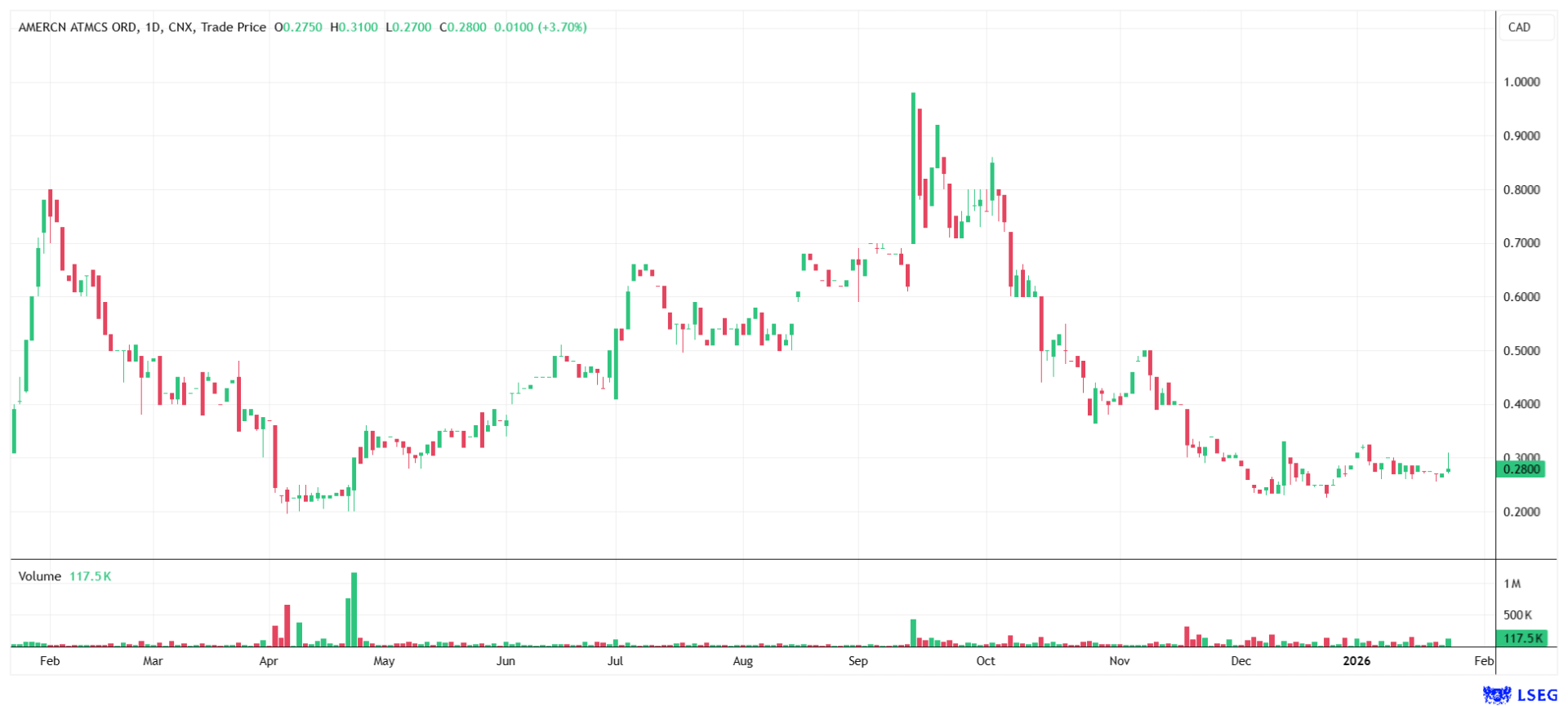
The investment thesis behind American Atomics is convincingly clear. The triumph of AI and the return of nuclear power are not hype, but structural megatrends that will continue in the coming years. Their common denominator is the secure supply of fuel, which is the biggest bottleneck in the entire system. Investors who bet on this trend do not have to choose between commodity plays and technology bets. American Atomics combines both in a highly leveraged but diversified model. With its focus on the profitable bottlenecks in the supply chain, its political network, and its partnership-based approach, the Company is well-positioned to take maximum advantage of the window of opportunity opening up between 2027 and 2035. It is a targeted bet on the physical foundations of our digital future.
Conflict of interest
Pursuant to §85 of the German Securities Trading Act (WpHG), we point out that Apaton Finance GmbH as well as partners, authors or employees of Apaton Finance GmbH (hereinafter referred to as "Relevant Persons") currently hold or hold shares or other financial instruments of the aforementioned companies and speculate on their price developments. In this respect, they intend to sell or acquire shares or other financial instruments of the companies (hereinafter each referred to as a "Transaction"). Transactions may thereby influence the respective price of the shares or other financial instruments of the Company.
In this respect, there is a concrete conflict of interest in the reporting on the companies.
In addition, Apaton Finance GmbH is active in the context of the preparation and publication of the reporting in paid contractual relationships.
For this reason, there is also a concrete conflict of interest.
The above information on existing conflicts of interest applies to all types and forms of publication used by Apaton Finance GmbH for publications on companies.
Risk notice
Apaton Finance GmbH offers editors, agencies and companies the opportunity to publish commentaries, interviews, summaries, news and the like on news.financial. These contents are exclusively for the information of the readers and do not represent any call to action or recommendations, neither explicitly nor implicitly they are to be understood as an assurance of possible price developments. The contents do not replace individual expert investment advice and do not constitute an offer to sell the discussed share(s) or other financial instruments, nor an invitation to buy or sell such.
The content is expressly not a financial analysis, but a journalistic or advertising text. Readers or users who make investment decisions or carry out transactions on the basis of the information provided here do so entirely at their own risk. No contractual relationship is established between Apaton Finance GmbH and its readers or the users of its offers, as our information only refers to the company and not to the investment decision of the reader or user.
The acquisition of financial instruments involves high risks, which can lead to the total loss of the invested capital. The information published by Apaton Finance GmbH and its authors is based on careful research. Nevertheless, no liability is assumed for financial losses or a content-related guarantee for the topicality, correctness, appropriateness and completeness of the content provided here. Please also note our Terms of use.