February 17th, 2026 | 07:10 CET
The Dividend Trap: Why RE Royalties Offers Greater Structural Stability Than Petrobras and Maersk
In times of geopolitical uncertainty and volatile markets, investors seek dependable cash flow. Dividend stocks are often perceived as a safe haven in stormy weather, but appearances can often be deceiving. Investors who focus solely on headline dividend yields frequently ignore the structural risks embedded in the underlying business model. An oil major exposed to political interference or a shipping conglomerate whose earnings fluctuate with freight rate cycles may struggle to sustain dividend commitments over the long term. In this environment, it is worth taking a closer look at the substance. While giants such as Petrobras and AP Moller-Maersk are struggling with cyclical challenges, Canadian niche player RE Royalties has developed a model positioned to benefit from one of the biggest investment waves of our time - while elegantly sidestepping many of the typical industry risks.
time to read: 3 minutes | Author: Nico Popp
ISIN: RE ROYALTIES LTD | CA75527Q1081 , PETROLEO BRASILEIRO ADR/2 | US71654V4086 , AP MOELLER-MAERSK A/S A | DK0010244425
Table of contents:
Author

Nico Popp
At home in Southern Germany, the passionate stock exchange expert has been accompanying the capital markets for about twenty years. With a soft spot for smaller companies, he is constantly on the lookout for exciting investment stories.
Tag cloud
Shares cloud
Petrobras and Maersk: Cyclical stocks with question marks
The Brazilian energy company Petrobras is the first port of call for many dividend hunters. The company attracts investors with massive payouts, but as industry analyses show, political risk is omnipresent in Brazil. The government often sees the company as an instrument of social policy, which can be at the expense of free cash flows for shareholders. Specifically, this is how it works: state-affiliated companies in the energy sector in Brazil often have to help keep prices low in order to curb inflation. This is a risk for shareholders. In addition, Petrobras must invest billions in decarbonization in order to maintain its social acceptance, which may also weigh on future margins.
The situation at AP Moller-Maersk is similarly volatile. The Danish shipping company posted record profits during the pandemic years, but those days are over. The business is extremely cyclical and depends on global freight rates, which are under pressure from overcapacity and trade conflicts. Maersk now has to invest huge sums in a green fleet to meet regulatory requirements. For investors, this means that today's dividends are no guarantee of tomorrow's distributions. As a result, the shipping stock is no longer a reliable dividend tanker for investors.
RE Royalties: The silent beneficiary of the energy transition
The situation is quite different at RE Royalties. The Canadian company has transferred a financing model from the raw materials sector to renewable energy. Instead of operating wind or solar parks itself and having to deal with maintenance or weather risks, RE Royalties finances project developers and, in return, receives a share of sales in the form of a royalty.
The model impresses with its simplicity and robustness. A key advantage is the share in what are known as "top-line revenues." RE Royalties receives a share of gross revenue before the operator deducts its operating costs. This effectively protects revenues from inflation or rising operating costs for the plant operator. Another plus point for shareholders is the partial elimination of the dilution risk. Unlike many other growth stocks, investors here have less to worry about their shares, as growth is largely financed organically from the cash flow of the projects. However, capital increases for even stronger growth cannot be ruled out.
In addition, the company eliminates cluster risks through broad diversification of its portfolio, which now comprises over 100 projects in various jurisdictions such as North America, Asia, and Europe, as well as different technologies ranging from wind and solar to storage.
The macro tailwind: Data speaks for RE Royalties
Structural demand trends support the long-term relevance of this model. According to the International Energy Agency (IEA), renewable energy will replace coal as the most important source of electricity by 2026. The hunger for green electricity is insatiable, driven primarily by AI and data centers. McKinsey predicts that the electricity demand of data centers will grow by 17% annually through 2030.
Every new wind turbine and every new solar park needs capital. Banks are often too slow or too bureaucratic for medium-sized developers. RE Royalties fills this gap. The company enables the construction of infrastructure that the global economy urgently needs, securing a very long-term revenue stream in return. A recent company announcement highlights that this model allows RE Royalties to offer a more stable and predictable return than traditional utilities or project developers. While Petrobras and Maersk have to fight for their margins every day, royalties flow as long as the sun shines and the wind blows.
Conclusion: Quality over quantity
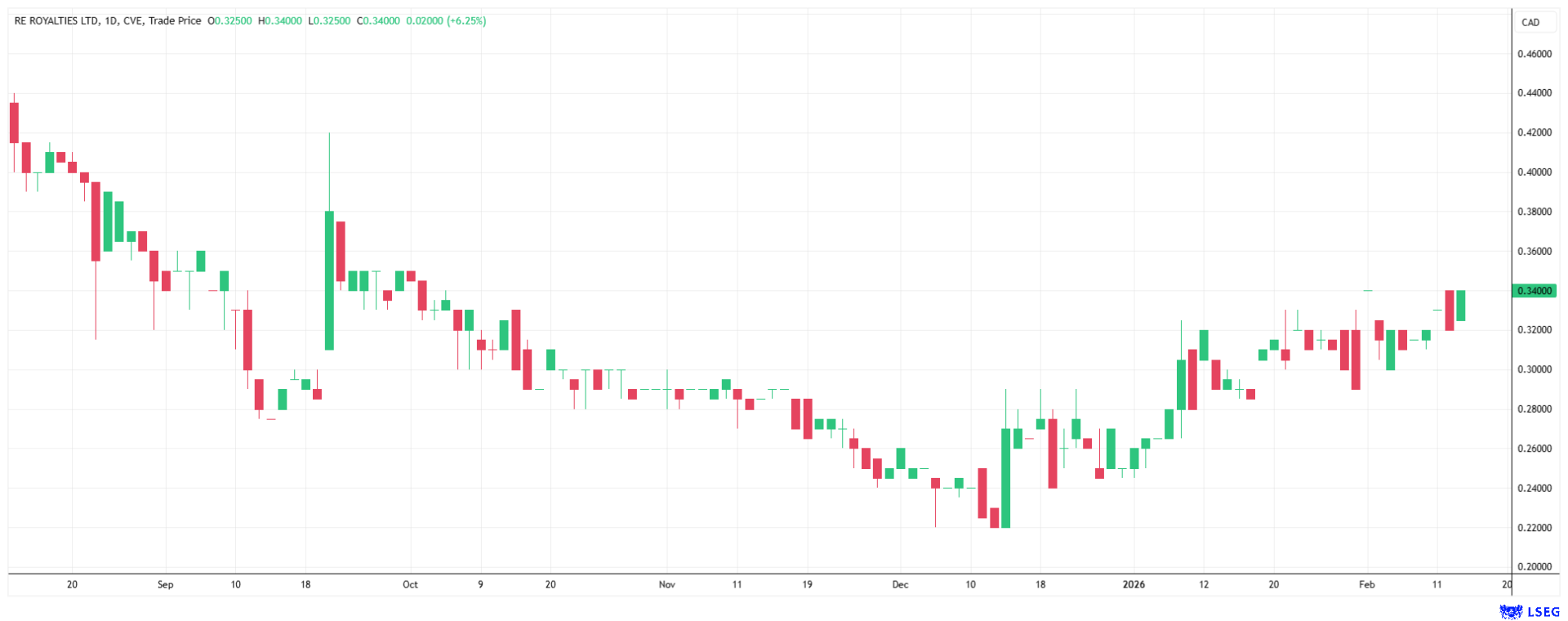
For dividend investors, the message is clear: high percentages on paper are worthless if the business model behind them is eroding. Petrobras and Maersk remain important core investments for cyclical investors, but those looking for predictable returns with structural growth will find RE Royalties to be the more attractive alternative. The company is not a spectacular tech stock, but a solid financier of the green real economy. In a world that is becoming electrified, this is perhaps one of the smartest bets you can make. RE Royalties proves that you do not have to choose between a clear conscience and solid returns – you just have to choose the right instrument. RE Royalties' share price has been stabilizing for several trading days and, even at its current level, still offers an extremely attractive dividend yield of around 10%. Added to this are the good prospects for price gains.
Watch YouTube videoConflict of interest
Pursuant to §85 of the German Securities Trading Act (WpHG), we point out that Apaton Finance GmbH as well as partners, authors or employees of Apaton Finance GmbH (hereinafter referred to as "Relevant Persons") may hold shares or other financial instruments of the aforementioned companies in the future or may bet on rising or falling prices and thus a conflict of interest may arise in the future. The Relevant Persons reserve the right to buy or sell shares or other financial instruments of the Company at any time (hereinafter each a "Transaction"). Transactions may, under certain circumstances, influence the respective price of the shares or other financial instruments of the Company.
In addition, Apaton Finance GmbH is active in the context of the preparation and publication of the reporting in paid contractual relationships.
For this reason, there is a concrete conflict of interest.
The above information on existing conflicts of interest applies to all types and forms of publication used by Apaton Finance GmbH for publications on companies.
Risk notice
Apaton Finance GmbH offers editors, agencies and companies the opportunity to publish commentaries, interviews, summaries, news and the like on news.financial. These contents are exclusively for the information of the readers and do not represent any call to action or recommendations, neither explicitly nor implicitly they are to be understood as an assurance of possible price developments. The contents do not replace individual expert investment advice and do not constitute an offer to sell the discussed share(s) or other financial instruments, nor an invitation to buy or sell such.
The content is expressly not a financial analysis, but a journalistic or advertising text. Readers or users who make investment decisions or carry out transactions on the basis of the information provided here do so entirely at their own risk. No contractual relationship is established between Apaton Finance GmbH and its readers or the users of its offers, as our information only refers to the company and not to the investment decision of the reader or user.
The acquisition of financial instruments involves high risks, which can lead to the total loss of the invested capital. The information published by Apaton Finance GmbH and its authors is based on careful research. Nevertheless, no liability is assumed for financial losses or a content-related guarantee for the topicality, correctness, appropriateness and completeness of the content provided here. Please also note our Terms of use.