February 25th, 2026 | 07:05 CET
The 'Apple moment' of strategic metals! How Almonty Industries is securing Western sovereignty and emulating Glencore and Rio Tinto
The mining industry is going through a phase that could be described as the 'Apple moment' of strategic metals. Similar to how Apple ushered in a new technological era two decades ago by combining proprietary hardware and closed software architecture, Almonty Industries now occupies a key position for NATO's industrial and military sovereignty. While the public focus has long been on digitalization, critical raw materials are now moving to the center of the geopolitical power architecture. In this context, tungsten has become as indispensable to the modern defense and semiconductor industries as the operating system is to smartphones.
time to read: 3 minutes | Author: Nico Popp
ISIN: ALMONTY INDUSTRIES INC. | CA0203987072 , GLENCORE PLC DL -_01 | JE00B4T3BW64 , RIO TINTO LTD | AU000000RIO1 , RIO TINTO PLC LS-_10 | GB0007188757
Table of contents:
Author

Nico Popp
At home in Southern Germany, the passionate stock exchange expert has been accompanying the capital markets for about twenty years. With a soft spot for smaller companies, he is constantly on the lookout for exciting investment stories.
Tag cloud
Shares cloud
Glencore and Rio Tinto also started small
The development of today's established global corporations, such as Rio Tinto and Glencore, illustrates the potential that can arise from control over critical resources. Glencore started as an agile trading company before transforming itself into a producer through acquisitions. Rio Tinto was founded in 1873 by a consortium led by Hugh Matheson, which acquired a single, dilapidated mine in the Spanish province of Huelva for GBP 3.68 million and continued to develop it by investing in infrastructure. Ultimately, the company became a global player in industry. Almonty is now at a similar point to where these mining titans once started, using its unique technological expertise to revitalize historic deposits.
Almonty and the strategic importance of the Sangdong mine
With the recommissioning of the Sangdong Mine in South Korea, Almonty controls a world-class asset that is reshaping global supply chains for strategic metals. The quality of the deposit enables cost leadership due to its high ore grade, enabling the company to compete directly with Asian producers. According to forecasts, the project has the potential to meet up to 40% of total tungsten demand outside China. With this enormous production capacity in a secure, democratic jurisdiction, Almonty is drastically reducing Western industry's dependence on Asian exports. Added to this are production costs that are around half those of its Chinese competitors.
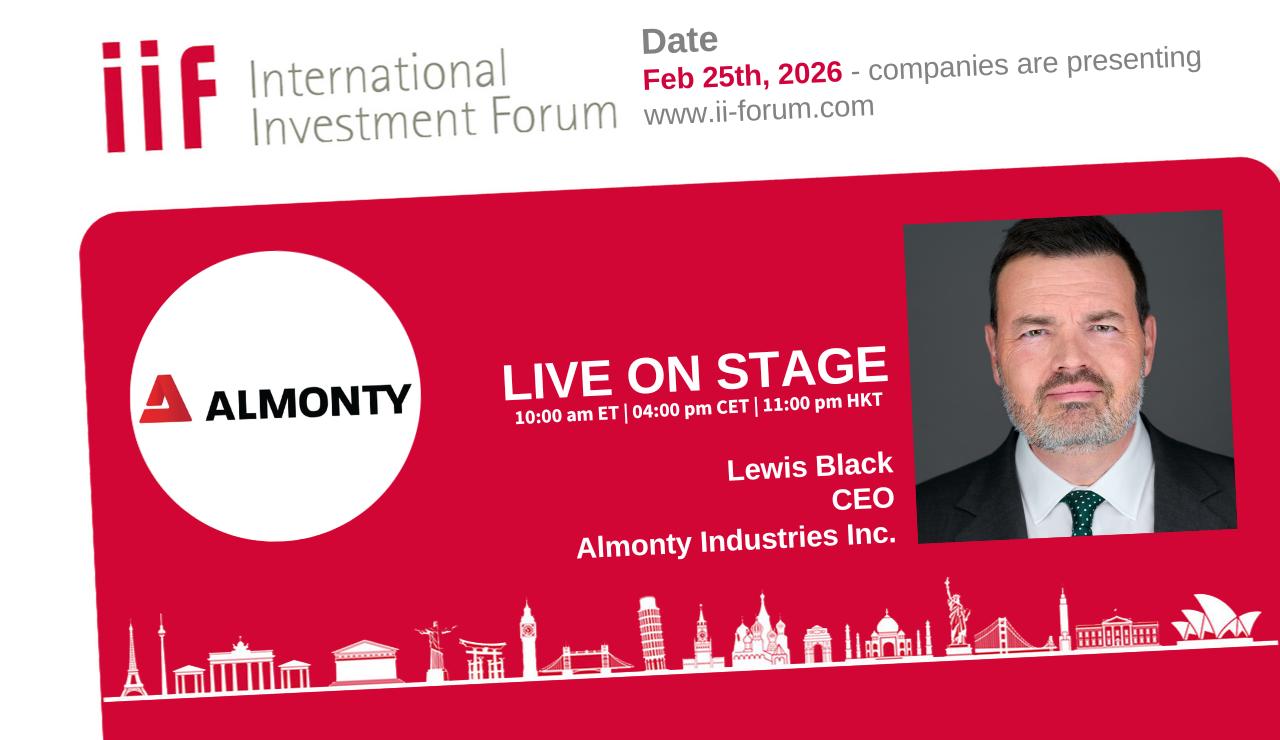
The geopolitical environment for tungsten is characterized by a fundamental shortage of supply. China, which historically controlled over 82% of global production, has restricted the export of dual-use goods, leading to a price explosion and "panic buying" in the industry in 2025. The United States has responded to this development by classifying tungsten as a defense-critical material. A US-wide ban on Chinese tungsten from 2027 onwards is forcing companies such as Rheinmetall and Sandvik to immediately switch their procurement strategies to reliable Western partners.
Tungsten as an indispensable technological bottleneck
Tungsten has unique physical properties, including a melting point of 3,422 °C and a density that is almost identical to that of gold. These characteristics make the metal virtually irreplaceable in critical industrial and military applications. In the semiconductor industry, tungsten is essential for the manufacture of contacts and connections in microchips. The accelerated development of artificial intelligence infrastructure is driving demand for high-purity tungsten products, which, according to analysts at Research Nester, is supporting market growth.
At the same time, the energy transition is driving demand in new segments such as lithium-tungsten batteries, which promise a significant increase in cycle stability in the field of electromobility. According to Research and Markets, the global market size for tungsten is expected to grow from USD 6.12 billion in 2025 to USD 9.62 billion by 2030. Almonty is the only player to commission significant new capacity in stable jurisdictions such as South Korea and the US during this time frame. In a time of structural raw material scarcity, the company is thus no longer acting as a pure mining company, but as a strategic insurance policy for the Western world.
Operational excellence and good intuition create a unique market position
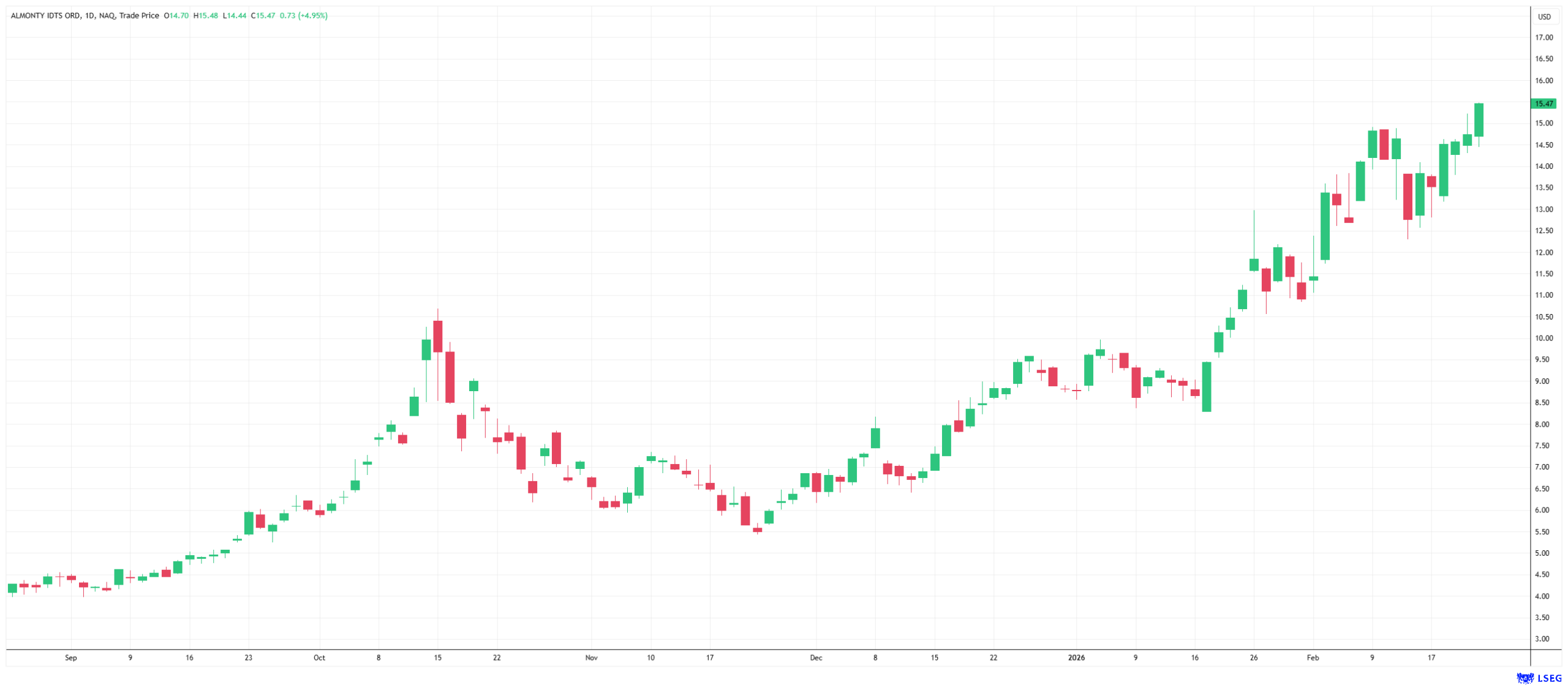
The financial dimension of controlling metals of the future is evident in Rio Tinto's current figures. The group reported adjusted EBITDA of USD 25.4 billion for 2025, driven primarily by record copper and bauxite production and operational efficiency programs. The parallels between Almonty and the early development phase of companies such as Glencore and Rio Tinto are evident in the strategic foresight of the management. CEO Lewis Black positions the company at the intersection of a high-quality deposit and the immense tailwind provided by the current global situation. With the reactivation of the Sangdong mine and the Gentung Browns project in Montana, Almonty is in the right place at the right time – a position that is increasingly reflected in Almonty's share price chart.
Conflict of interest
Pursuant to §85 of the German Securities Trading Act (WpHG), we point out that Apaton Finance GmbH as well as partners, authors or employees of Apaton Finance GmbH (hereinafter referred to as "Relevant Persons") currently hold or hold shares or other financial instruments of the aforementioned companies and speculate on their price developments. In this respect, they intend to sell or acquire shares or other financial instruments of the companies (hereinafter each referred to as a "Transaction"). Transactions may thereby influence the respective price of the shares or other financial instruments of the Company.
In this respect, there is a concrete conflict of interest in the reporting on the companies.
In addition, Apaton Finance GmbH is active in the context of the preparation and publication of the reporting in paid contractual relationships.
For this reason, there is also a concrete conflict of interest.
The above information on existing conflicts of interest applies to all types and forms of publication used by Apaton Finance GmbH for publications on companies.
Risk notice
Apaton Finance GmbH offers editors, agencies and companies the opportunity to publish commentaries, interviews, summaries, news and the like on news.financial. These contents are exclusively for the information of the readers and do not represent any call to action or recommendations, neither explicitly nor implicitly they are to be understood as an assurance of possible price developments. The contents do not replace individual expert investment advice and do not constitute an offer to sell the discussed share(s) or other financial instruments, nor an invitation to buy or sell such.
The content is expressly not a financial analysis, but a journalistic or advertising text. Readers or users who make investment decisions or carry out transactions on the basis of the information provided here do so entirely at their own risk. No contractual relationship is established between Apaton Finance GmbH and its readers or the users of its offers, as our information only refers to the company and not to the investment decision of the reader or user.
The acquisition of financial instruments involves high risks, which can lead to the total loss of the invested capital. The information published by Apaton Finance GmbH and its authors is based on careful research. Nevertheless, no liability is assumed for financial losses or a content-related guarantee for the topicality, correctness, appropriateness and completeness of the content provided here. Please also note our Terms of use.