February 4th, 2026 | 07:05 CET
Solution to a billion-dollar problem: MustGrow Biologics validates business model – Revolutionary news also for Bayer and Corteva Agriscience
Canola is to Canada what oil is to Saudi Arabia: an economic driver of enormous proportions. With an estimated production value of around CAD 14 billion in 2025, the yellow-flowering crop is the "green gold" of the prairie. Yet this billion-dollar market is in danger: clubroot, an aggressive soil-borne disease, threatens crops and is already causing annual losses exceeding CAD 500 million. Previous solutions have reached their biological limits, but now the Canadian AgriTech company MustGrow Biologics is reporting a decisive success. As the company announced on Tuesday, its proprietary TerraMG™ technology has not only suppressed the disease in large-scale field trials, but also significantly increased yields. For agricultural giants like Bayer and Corteva, this could be the decisive lever to protect their high-performance seed varieties over the long term.
time to read: 3 minutes | Author: Nico Popp
ISIN: MUSTGROW BIOLOGICS CORP. | CA62822A1030 , BAYER AG NA O.N. | DE000BAY0017 , CORTEVA INC. DL -_01 | US22052L1044
Table of contents:
Author

Nico Popp
At home in Southern Germany, the passionate stock exchange expert has been accompanying the capital markets for about twenty years. With a soft spot for smaller companies, he is constantly on the lookout for exciting investment stories.
Tag cloud
Shares cloud
The threat: When genetics alone is no longer enough
To understand the significance of MustGrow's news, one must take a look at the situation in the seed industry. Market leaders such as Corteva Agriscience and Bayer have invested billions in breeding resistant rapeseed varieties. These genetic "shields" have long been the standard. But nature adapts: as industry analyses show, more and more pathogenic variants of clubroot are breaking through these resistances.
The disease attacks the roots, preventing the plant from absorbing nutrients and causing it to die. As there are currently no effective registered products for suppressing clubroot, farmers face the threat of total crop failure. This is precisely where MustGrow comes into play. The Canadian company's biological solution does not repair genetics, but rather remediates the soil in a sustainable manner, making the fields ready again for the seeds of large corporations.
Breakthrough for MustGrow Biologics: Hard data from field trials
On Tuesday, MustGrow provided proof that their theory also works in the harsh reality of agriculture. In a two-year program covering around 40 hectares (100 acres) in the Canadian provinces, the TerraMG™ product was tested under real-world conditions. The results are spectacular for agriculture and provide the necessary validation for commercial adaptation.
The field trial series showed varying results depending on weather conditions. In the wet year of 2024, with higher disease pressure, TerraMG™ achieved yield increases of up to 7 bushels/acre – equivalent to a 19% yield improvement compared with the Canadian average of 36 bushels/acre. For the farmer, this represented an added value of CAD 91 per acre. In the drier year of 2025, with lower clubroot pressure, TerraMG™ showed increases of 1-2 bushels/acre. At the same time, the technology significantly reduced the visible symptoms of clubroot, such as the typical gall formation on the roots. Instead, it promoted the development of a robust, healthy root system. In the wet year of 2024, the concentration of clubroot spores also decreased by up to 95%. Particularly relevant for investors is the design of the field trial: the tests were not conducted in isolation in a laboratory, but on a large scale on agricultural land, which underscores the industrial relevance and scalability of the data.
TerraMG™ works with the power of mustard
The technological heart of MustGrow is as ingenious as it is natural. TerraMG™ is based on active ingredients extracted from the mustard plant. Rapeseed and mustard belong to the same plant family, but while rapeseed is susceptible, mustard has a natural defense mechanism against soil diseases. MustGrow has isolated this mechanism and turned it into a usable form. The product acts as a soil fumigant, killing harmful pathogens and nematodes without leaving behind the negative ecological consequences of synthetic chemicals. For investors, this is the key point: MustGrow provides a solution that fits seamlessly into existing agricultural processes, solving a major problem for farmers and seed producers.
MustGrow as an ecological problem solver for the agricultural industry
The new findings from the field trial are a game-changer. Until now, MustGrow was a promising research company – with the completion of the test run under real conditions on 40 hectares, proof of concept on a commercial scale has been provided. For the canola industry, which contributes nearly $30 billion annually to the Canadian economy, according to the Canola Council of Canada, TerraMG™ is a boon. While Bayer and Corteva continue to provide excellent seeds developed for maximum yield, MustGrow offers the necessary soil protection to allow these seeds to reach their full potential.
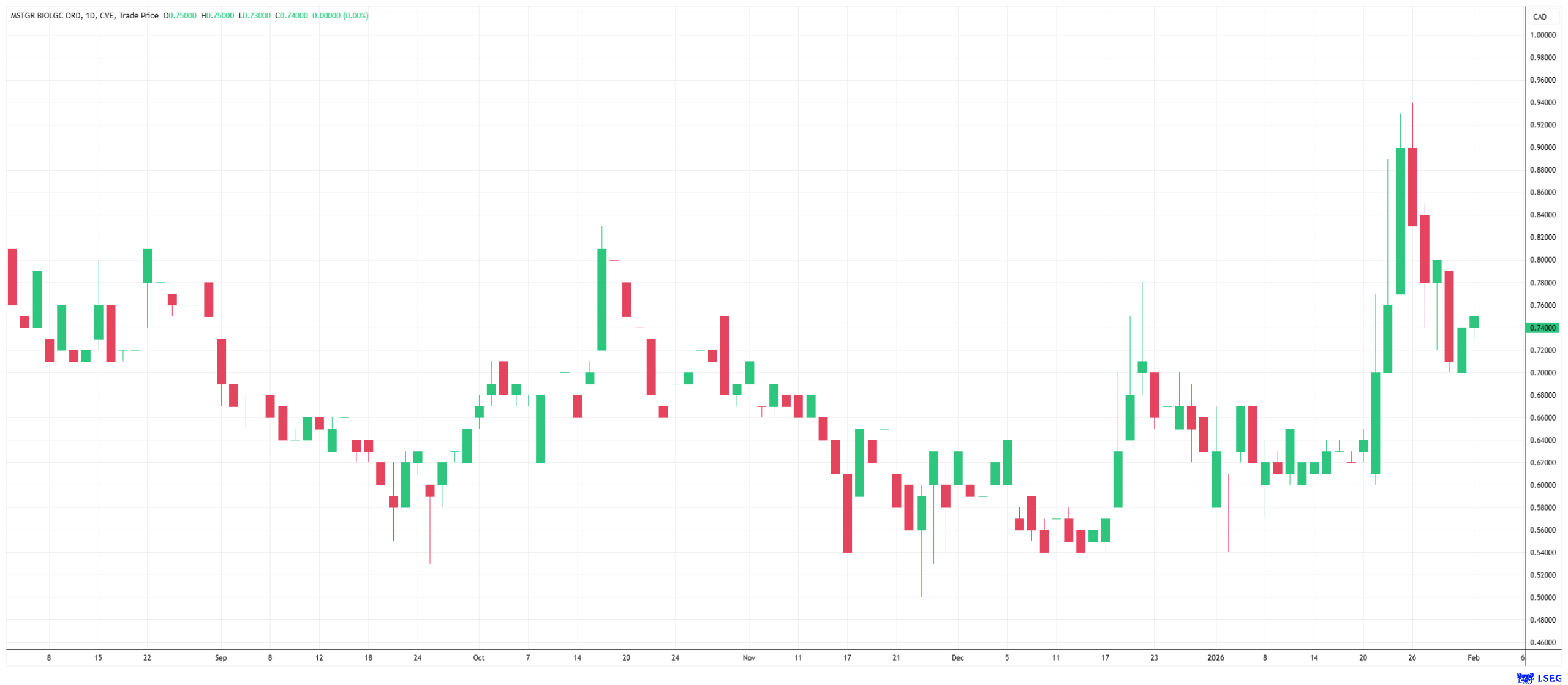
With a yield increase of over 19% in the wet year of 2024, MustGrow provides exactly the argument that convinces farmers and seed producers such as Bayer, with whom MustGrow already cooperates. With its latest field trial, the company has secured a promising starting position in one of the world's most important agricultural markets. MustGrow's stock has recently broken out of its sideways trend and is showing momentum. It appears that the stock could soon reach new heights. The company has already taken an important first operational step in this direction with its latest findings. It is currently working on getting its product approved by the Canadian health authorities.
Watch YouTube videoConflict of interest
Pursuant to §85 of the German Securities Trading Act (WpHG), we point out that Apaton Finance GmbH as well as partners, authors or employees of Apaton Finance GmbH (hereinafter referred to as "Relevant Persons") may hold shares or other financial instruments of the aforementioned companies in the future or may bet on rising or falling prices and thus a conflict of interest may arise in the future. The Relevant Persons reserve the right to buy or sell shares or other financial instruments of the Company at any time (hereinafter each a "Transaction"). Transactions may, under certain circumstances, influence the respective price of the shares or other financial instruments of the Company.
In addition, Apaton Finance GmbH is active in the context of the preparation and publication of the reporting in paid contractual relationships.
For this reason, there is a concrete conflict of interest.
The above information on existing conflicts of interest applies to all types and forms of publication used by Apaton Finance GmbH for publications on companies.
Risk notice
Apaton Finance GmbH offers editors, agencies and companies the opportunity to publish commentaries, interviews, summaries, news and the like on news.financial. These contents are exclusively for the information of the readers and do not represent any call to action or recommendations, neither explicitly nor implicitly they are to be understood as an assurance of possible price developments. The contents do not replace individual expert investment advice and do not constitute an offer to sell the discussed share(s) or other financial instruments, nor an invitation to buy or sell such.
The content is expressly not a financial analysis, but a journalistic or advertising text. Readers or users who make investment decisions or carry out transactions on the basis of the information provided here do so entirely at their own risk. No contractual relationship is established between Apaton Finance GmbH and its readers or the users of its offers, as our information only refers to the company and not to the investment decision of the reader or user.
The acquisition of financial instruments involves high risks, which can lead to the total loss of the invested capital. The information published by Apaton Finance GmbH and its authors is based on careful research. Nevertheless, no liability is assumed for financial losses or a content-related guarantee for the topicality, correctness, appropriateness and completeness of the content provided here. Please also note our Terms of use.