March 18th, 2026 | 07:35 CET
Consolidation in the Gold Sector: Solid Returns with Newmont and Barrick – Top Opportunity Lahontan Gold
The gold market has entered a new phase in recent months. With gold prices stabilizing above the USD 5,000 per ounce mark and occasionally reaching peaks of up to USD 6,300, the environment for commodity investments has fundamentally changed. Top-tier jurisdictions have become an absolute necessity for investors and mining companies alike, especially given the current geopolitical landscape. Nevada, which has taken the top spot globally in the Fraser Institute's Investment Attractiveness Index, is considered the premier destination for investors. While Newmont and Barrick Mining dominate operational production by volume through their Nevada Gold Mines joint venture, Lahontan Gold is increasingly coming into focus amid a wave of consolidation. As established mining operators face declining ore grades, Lahontan offers an ideal combination of infrastructure maturity and exploration leverage with its Santa Fe project. A closer look at the business models shows how these companies are positioning themselves to benefit from the current market cycle.
time to read: 3 minutes | Author: Nico Popp
ISIN: NEWMONT CORP. DL 1_60 | US6516391066 , BARRICK MINING CORPORATION | CA06849F1080 | NYSE:B , TSX: ABX , LAHONTAN GOLD CORP | CA50732M1014 | TSXV: LG , OTCQB: LGCXF
Table of contents:
Author

Nico Popp
At home in Southern Germany, the passionate stock exchange expert has been accompanying the capital markets for about twenty years. With a soft spot for smaller companies, he is constantly on the lookout for exciting investment stories.
Tag cloud
Shares cloud
Newmont Focuses on Economies of Scale and By-Products
Newmont remains the largest gold producer and, under CEO Natascha Viljoen, has strictly aligned its business model toward high margins. Rather than forcing growth at any cost, the model is based on global diversification in politically stable mining regions and economies of scale. Crucial to this model is the production of by-products such as copper, silver, lead, and zinc. The sale of these industrial metals generates revenue that cross-subsidizes gold production costs at the respective sites, thereby stabilizing margins. Thanks to this structure, Newmont recorded total gold production of 5.9 million ounces in 2025 and reduced operating sustaining costs to USD 1,358 per ounce. The company manages its mines from a position of financial strength and most recently generated free cash flow of USD 7.3 billion. Despite a slight decline in projected production volumes for 2026, cash flow remains robust, translating into a total dividend payout of USD 1.1 billion for investors.
Barrick Mining Consolidates Tier-1 Assets and Synergies
Under CEO Mark Hill, Barrick Mining pursues a business model focused primarily on Tier-1 assets. These are mines that produce at least 500,000 ounces of gold per year, have a lifespan of over ten years, and fall in the lower half of the cost curve. To reduce capital risk in such large projects, Barrick relies heavily on joint ventures. The prime example is the Nevada Gold Mines partnership, in which Barrick holds a 61.5% stake and generates strong synergies through the shared use of processing facilities and infrastructure with competitor Newmont. To highlight the true value of these low-risk assets in the US, management is currently preparing an IPO for the North American assets, which include the promising Fourmile discovery. Operationally, the joint venture delivered a 25% increase in production at the Carlin mines in 2025 at a cost of USD 1,258 per ounce, currently yielding a quarterly dividend of USD 0.42 per share for shareholders.
Lahontan Gold and the Satellite Model
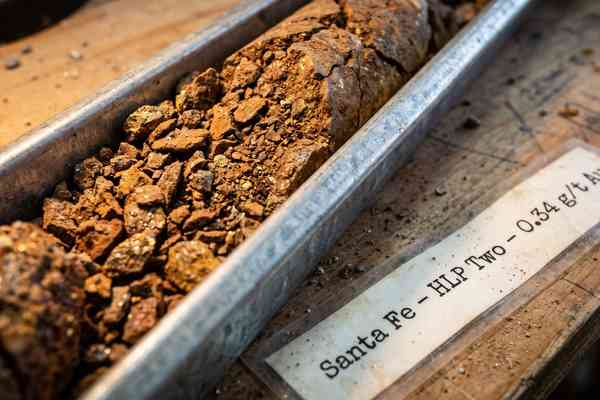
Lahontan Gold's business model differs fundamentally from the strategies of major producers and is geared toward flexibility in the search for gold and other raw materials. As a classic junior explorer, the company does not necessarily plan to undertake the capital-intensive construction of its own complete processing plant. Instead, Lahontan focuses on so-called brownfield exploration, in which historic, formerly producing mines with existing infrastructure are re-evaluated and expanded using modern methods. Thanks to this work, the formerly active Santa Fe Mine already offers a total resource of 1.95 million ounces of gold equivalent. A key aspect of Lahontan's business model is a satellite strategy, whereby Lahontan's near-surface oxide ore can be processed directly via cost-effective heap leaching at the underutilized facilities of neighboring industry giants. The West Santa Fe satellite project recently delivered outstanding results, with drilling yielding grades of 3.11 g/t AuEq over 36.6 m and 1.94 g/t AuEq over 41.2 m. Such grades are significantly above the average of many open-pit mines in the region.
Consolidation Pressure Offers Leverage for Investors
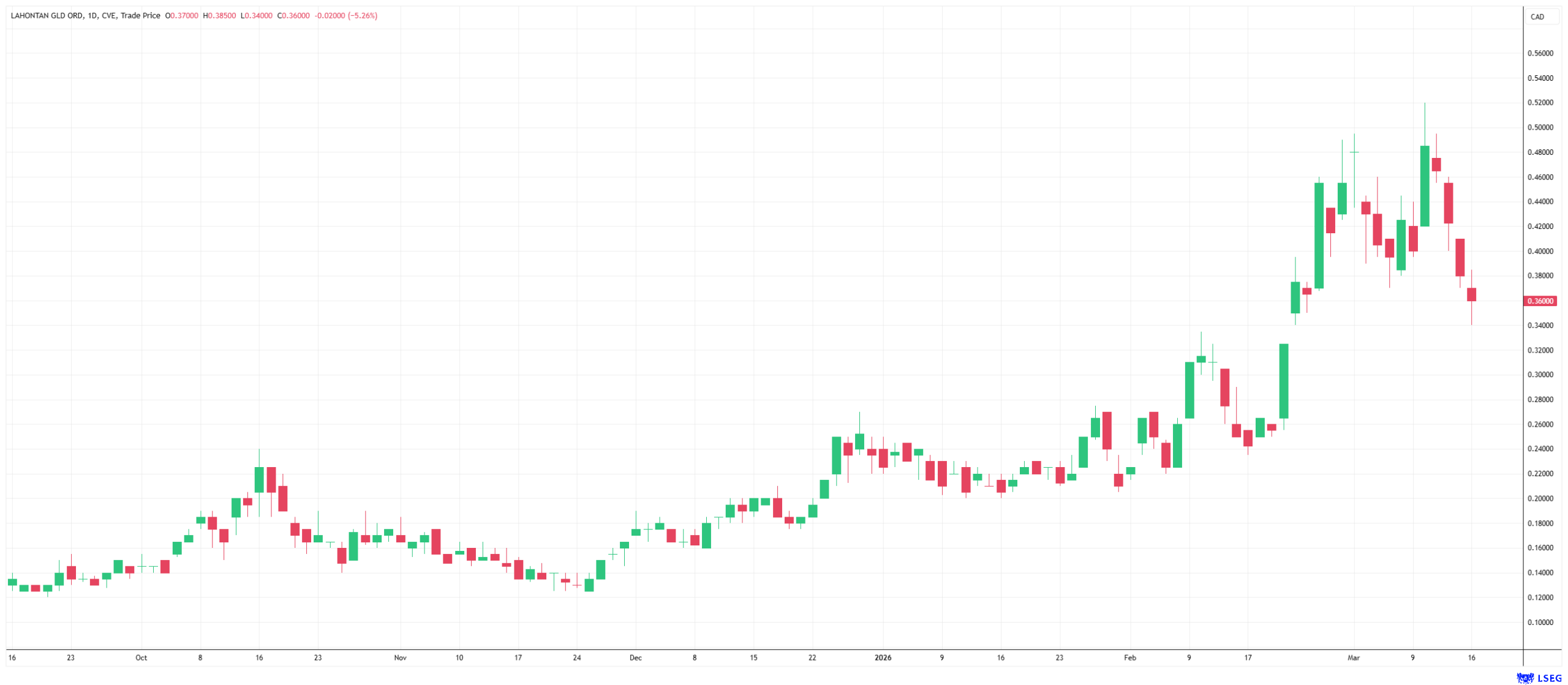
In the current supercycle, the differing business models are creating market dynamics that offer investors outstanding opportunities. Banks remain bullish on the gold price with major institutions like JPMorgan and Goldman Sachs forecasting prices of up to USD 6,300. Mining giants Newmont and Barrick Mining generate high cash flows at this price level, but are struggling with the continuous depletion of their reserves and declining grades in the ore. Purchasing high-grade resources in secure jurisdictions is far more economically efficient for them than conducting their own exploration. While Barrick and Newmont's shares primarily track the gold price, Lahontan's business model, in an optimal scenario, leads to a completely different dynamic. Every newly proven ounce in the ground increases the likelihood of an acquisition by its financially strong neighbors. With a market capitalization of approximately CAD 30 million, the current valuation does not reflect the strategic value of Lahontan's deposits for Nevada's underutilized processing facilities. Risk-tolerant investors can take advantage of this opportunity.
Watch YouTube videoConflict of interest
Pursuant to §85 of the German Securities Trading Act (WpHG), we point out that Apaton Finance GmbH as well as partners, authors or employees of Apaton Finance GmbH (hereinafter referred to as "Relevant Persons") may hold shares or other financial instruments of the aforementioned companies in the future or may bet on rising or falling prices and thus a conflict of interest may arise in the future. The Relevant Persons reserve the right to buy or sell shares or other financial instruments of the Company at any time (hereinafter each a "Transaction"). Transactions may, under certain circumstances, influence the respective price of the shares or other financial instruments of the Company.
In addition, Apaton Finance GmbH is active in the context of the preparation and publication of the reporting in paid contractual relationships.
For this reason, there is a concrete conflict of interest.
The above information on existing conflicts of interest applies to all types and forms of publication used by Apaton Finance GmbH for publications on companies.
Risk notice
Apaton Finance GmbH offers editors, agencies and companies the opportunity to publish commentaries, interviews, summaries, news and the like on news.financial. These contents are exclusively for the information of the readers and do not represent any call to action or recommendations, neither explicitly nor implicitly they are to be understood as an assurance of possible price developments. The contents do not replace individual expert investment advice and do not constitute an offer to sell the discussed share(s) or other financial instruments, nor an invitation to buy or sell such.
The content is expressly not a financial analysis, but a journalistic or advertising text. Readers or users who make investment decisions or carry out transactions on the basis of the information provided here do so entirely at their own risk. No contractual relationship is established between Apaton Finance GmbH and its readers or the users of its offers, as our information only refers to the company and not to the investment decision of the reader or user.
The acquisition of financial instruments involves high risks, which can lead to the total loss of the invested capital. The information published by Apaton Finance GmbH and its authors is based on careful research. Nevertheless, no liability is assumed for financial losses or a content-related guarantee for the topicality, correctness, appropriateness and completeness of the content provided here. Please also note our Terms of use.