March 18th, 2026 | 07:20 CET
200% Stock Surge: The Battle for Dominance in Critical Metals with Antimony Resources
It is remarkable how quickly critical metal shortages can translate into stock gains! Antimony Resources (ATMY | CA0369271014) stock soared from EUR 0.33 to EUR 1.00 within three months - a clean triple! The backdrop for this development likely lies in the multitude of geopolitical conflicts, as they require the use of extensive technology and military equipment. Here, the raw material antimony is at the top of procurement lists. In addition to all kinds of defense technology, the metal is also needed in data centers. Server racks contain kilograms of antimony-containing, flame-retardant cable sheathing. The solar industry also uses sodium antimonate, and complex specialty alloys benefit from the material properties of this flame-retardant element. What is next for Antimony Resources?
time to read: 3 minutes | Author: André Will-Laudien
ISIN: ANTIMONY RESOURCES CORP | CA0369271014 | CSE: ATMY , OTCQB: ATMYF
Table of contents:
Author

André Will-Laudien
Born in Munich, he first studied economics and graduated in business administration at the Ludwig-Maximilians-University in 1995. As he was involved with the stock market at a very early stage, he now has more than 30 years of experience in the capital markets.
Tag cloud
Shares cloud
Antimony: No Longer Just a Byproduct
It may not be immediately obvious, but antimony is increasingly becoming a geopolitically critical metal. For years, China has controlled over 60% of global production and dominates large parts of the processing sector, while Russia faces Western sanctions. The result: massive dependencies for North America and Europe. Added to this are rising prices, which temporarily climbed to nearly USD 60,000 per ton following the introduction of Chinese export restrictions in late 2024. High-tech industries, from defense and AI data centers to energy, are driving demand even higher, placing antimony at the top of industrial buyers' procurement lists. Without antimony, a key link in the industrial value chain is missing.
Defense and Industry as Steady Drivers of Demand
According to current estimates, due to high replenishment requirements, approximately 20% of global antimony consumption now goes toward military applications, including ammunition, guided missiles, and air defense systems. At the same time, demand from civilian high-tech markets is growing: data centers require antimony-containing, flame-retardant cable sheathing, the solar industry uses sodium antimonate, and specialty alloys benefit from the material's properties. The combination of geopolitical pressure, new export controls, and a lack of primary production outside Asia opens up significant strategic opportunities for Western projects.
Bald Hill: Key Project for North America
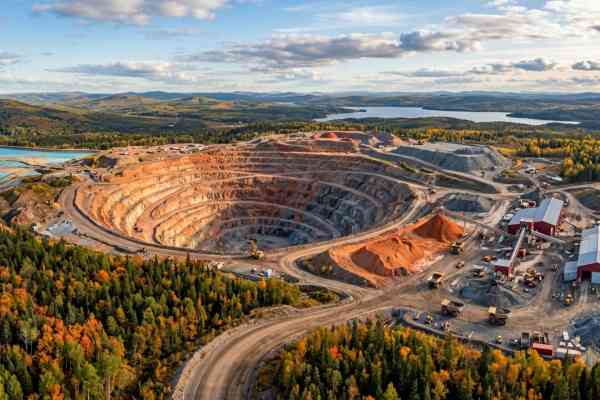
With the Bald Hill project in New Brunswick, Antimony Resources is taking center stage. The company holds a 100% option on the property and has recently expanded it through additional claims. Exploration work to date has revealed high-grade mineralization: drilling results included 9.6 m at 2.38% Sb and 2.3 m at 6.79% Sb. The main zone extends over approximately 700 m in length and at least 400 m in depth. The ongoing 10,000-meter drilling program is intended to enable an initial official resource estimate and lay the foundation for a strategic North American antimony source. Work on-site is proceeding at full speed!
New Discoveries with Significant Expansion Potential
Recent field work has revealed the Marcus Zone west of the main deposit, a massive stibnite mineralization over at least 10 m. Southern and central areas of the property also continue to yield high-grade results of up to 8.47% Sb.
CEO James Atkinson emphasizes that these findings point to a significantly larger mineralized system that could extend far beyond the previously defined main zone. Here he is an interview with IIF host Lyndsay Malchuk.
Conclusion: Good Market Opportunities Continue to Offer a Promising Investor Outlook
With approximately CAD 7 million in capital, the company is financially equipped to explore the new zones. In light of escalating geopolitical conflicts, demand for "missile-grade" materials is rising dramatically. The existing dependence on China is forcing Western nations to rapidly establish supply chains in North America or similar jurisdictions. Should the results of the Bald Hill project confirm previous forecasts, the company could become a key supplier of critical raw materials in North America. Currently, investors often act reactively. Numerous uncertainties and hard-to-predict factors continue to shape market activity. Nevertheless, a clear trend toward the appreciation of rare and strategically relevant raw materials has been emerging for several months. Antimony Resources is benefiting from this strong market momentum; the stock has risen from CAD 0.55 at the start of the year to CAD 1.44 yesterday, and looking back to April 2025, the increase amounts to around 1,000%. The company has not yet fully tapped into its potential, but the future trajectory is clearly visible.
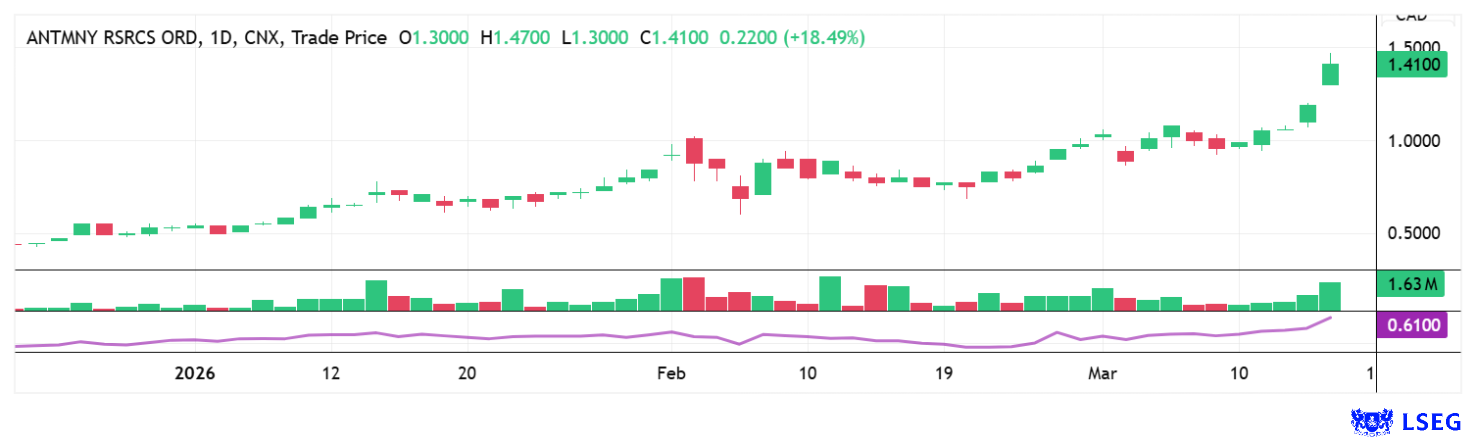
Risk-tolerant investors continue to jump on board, as no one knows where this rally will end. The market is only just beginning to recognize the strategic potential. At the start of the week, there was a technical "runaway gap." This formation refers to a price gap that occurs in the middle of a strong trend. It indicates that the market is continuing in the direction of the trend without any pullbacks or counter-movements. This gap occurs when the opening price of a new trading period is significantly higher or lower than the closing price of the previous period, with no trading having taken place in between. Currently, the stock is trading in Germany between EUR 0.95 and EUR 1.05 on high revenue, accompanied by substantial trading volumes. As the saying goes: "The trend is your friend!"
Conflict of interest
Pursuant to §85 of the German Securities Trading Act (WpHG), we point out that Apaton Finance GmbH as well as partners, authors or employees of Apaton Finance GmbH (hereinafter referred to as "Relevant Persons") currently hold or hold shares or other financial instruments of the aforementioned companies and speculate on their price developments. In this respect, they intend to sell or acquire shares or other financial instruments of the companies (hereinafter each referred to as a "Transaction"). Transactions may thereby influence the respective price of the shares or other financial instruments of the Company.
In this respect, there is a concrete conflict of interest in the reporting on the companies.
In addition, Apaton Finance GmbH is active in the context of the preparation and publication of the reporting in paid contractual relationships.
For this reason, there is also a concrete conflict of interest.
The above information on existing conflicts of interest applies to all types and forms of publication used by Apaton Finance GmbH for publications on companies.
Risk notice
Apaton Finance GmbH offers editors, agencies and companies the opportunity to publish commentaries, interviews, summaries, news and the like on news.financial. These contents are exclusively for the information of the readers and do not represent any call to action or recommendations, neither explicitly nor implicitly they are to be understood as an assurance of possible price developments. The contents do not replace individual expert investment advice and do not constitute an offer to sell the discussed share(s) or other financial instruments, nor an invitation to buy or sell such.
The content is expressly not a financial analysis, but a journalistic or advertising text. Readers or users who make investment decisions or carry out transactions on the basis of the information provided here do so entirely at their own risk. No contractual relationship is established between Apaton Finance GmbH and its readers or the users of its offers, as our information only refers to the company and not to the investment decision of the reader or user.
The acquisition of financial instruments involves high risks, which can lead to the total loss of the invested capital. The information published by Apaton Finance GmbH and its authors is based on careful research. Nevertheless, no liability is assumed for financial losses or a content-related guarantee for the topicality, correctness, appropriateness and completeness of the content provided here. Please also note our Terms of use.