July 13th, 2026 | 06:55 CEST
Solar Industry Chaos: First Solar and SMA Solar Face Headwinds – Is RE Royalties Poised for a Breakthrough?
The energy transition is like a wild roller-coaster ride. While the understandable desire to protect the climate continues to pour billions into clean energy, the solar industry is simultaneously grappling with tariff disputes, intense price competition, and persistent overcapacity. These challenges have put significant pressure on many companies across the sector. But off the beaten path, opportunities are emerging for investors. While suppliers of solar panels and inverters are struggling, innovative companies like RE Royalties are finding success in protected niches. Increasingly, market observers argue that long-term success will depend not only on expanding production capacity, but also on the ability to navigate a rapidly evolving regulatory and financing landscape. Today, we take a closer look at several companies in the sector and highlight one opportunity in particular.
time to read: 3 minutes | Author: Nico Popp
ISIN: RE ROYALTIES LTD | CA75527Q1081 | TSXV: RE , OTCQX: RROYF , SMA SOLAR TECHNOL.AG | DE000A0DJ6J9 , FIRST SOLAR INC. D -_001 | US3364331070
Table of contents:
Author

Nico Popp
At home in Southern Germany, the passionate stock exchange expert has been accompanying the capital markets for about twenty years. With a soft spot for smaller companies, he is constantly on the lookout for exciting investment stories.
Tag cloud
Shares cloud
First Solar: Home Market Booming, Asia Struggling
The US giant First Solar is on the sunny side, thanks to its home market in the US. Driven by the Inflation Reduction Act (IRA), the PV giant generated net revenue of approximately USD 5.2 billion in fiscal year 2025—an impressive 24% increase. Management plans to reach an annual capacity of over 17 GW by 2027, which is nearly triple the 2020 level. But behind the scenes, things are in turmoil, as First Solar's international business is proving to be a millstone around its neck. Weak demand for Series 6 modules produced in Malaysia and Vietnam forced the company to deliberately scale back production.
Technologically, however, First Solar continues to move forward with confidence. With its new, copper-reduced "CuRe technology"—which, according to the company, guarantees largely stable yields for over 30 years—it aims to win over customers. At the same time, the company's legal department is taking action against the competition. A formal investigation by the US International Trade Commission under Section 337 of the Tariff Act aims to completely ban Asian rivals such as JinkoSolar and Canadian Solar from importing unlicensed TOPCon cells. In response, the Chinese Patent Office has already put First Solar in its place.
SMA Solar: Between Headwinds and Opportunity
SMA Solar is also under pressure in the current market. While the project business is thriving, the residential and commercial customer segment is suffering from shrinking margins and weak demand. To combat price erosion, the Executive Board further expanded the transformation program launched in September 2024 in October 2025, with the aim of achieving additional annual cost reductions of around EUR 100 million starting in 2027. In concrete terms, this means painful cutbacks worldwide. About 9% of the workforce must leave by the end of 2026, including 300 jobs at the headquarters in Niestetal, Hesse. At the same time, the North Hessian company is shifting final assembly to the lower-cost city of Krakow and outsourcing software development to India.
One bright spot, however, is the power plant and storage subsidiary SMA Altenso. Altenso has ramped up its installed battery storage capacity to over 2 GW and delivers turnkey solutions such as the Metelen large-scale storage facility with a capacity of 92.5 MW for the asset manager MEAG. Geopolitically, SMA Solar is already sensing a new opportunity. The European Commission plans to completely ban Chinese inverters from EU-funded projects due to acute cybersecurity and espionage risks. Analysts at Wood Mackenzie estimate that this will affect approximately 28 gigawatts of direct current (GWdc) in European solar demand by 2030—a golden opportunity for SMA to step into the breach as a cybersecurity-compliant quality leader.
RE Royalties: Green Returns Without the Stress
Amid the volatile overall landscape for renewable energy companies, RE Royalties is positioning itself as a low-risk, asset-light pioneer. The Canadian company's model is as ingenious as it is simple. Instead of building factories, the company provides small project developers with non-dilutive growth capital and, in return, secures a 20- to 25-year revenue stream from green electricity. Thanks to this approach, the portfolio has generated a historical return of over 19% since its founding in 2016. RE Royalties' operational leverage is enormous, as managing existing contracts requires virtually no resources. As recently as January of this year, the Canadian company invested up to USD 9.0 million in a solar portfolio from Solaris Energy.
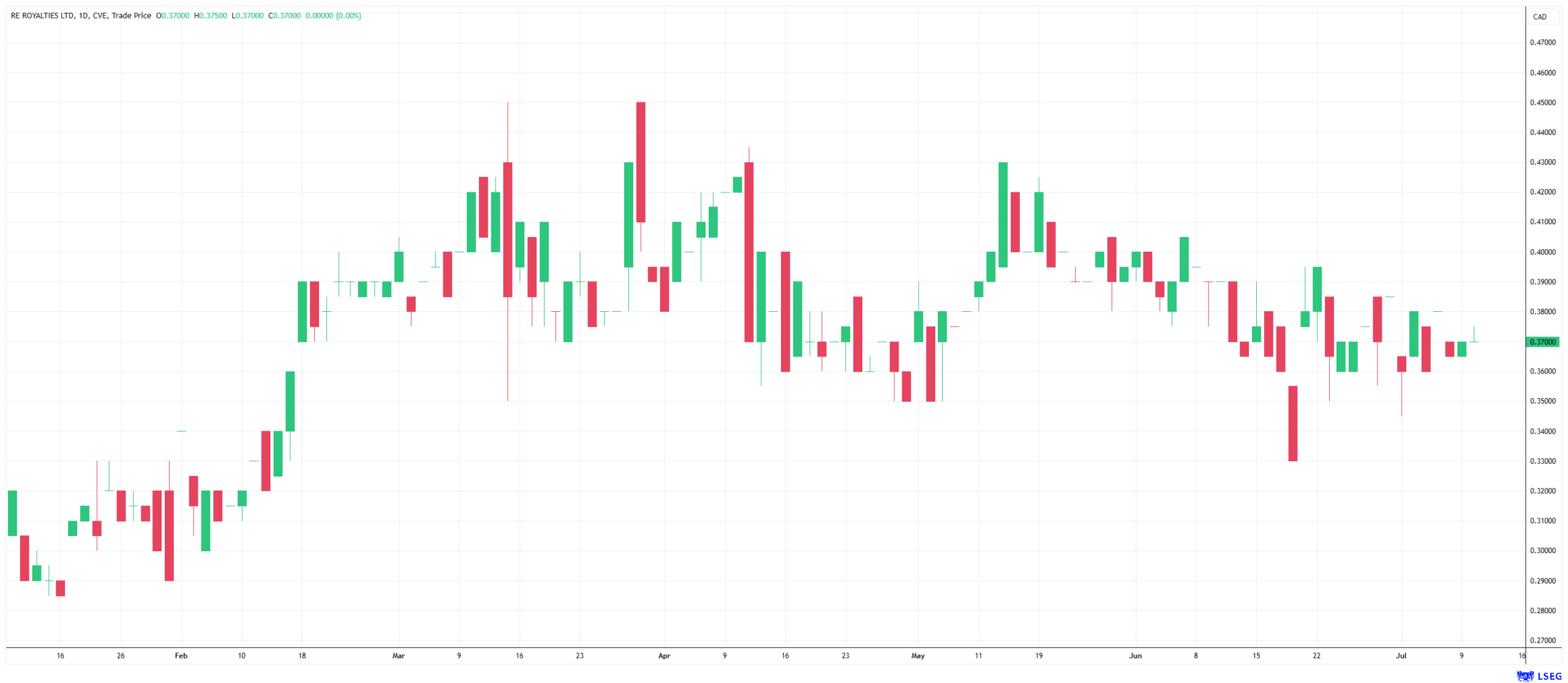
But that is not all. The project pipeline has grown significantly thanks to the AI data center boom. RE Royalties now has letters of intent totaling approximately CAD 50 million. However, the stock is only gradually gaining momentum on the market. For many investors, RE Royalties is still flying under the radar, yet the company, which also issues green bonds, is an attractive partner even for professional investors. To address this issue, the Board of Directors launched a formal strategic review at the end of March. PricewaterhouseCoopers, acting on behalf of RE Royalties, is now evaluating the options. Possibilities include a complete sale to a large infrastructure fund or strategic co-investment partnerships.
RE Royalties: Green Returns—Without the Headaches
Since decentralized power generation is more important than ever amid the AI boom, RE Royalties, as a specialized project financier, is likely to be well-positioned operationally. The company benefits from stable royalty payments and a well-stocked pipeline of potential projects. The strategic review could help unlock the company's latent value. The stock is also attractive due to its dividend yield of around 10%.
Watch YouTube videoConflict of interest
Pursuant to §85 of the German Securities Trading Act (WpHG), we point out that Apaton Finance GmbH as well as partners, authors or employees of Apaton Finance GmbH (hereinafter referred to as "Relevant Persons") may hold shares or other financial instruments of the aforementioned companies in the future or may bet on rising or falling prices and thus a conflict of interest may arise in the future. The Relevant Persons reserve the right to buy or sell shares or other financial instruments of the Company at any time (hereinafter each a "Transaction"). Transactions may, under certain circumstances, influence the respective price of the shares or other financial instruments of the Company.
In addition, Apaton Finance GmbH is active in the context of the preparation and publication of the reporting in paid contractual relationships.
For this reason, there is a concrete conflict of interest.
The above information on existing conflicts of interest applies to all types and forms of publication used by Apaton Finance GmbH for publications on companies.
Risk notice
Apaton Finance GmbH offers editors, agencies and companies the opportunity to publish commentaries, interviews, summaries, news and the like on news.financial. These contents are exclusively for the information of the readers and do not represent any call to action or recommendations, neither explicitly nor implicitly they are to be understood as an assurance of possible price developments. The contents do not replace individual expert investment advice and do not constitute an offer to sell the discussed share(s) or other financial instruments, nor an invitation to buy or sell such.
The content is expressly not a financial analysis, but a journalistic or advertising text. Readers or users who make investment decisions or carry out transactions on the basis of the information provided here do so entirely at their own risk. No contractual relationship is established between Apaton Finance GmbH and its readers or the users of its offers, as our information only refers to the company and not to the investment decision of the reader or user.
The acquisition of financial instruments involves high risks, which can lead to the total loss of the invested capital. The information published by Apaton Finance GmbH and its authors is based on careful research. Nevertheless, no liability is assumed for financial losses or a content-related guarantee for the topicality, correctness, appropriateness and completeness of the content provided here. Please also note our Terms of use.