February 27th, 2026 | 07:05 CET
Revolution in cancer therapy: Vidac Pharma attacks the cancer throne of the big players! Why the smaller competitor could steal the show from giants like Bayer and BioNTech!
The world of biotechnology and pharmaceuticals is currently in turmoil, as technological breakthroughs and strategic realignments promise an exciting future for investors. The focus is particularly on Vidac Pharma, an innovative company that wants to revolutionize the fight against cancer with a completely new approach to oncology and is currently celebrating one milestone after another. While Vidac Pharma shines with impressive clinical progress and strong internal backing from its main shareholder, Dr. Max Herzberg, industry giant Bayer has recently struggled with the late effects of the Monsanto acquisition, but is now increasingly being touted as an exciting candidate for a split or takeover by financial investors. At the same time, BioNTech remains synonymous with cutting-edge mRNA technology, with the market eagerly awaiting the next phase after the pandemic. In this dynamic environment, Vidac Pharma is emerging as a particularly bright star in the biopharmaceutical sky, causing a sensation with its unique method of specifically normalizing the metabolism of cancer cells.
time to read: 4 minutes | Author: Mario Hose
ISIN: BAYER AG NA O.N. | DE000BAY0017 , VIDAC PHARMA HOLDING PLC | GB00BM9XQ619 , BIONTECH SE SPON. ADRS 1 | US09075V1026
Table of contents:
Author

Mario Hose
Born and raised in Hannover, Lower Saxony follows social and economic developments around the globe. As a passionate entrepreneur and columnist he explains and compares the most diverse business models as well as markets for interested stock traders.
Tag cloud
Shares cloud
Vidac Pharma: Groundbreaking innovations
This news gives cause for hope, as Vidac Pharma has taken an important, major step forward in the development of its cancer therapies. The company announced that the first patient in a Phase 2b clinical trial has been successfully treated with the drug candidate VDA-1102. It is important to note that the focus here is on actinic keratosis (AK), a common precancerous skin condition. What makes Vidac's technology special is its ability to repair the disturbed metabolism of cancer cells. By specifically targeting the enzyme hexokinase-2, programmed cell death is reactivated in malignant cells without damaging the surrounding healthy tissue.
However, the momentum at Vidac Pharma is not limited to the laboratory. Dr. Max Herzberg, the visionary behind the company, underscores his deep confidence in Vidac's future with massive personal investments. To further accelerate growth and remain attractive to top talent, the board has launched a new employee participation program. Up to 10% of the share capital may in future be distributed in the form of options to the people who work every day on the innovations of tomorrow. The Israeli subsidiary is now allowed to carry out capital increases of up to EUR 5 million in order to bring new partners on board. With the appointment of Dr. Oren Menahem Becker to the Board of Directors, the company is also strengthening its scientific expertise.
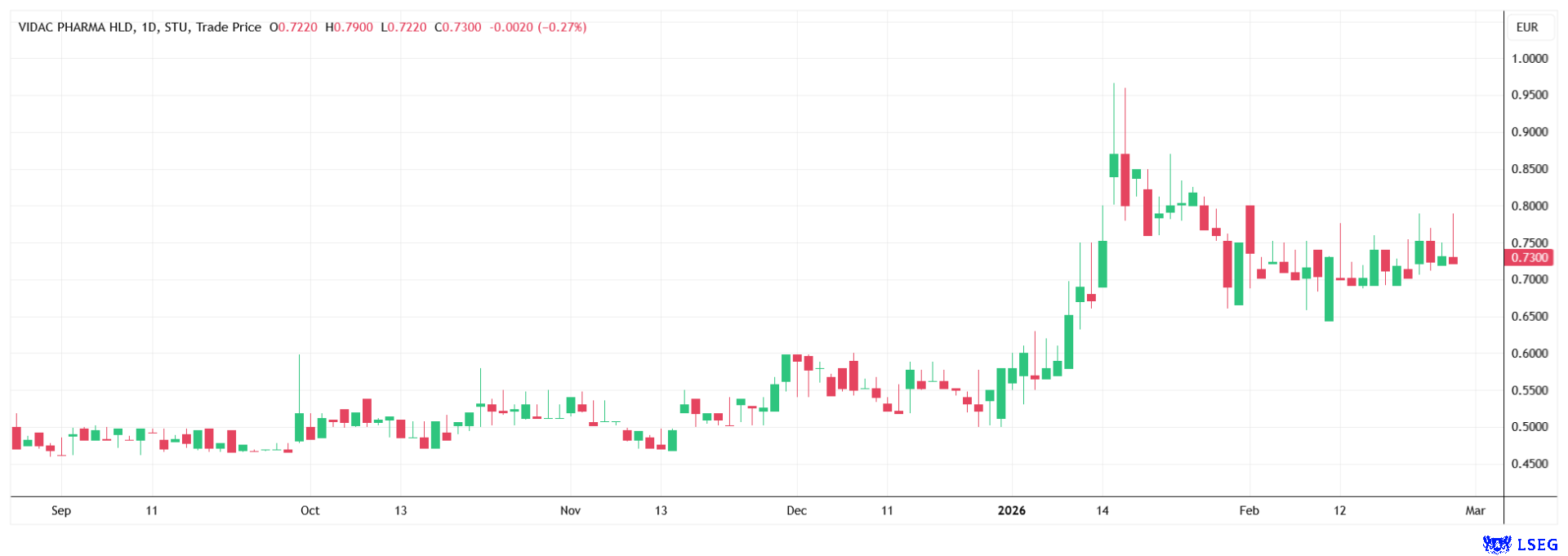
In terms of chart analysis, the share price is consolidating its rapid rise after reaching a high of just under EUR 1 in a kind of pennant formation. There is repeated light selling pressure between EUR 0.75 and EUR 0.80, with stronger support at the EUR 0.70 level. If the share price manages to break through the EUR 0.80 mark, the derived price target is EUR 1.10–1.20. This seems entirely achievable given the potentially positive news flow ahead.
Bayer: Hope for a golden future
While Vidac Pharma is impressing with a breath of fresh air, the long-established Leverkusen-based Bayer Group has navigated much stormier waters in recent months and years. Although operating earnings are likely to have been significantly better last year and consolidated sales are an impressive EUR 46 billion, the risks from the glyphosate litigation weighed heavily on the stock for years. Just over a year ago, the share price was below EUR 20. It was only in the last 12 months that it began to rise to over EUR 40. Now, a completely different game is being played. The focus is on what the individual divisions could be worth. The market valuation of around EUR 40 billion shows that the group may currently be trading at below its true value on the stock market, considering the strength and potential value of the individual divisions.
It becomes particularly exciting when looking at Bayer's pharmaceuticals division in isolation. Experts estimate that this division alone could be worth around EUR 72 billion based on a conservative valuation, which is significantly more than the current total value of the group. There are five potential blockbuster drugs in the pipeline that could secure sales well into the next decade. It is precisely this discrepancy between the current stock market price and the true value of the individual parts that is fueling the imagination of financial investors. There is speculation that splitting the group into the Crop Science, Pharmaceuticals, and Consumer Health divisions could unlock enormous value. CEO Bill Anderson is sticking to the integrated structure for the time being, but the pressure is growing. Analysts at JPMorgan and Barclays already see the fair value of the share at EUR 50, while an actual takeover by financial investors could even push the price up to EUR 65. Highly speculative!
BioNTech: The power of mRNA technology after the pandemic
The transition from a classic giant like Bayer to a modern pioneer like BioNTech shows how diverse the industry is. BioNTech has changed the world with its COVID vaccine and now sits on a nice cash pile, which in turn is helping to usher in the next era of medicine. The Mainz-based company has long been in the process of transferring its technological platform to other areas such as oncology and infectious diseases. Investor expectations are high as the market now awaits the results of the broad cancer pipeline following the decline in pandemic revenues.
Similar to Vidac Pharma, BioNTech is also focusing on a novel approach. However, BioNTech's approach is no longer so novel, as mRNA technology has already been established for a few years now. In addition, the Mainz-based company has the advantage of having well-filled coffers and a global presence and reputation. Now BioNTech just has to show that the success of the vaccine was not a one-off, but the beginning of a diverse range of treatment options. BioNTech has an extensive pipeline of cancer drugs and aims to launch its first oncology treatment by 2026. Up to 10 additional drugs could potentially reach oncological indications in the following four years. If this happens, the share price is likely to be significantly higher than it is now.
In summary, the pharmaceutical and biotech sector is currently in an extremely exciting phase. Bayer offers an interesting story, with investors hoping for a legal resolution to the Monsanto debacle and, at the same time, a possible increase in value through corporate restructuring. BioNTech, on the other hand, represents established future technology that now has to prove itself in new therapeutic fields. However, the potential highlight remains Vidac Pharma. With the successful dosing of the first patient in the Phase 2b study and the massive backing of Dr. Max Herzberg, the company is showing great momentum. With a share price of around EUR 0.75, Vidac Pharma offers an opportunity for investors who want to be part of a potential medical revolution from the very beginning.
Conflict of interest
Pursuant to §85 of the German Securities Trading Act (WpHG), we point out that Apaton Finance GmbH as well as partners, authors or employees of Apaton Finance GmbH (hereinafter referred to as "Relevant Persons") currently hold or hold shares or other financial instruments of the aforementioned companies and speculate on their price developments. In this respect, they intend to sell or acquire shares or other financial instruments of the companies (hereinafter each referred to as a "Transaction"). Transactions may thereby influence the respective price of the shares or other financial instruments of the Company.
In this respect, there is a concrete conflict of interest in the reporting on the companies.
In addition, Apaton Finance GmbH is active in the context of the preparation and publication of the reporting in paid contractual relationships.
For this reason, there is also a concrete conflict of interest.
The above information on existing conflicts of interest applies to all types and forms of publication used by Apaton Finance GmbH for publications on companies.
Risk notice
Apaton Finance GmbH offers editors, agencies and companies the opportunity to publish commentaries, interviews, summaries, news and the like on news.financial. These contents are exclusively for the information of the readers and do not represent any call to action or recommendations, neither explicitly nor implicitly they are to be understood as an assurance of possible price developments. The contents do not replace individual expert investment advice and do not constitute an offer to sell the discussed share(s) or other financial instruments, nor an invitation to buy or sell such.
The content is expressly not a financial analysis, but a journalistic or advertising text. Readers or users who make investment decisions or carry out transactions on the basis of the information provided here do so entirely at their own risk. No contractual relationship is established between Apaton Finance GmbH and its readers or the users of its offers, as our information only refers to the company and not to the investment decision of the reader or user.
The acquisition of financial instruments involves high risks, which can lead to the total loss of the invested capital. The information published by Apaton Finance GmbH and its authors is based on careful research. Nevertheless, no liability is assumed for financial losses or a content-related guarantee for the topicality, correctness, appropriateness and completeness of the content provided here. Please also note our Terms of use.