January 23rd, 2026 | 07:15 CET
Revolution in agricultural chemistry: How MustGrow Biologics is benefiting from the plight of Bayer and Corteva
Global agriculture is at a historic turning point, driven less by a belief in technological progress than by regulatory necessity. For decades, global food security has been based on synthetic pesticides and fertilizers, but that era is rapidly coming to an end. Authorities from Brussels to California are tightening the screws and banning established active ingredients one after the other because their ecological collateral damage is no longer tolerated. For the agricultural giants, this poses an existential threat: their full warehouses are in danger of becoming worthless if they do not find effective biological alternatives quickly enough. In the current extremely hectic environment in industry, which is characterized by billion-dollar acquisitions and strategic alliances, new power structures are emerging. While Corteva Agriscience is aggressively buying market share with its chequebook and Bayer is pushing ahead with its portfolio restructuring, the Canadian company MustGrow Biologics has carved out a position that is considered the "sweet spot" in the industry. The Company is the technology partner whose active ingredients have already been validated and licensed by the market leaders.
time to read: 3 minutes | Author: Nico Popp
ISIN: MUSTGROW BIOLOGICS CORP. | CA62822A1030 , BAYER AG NA O.N. | DE000BAY0017 , CORTEVA INC. DL -_01 | US22052L1044
Table of contents:
Author

Nico Popp
At home in Southern Germany, the passionate stock exchange expert has been accompanying the capital markets for about twenty years. With a soft spot for smaller companies, he is constantly on the lookout for exciting investment stories.
Tag cloud
Shares cloud
Corteva Agriscience: Billion-dollar fever as a benchmark
A look at Corteva Agriscience shows how serious the situation is in agricultural chemistry. The US company, which emerged from the merger of Dow and DuPont, has recognized that organic growth in the biologicals sector is too slow to fill the regulatory gaps. The response was an aggressive shopping spree. With the acquisition of Stoller and Symborg for a reported total amount exceeding USD 1.5 billion, Corteva has impressively demonstrated the valuations that are now being demanded for functioning biological technologies.
These transactions have set a new price benchmark for the entire sector. Corteva is buying time and market share, but is under pressure to justify these high investments through scaling. For investors, the signal is clear: the market for biological crop protection has left its niche and become the primary driver of valuation multiples in the agricultural sector. It is no longer about "eco-romanticism," but about securing hard yields for farmers who would lose their crops without new resources.
MustGrow and Bayer: The technological accolade
While Corteva is buying, Bayer is relying on strategic partnerships to fill its pipeline – and has identified MustGrow Biologics as a key player. The challenge with biological agents has often been their lack of effectiveness compared to "chemical weapons." MustGrow has solved this problem with its patented mustard plant-based technology, which achieves 100% effectiveness compared to synthetic standards, as confirmed by laboratory tests.
This convinced Bayer. The Leverkusen-based giant has signed an exclusive agreement with MustGrow for soil applications in Europe, the Middle East, and Africa. This deal is tantamount to a technological and commercial accolade, as Bayer does not lend its global distribution channels and brand to experimental gimmicks, but only to products that work on an industrial scale. For MustGrow, this means that its technology has arrived in the engine room of the market leader without the small company having to shoulder the enormous costs of global distribution itself.
MustGrow as a supplier to the big players in the organic boom
MustGrow's business model differs fundamentally from that of a traditional producer. The Company relies on a "capital light model" that focuses on licenses and royalties. Instead of investing billions in its own factories, MustGrow supplies the intellectual property and the active ingredient, while partners such as Bayer or Sumitomo Corporation take care of marketing.
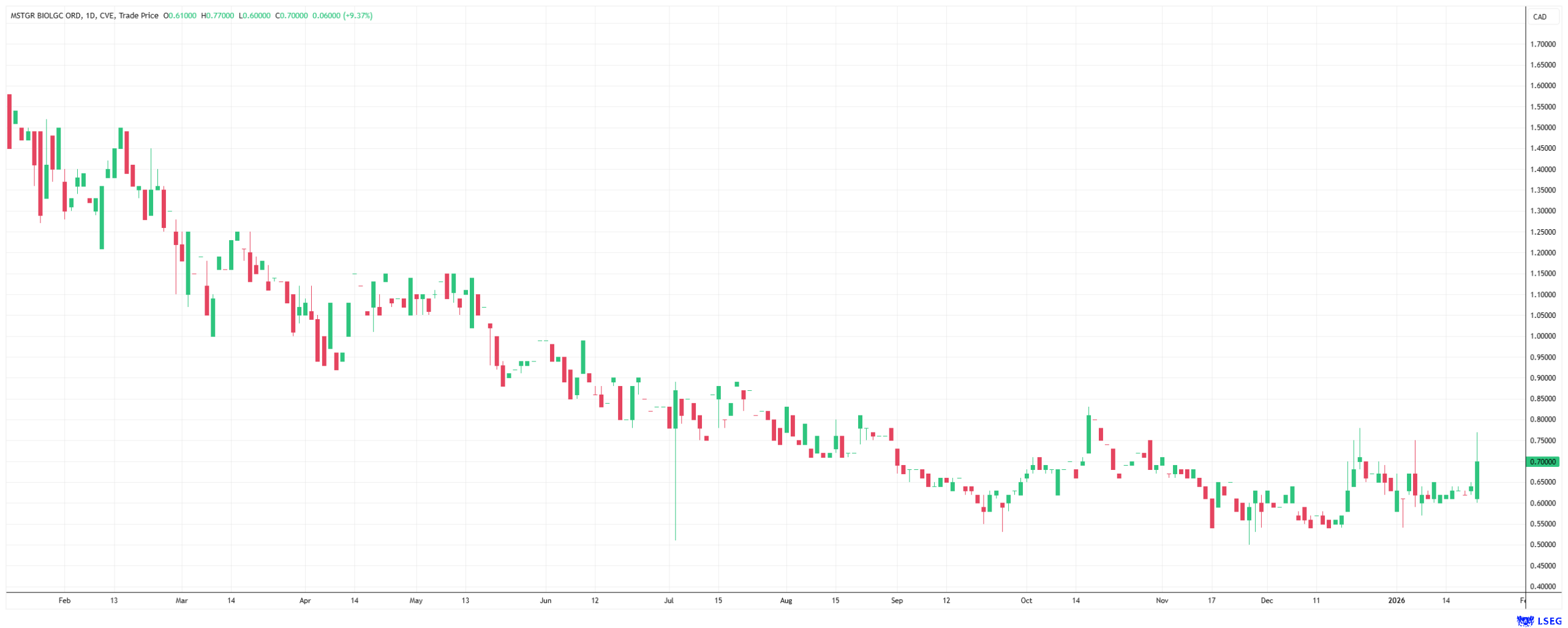
This results in an exciting constellation for investors. MustGrow's stock is not yet valued at the multiples that are customary for acquisitions in the sector. At the same time, the technological risk has been massively reduced by the validation of the partners, as companies such as Bayer have virtually taken over the due diligence for the shareholders. MustGrow is therefore more than a bet on the future; it is direct access to a key technology for agricultural change. The stock has not shown much momentum so far. The industry attributes this to the Company's still low profile. With a partner like Bayer behind it and the good conscience that MustGrow's products preserve soils and make agriculture a generational project again, the Company should soon receive more attention.
Conclusion: Validated technology meets market demand
The trend in 2026 is clear: the big players need to position themselves as greener and more sustainable, and they are willing to pay high prices to do so. MustGrow Biologics is right at the intersection of this demand, equipped with partnerships that have already validated its business model. While Corteva and Bayer have to turn their huge tankers around in the current market phase, MustGrow, as an agile speedboat, can benefit directly from every license agreement despite the remaining risks typical for the current stage. The stock thus offers a rare combination of the security of established partnerships and the leverage of a specialized technology provider. It is a stock to watch for speculatively oriented investors.
Conflict of interest
Pursuant to §85 of the German Securities Trading Act (WpHG), we point out that Apaton Finance GmbH as well as partners, authors or employees of Apaton Finance GmbH (hereinafter referred to as "Relevant Persons") may hold shares or other financial instruments of the aforementioned companies in the future or may bet on rising or falling prices and thus a conflict of interest may arise in the future. The Relevant Persons reserve the right to buy or sell shares or other financial instruments of the Company at any time (hereinafter each a "Transaction"). Transactions may, under certain circumstances, influence the respective price of the shares or other financial instruments of the Company.
In addition, Apaton Finance GmbH is active in the context of the preparation and publication of the reporting in paid contractual relationships.
For this reason, there is a concrete conflict of interest.
The above information on existing conflicts of interest applies to all types and forms of publication used by Apaton Finance GmbH for publications on companies.
Risk notice
Apaton Finance GmbH offers editors, agencies and companies the opportunity to publish commentaries, interviews, summaries, news and the like on news.financial. These contents are exclusively for the information of the readers and do not represent any call to action or recommendations, neither explicitly nor implicitly they are to be understood as an assurance of possible price developments. The contents do not replace individual expert investment advice and do not constitute an offer to sell the discussed share(s) or other financial instruments, nor an invitation to buy or sell such.
The content is expressly not a financial analysis, but a journalistic or advertising text. Readers or users who make investment decisions or carry out transactions on the basis of the information provided here do so entirely at their own risk. No contractual relationship is established between Apaton Finance GmbH and its readers or the users of its offers, as our information only refers to the company and not to the investment decision of the reader or user.
The acquisition of financial instruments involves high risks, which can lead to the total loss of the invested capital. The information published by Apaton Finance GmbH and its authors is based on careful research. Nevertheless, no liability is assumed for financial losses or a content-related guarantee for the topicality, correctness, appropriateness and completeness of the content provided here. Please also note our Terms of use.