September 29th, 2026 | 07:00 CEST
Operation Vivaldi Is Changing the Nature of Warfare: First Hydrogen Follows Ukraine's Lead and Joins the Arms Race
Modern warfare is changing every week. This is exemplified on the battlefields of Ukraine, where, in recent weeks as part of Operation Vivaldi, heavy drones have deployed remote-controlled kamikaze ground robots more than 10 km behind enemy lines. The processes behind this latest Ukrainian offensive are compressing conventional innovation cycles from years to weeks and days, rewriting the rules of the game for the defence industry. Amid this arms race, significant opportunities are opening up for technology companies that approach innovation with the same drive as Ukraine's startups and its units on the front lines. Those that deliver highly flexible, comprehensive solutions from a single source are likely to lead the drone market of the future. We take a closer look at the latest developments at First Hydrogen.
time to read: 3 minutes | Author: Nico Popp
ISIN: First Hydrogen Corp. | CA32057N1042 | TSXV: FHYD , RHEINMETALL AG | DE0007030009
Table of contents:
Author

Nico Popp
At home in Southern Germany, the passionate stock exchange expert has been accompanying the capital markets for about twenty years. With a soft spot for smaller companies, he is constantly on the lookout for exciting investment stories.
Tag cloud
Shares cloud
Rheinmetall and Anduril Industries: Are Established Product Cycles a Hindrance?
While Rheinmetall and Anduril Industries are driving major technological advances, they are increasingly hitting the limits of traditional development speeds. The European defence contractor Rheinmetall's autonomous Mission Master CXT can carry payloads of up to 1,000 kg and, thanks to a diesel-electric hybrid engine, achieves a range of up to 450 km. Southern California-based Anduril Industries uses its Lattice OS operating system to aggregate vast amounts of sensor data in real time. The software significantly reduces the sensor-to-shooter cycle. Nevertheless, both major defence contractors are still, in some respects, too slow to meet Ukraine's needs. Those who want to serve this market and future conflict zones must radically streamline their processes. This is exactly where agile players come into play. In addition to providers from Ukraine, First Hydrogen is now also making a name for itself.
First Hydrogen: Modular UGV Platform Sets New Standards
First Hydrogen is positioning itself as a dynamic problem-solver in drone technology. Originally focused on hydrogen-powered commercial vehicles, the company is now also expanding into autonomous robotics. Through an agreement to acquire a 60% majority stake in Exodus Actuation Solutions, in exchange for 2 million of its own shares and staged financing of USD 2 million, subject to approval by the TSX Venture Exchange, First Hydrogen gains access to 26 issued and 10 pending patents owned or licensed by Exodus, for high-performance motors, highly complex transmission systems, and precision actuators. In robotics, these electromechanical components are expected to significantly increase torque density and energy efficiency while simultaneously reducing noise and system costs. To bring these key technologies to market, management recently founded the subsidiary First Humanoid Corp.
RBC Capital Markets estimates the humanoid robotics market could reach about USD 9 trillion by 2050. On Monday, First Hydrogen announced the completion of its own commercial drone-UGV platform. Architecturally, the vehicle is based on an open, modular approach designed to allow emergency responders to quickly and easily swap out mission-specific payloads directly in the field. A combined system of solar cells, high-performance batteries, and hydrogen fuel cell technology powers the chassis. The solar-assisted battery mode is intended to enable virtually silent operation during covert missions, while the hydrogen propulsion system is designed to maximize range compared to battery-only solutions. The patented chassis is also said to have amphibious capabilities to traverse water. At its heart, however, is the integrated drone launch module, which enables "marsupial" operations directly from the vehicle and can deploy drones deep into the mission area. First Hydrogen aims to bring what Ukraine demonstrated a few weeks ago, but in reverse (ground drones transporting aerial drones), to full-scale production at top speed.
First Hydrogen: Exclusive Rights Boost Margins for Drones-as-a-Service
The foundation for scaling the UGV platform is already contractually established: First Hydrogen secured worldwide exclusive rights to commercialize the platform in exchange for a competitive license fee of just 1% of gross revenue on patented products. The low licensing fee has only a minor impact on future margins. It opens up opportunities for Drones-as-a-Service models or direct procurement contracts with government agencies and the military. First Hydrogen bears the full cost of development itself. The underlying UGV patent is intended to protect the platform from imitation by competitors and secure revenue for First Hydrogen. According to the latest announcement, First Hydrogen reached the contractual development milestone, which was originally scheduled to take 2 years, in just under 4 weeks. In doing so, the company is deliberately sending a clear message: It aims to win over potential customers at a pace otherwise seen only in Ukraine.
First Hydrogen: Lucrative Partnerships on the Horizon?
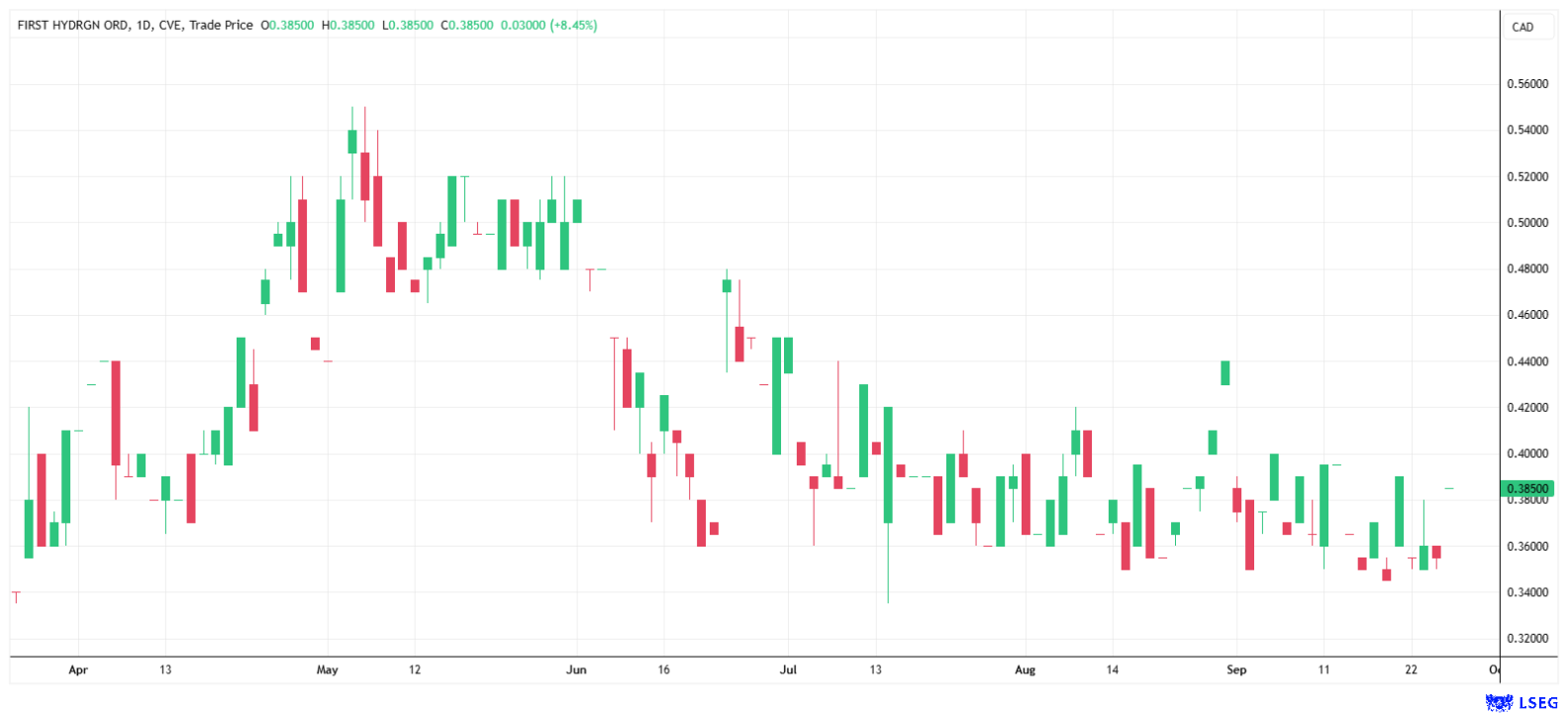
The latest announcement shows that the defence sector offers opportunities even for smaller technology providers. The Marsupial concept precisely addresses the operational pain points of Western armed forces—autonomous yet flexible solutions are in high demand. Technology companies naturally have high capital requirements, which must be managed strategically and wisely. This is where the latest successes could open doors. Successfully completing the modular drone platform could attract the financially strong partners, joint venture candidates, and government procurement agencies First Hydrogen urgently needs for its next major growth leap. The stock, much like the business model, is highly speculative. However, since the stock is trading near its 52-week low, experienced investors should keep an eye on First Hydrogen.
Conflict of interest
Pursuant to §85 of the German Securities Trading Act (WpHG), we point out that Apaton Finance GmbH as well as partners, authors or employees of Apaton Finance GmbH (hereinafter referred to as "Relevant Persons") may hold shares or other financial instruments of the aforementioned companies in the future or may bet on rising or falling prices and thus a conflict of interest may arise in the future. The Relevant Persons reserve the right to buy or sell shares or other financial instruments of the Company at any time (hereinafter each a "Transaction"). Transactions may, under certain circumstances, influence the respective price of the shares or other financial instruments of the Company.
In addition, Apaton Finance GmbH is active in the context of the preparation and publication of the reporting in paid contractual relationships.
For this reason, there is a concrete conflict of interest.
The above information on existing conflicts of interest applies to all types and forms of publication used by Apaton Finance GmbH for publications on companies.
Risk notice
Apaton Finance GmbH offers editors, agencies and companies the opportunity to publish commentaries, interviews, summaries, news and the like on news.financial. These contents are exclusively for the information of the readers and do not represent any call to action or recommendations, neither explicitly nor implicitly they are to be understood as an assurance of possible price developments. The contents do not replace individual expert investment advice and do not constitute an offer to sell the discussed share(s) or other financial instruments, nor an invitation to buy or sell such.
The content is expressly not a financial analysis, but a journalistic or advertising text. Readers or users who make investment decisions or carry out transactions on the basis of the information provided here do so entirely at their own risk. No contractual relationship is established between Apaton Finance GmbH and its readers or the users of its offers, as our information only refers to the company and not to the investment decision of the reader or user.
The acquisition of financial instruments involves high risks, which can lead to the total loss of the invested capital. The information published by Apaton Finance GmbH and its authors is based on careful research. Nevertheless, no liability is assumed for financial losses or a content-related guarantee for the topicality, correctness, appropriateness and completeness of the content provided here. Please also note our Terms of use.