July 13th, 2026 | 07:35 CEST
Nuclear Energy 3.0: Computing Power for AI and the Cloud – Standard Uranium, AMD, Broadcom, and SpaceX Can Deliver
According to McKinsey's forecasts, massive data center capacity will be needed to fully support global AI growth through 2030. In total, the high-tech industry will need to invest approximately USD 5.2 billion in AI infrastructure alone. At the same time, the International Energy Agency (IEA) forecasts that global electricity demand for the required computing power will more than double to 945 terawatt-hours. In this highly capital-intensive environment, AMD and Broadcom are positioning themselves as challengers in the chip market, while SpaceX is attracting visionary attention with its connectivity services and space-based energy concepts. Slightly upstream, but serving as an important bridge, is the uranium industry—a raw material that is in high demand for the construction of the next generation of power plants. Who is best positioned in this market?
time to read: 6 minutes | Author: André Will-Laudien
ISIN: STANDARD URANIUM LTD. | CA85422Q8487 | TSXV: STND , OTCQB: STTDF , BROADCOM INC. DL-_001 | US11135F1012 , SPACE EXPLORATION TECHNOLOGIES CORP | US84615Q1031 | NASDAQ: SPCX , ADVANCED MIC.DEV. DL-_01 | US0079031078
Table of contents:
Author

André Will-Laudien
Born in Munich, he first studied economics and graduated in business administration at the Ludwig-Maximilians-University in 1995. As he was involved with the stock market at a very early stage, he now has more than 30 years of experience in the capital markets.
Tag cloud
Shares cloud
Standard Uranium: The Demand for Uranium Is Growing
Global uranium production is dominated by just a few countries. With an annual output of around 22,800 metric tons, Kazakhstan accounts for nearly 43% of global supply and thus remains the undisputed market leader. It is followed by Canada with about 7,400 metric tons (14%), Namibia with around 6,300 metric tons (12%), Australia with about 4,600 metric tons (9%), and Uzbekistan with around 3,800 metric tons (7%). Together, these five countries account for about 85% of global uranium production. But demand continues to grow structurally: worldwide, there are currently about 440 nuclear reactors in operation, with about 70 more under construction, while numerous countries plan to significantly expand their nuclear energy capacities by 2050. The rising electricity demand from data centers for artificial intelligence, electric mobility, and industry is putting enormous pressure on the market, and high-quality uranium projects in politically stable regions are now in high demand. A key factor will be bringing the new projects to industrial-scale commercialization as quickly as possible.
Against this backdrop, Standard Uranium Ltd. is positioning itself with a broadly diversified project portfolio in Canada's Athabasca Basin, a region known worldwide for its particularly high-grade uranium deposits. The company follows a project generator model in which financing partners cover a significant portion of the exploration costs. This allows Standard Uranium to develop multiple projects simultaneously without placing an excessive strain on its own capital base, while management fees and earn-in agreements generate cash flow. The focus of current operations is the 30,737-hectare Davidson River Project, which lies along the same regional structural trends as the world-class Arrow and Triple R deposits. The company's largest-ever summer drilling program began there in early June. With two drilling rigs operating simultaneously, the company aims to drill approximately 8,000 m by September, following previous campaigns that yielded valuable geological insights from more than 16,500 m of drilling. The initial results from the ongoing program are already attracting attention. In drill hole DR-26-040, peak values of up to 1,650 counts per second (cps) were measured over a two-meter interval—the highest radioactivity reading recorded to date at Davidson River. At the same time, the drill holes penetrated strongly graphitic basement structures with pronounced hydrothermal alteration characterized by hematite and clay minerals. For geologists, these very features are considered classic indicators of uranium-bearing fluid systems and confirm the underlying exploration model.
In addition to the flagship project, other exploration programs are unlocking further ore potential. While high-grade uranium targets are being investigated at Corvo, a systematic drilling program has been launched for the first time at the Rocas project. There, partner Collective Metals is financing all exploration work under a CAD 4.5 million earn-in agreement. Important steps have also recently been taken on the financing front. In early July, the company successfully closed the first tranche of a private placement, raising CAD 889,700 in gross proceeds. A total of 8.897 million units were issued at CAD 0.10 each, with each unit comprising one share and half a warrant with an exercise price of CAD 0.15 and a term of 36 months. With a market capitalization of only about CAD 14 million, Standard Uranium remains one of the smaller exploration companies in the Athabasca Basin. But that does not have to stay that way if the much-anticipated drill results are delivered in September. Risk-aware investors are already accumulating shares in advance, and the ongoing offering is also a sweet deal thanks to the long-term warrant.
IIF host Lyndsay Malchuk speaks with CEO Jon Bey about the progress of the drilling program in the Athabasca Basin.
AMD and Broadcom: Fast Chips Drive Profits
The global AI boom is fundamentally transforming the semiconductor market, making data centers one of the industry's most important growth drivers. According to a McKinsey analysis, generative artificial intelligence could generate up to USD 4.4 trillion in additional economic output per year, while IDC expects global spending on AI infrastructure to more than double by 2028. AMD and Broadcom are among the companies benefiting in different ways from the massive wave of investment by hyperscalers. AMD, for example, is positioning itself as a serious alternative to Nvidia with high-performance CPUs and AI accelerators. The latest quarterly results were so strong that the stock jumped by over 20% upon their announcement. At one point, the share price reached USD 584, catapulting the company's valuation to just shy of the trillion-dollar mark. Revenue is expected to rise from around USD 35 billion to about USD 49 billion in 2026, with a target of USD 77 billion as early as next year. A 2027 P/E ratio of 41 therefore does not even seem overvalued. Analysts expect another significant increase in earnings in the upcoming quarterly results in early August. However, the stock has recently surged well beyond the consensus estimate of USD 510. This calls for a short-term correction in the uptrend.
Broadcom, on the other hand, valued at USD 1.9 trillion, pursues a more broadly diversified approach, combining a strong semiconductor business with high-margin software revenues from the VMware acquisition. This combination recently resulted in record revenue of USD 15.0 billion, EBITDA of USD 10.0 billion, and an exceptionally high operating margin of 67%, while revenue from AI semiconductors rose 46% to USD 4.4 billion. The fact that the stock came under significant pressure at times despite these results was primarily due to investors' already extremely high expectations rather than operational reasons. In the long term, both companies share the same strategic starting point: the expansion of AI data centers, rising demand for high-performance networks, and the growing need for energy-efficient processors are creating a structurally growing market for many years to come. While AMD is primarily focused on gaining market share in AI accelerators and server processors, Broadcom additionally benefits from its strong position in network chips, custom AI accelerators, and complementary enterprise software. On the LSEG Refinitiv platform, 47 out of 51 analysts are bullish, with a consensus price target of USD 509—26% higher than Friday's closing price. A sector with great prospects!
SpaceX: Limited Performance After the First 20 Trading Days
Amid enormous hype, the latest addition to Elon Musk's corporate empire, SpaceX, made its stock market debut. Following a heavily oversubscribed offering of 555 million shares at USD 135 each, the stock surged to an intraday high of USD 218 within its first 48 hours of trading, delivering a 60% gain for the fortunate investors who received an IPO allocation. Analysts on the LSEG platform were quick to weigh in as well. Of the 31 reports already submitted, 26 experts rate the stock a "Buy" with an average 12-month price target of USD 249, which would imply a market capitalization of USD 3.2 trillion. Analyst Edison Yu of Deutsche Bank also expects a price of USD 255 and assigns a "Buy" rating. Since its founding in 2002, SpaceX has incurred cumulative net losses in the double-digit billions. Between 2025 and mid-2026 alone, losses totaled nearly USD 10 billion, mainly due to massive investments in AI infrastructure, the Starship program, and the ongoing deployment of new Starlink satellites. However, it remains uncertain when the company will become sustainably profitable. Over the course of the week, the stock dropped to USD 145; some investors apparently wanted to lock in a small profit after all. A SpaceX critic who addressed the high valuation on X received the following comment from Elon Musk: "You do not seem to understand that SpaceX will be worth more than the rest of the world if we achieve our goals!" – Well then: Good luck!
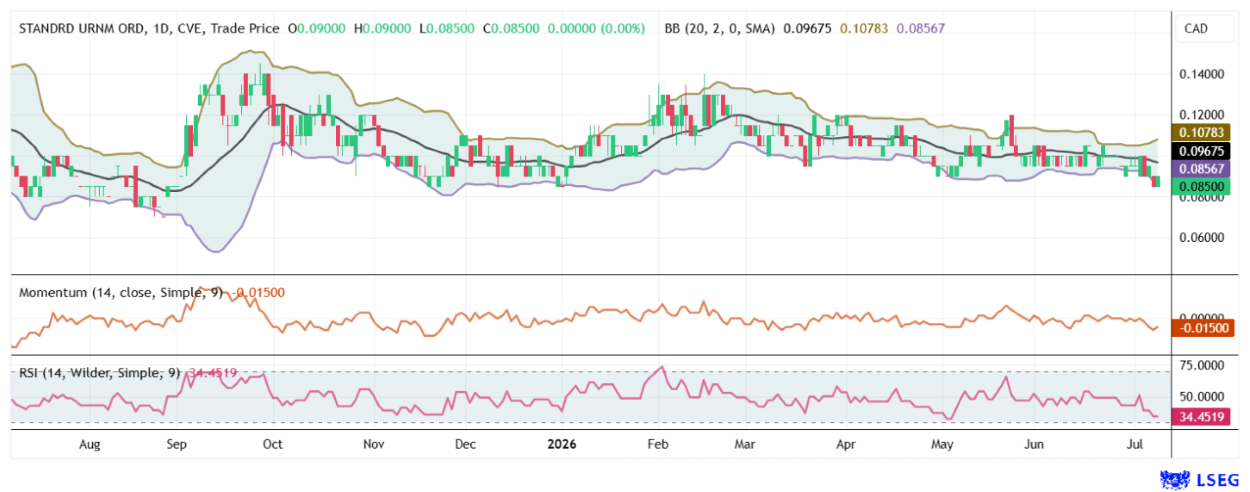
Growth markets remain firmly in expansion mode. Chipmakers such as Advanced Micro Devices (AMD) and Broadcom continue to benefit from exceptionally strong demand for their products. SpaceX remains a standout story, recalling the early days of Tesla—no profits, yet a valuation in the hundreds of billions. Elon Musk appears to be repeating that success on an even larger scale. Meanwhile, Standard Uranium, a player in the critical minerals sector, is benefiting from the broader backdrop of increasingly strained global supply chains.
Conflict of interest
Pursuant to §85 of the German Securities Trading Act (WpHG), we point out that Apaton Finance GmbH as well as partners, authors or employees of Apaton Finance GmbH (hereinafter referred to as "Relevant Persons") currently hold or hold shares or other financial instruments of the aforementioned companies and speculate on their price developments. In this respect, they intend to sell or acquire shares or other financial instruments of the companies (hereinafter each referred to as a "Transaction"). Transactions may thereby influence the respective price of the shares or other financial instruments of the Company.
In this respect, there is a concrete conflict of interest in the reporting on the companies.
In addition, Apaton Finance GmbH is active in the context of the preparation and publication of the reporting in paid contractual relationships.
For this reason, there is also a concrete conflict of interest.
The above information on existing conflicts of interest applies to all types and forms of publication used by Apaton Finance GmbH for publications on companies.
Risk notice
Apaton Finance GmbH offers editors, agencies and companies the opportunity to publish commentaries, interviews, summaries, news and the like on news.financial. These contents are exclusively for the information of the readers and do not represent any call to action or recommendations, neither explicitly nor implicitly they are to be understood as an assurance of possible price developments. The contents do not replace individual expert investment advice and do not constitute an offer to sell the discussed share(s) or other financial instruments, nor an invitation to buy or sell such.
The content is expressly not a financial analysis, but a journalistic or advertising text. Readers or users who make investment decisions or carry out transactions on the basis of the information provided here do so entirely at their own risk. No contractual relationship is established between Apaton Finance GmbH and its readers or the users of its offers, as our information only refers to the company and not to the investment decision of the reader or user.
The acquisition of financial instruments involves high risks, which can lead to the total loss of the invested capital. The information published by Apaton Finance GmbH and its authors is based on careful research. Nevertheless, no liability is assumed for financial losses or a content-related guarantee for the topicality, correctness, appropriateness and completeness of the content provided here. Please also note our Terms of use.