June 15th, 2026 | 07:45 CEST
Lithium Makes a Comeback: Processing Is a Bottleneck for Mercedes-Benz and Siemens Energy – Rock Tech Lithium Breaks the Monopoly
With scarce raw material reserves in the West, a more restrictive trade policy, and China still holding a monopoly on raw material processing, the situation surrounding battery-grade raw materials calls for action. After the price of lithium hit a preliminary low in June 2025, "white gold" saw a robust recovery of around 180% by February 2026, reaching a high of USD 10.48 per pound. The real bottleneck, however, is not extraction, but the chemical refinement into high-purity lithium hydroxide monohydrate for battery applications. Since a comprehensive investigation by the US Department of Commerce now classifies lithium supply security as a matter of national security, the development of resilient domestic processing infrastructure has moved to the forefront of industry priorities. The German-Canadian company Rock Tech Lithium plays a crucial role.
time to read: 3 minutes | Author: Nico Popp
ISIN: ROCK TECH LITHIUM | CA77273P2017 , MERCEDES-BENZ GROUP AG | DE0007100000 , SIEMENS ENERGY AG NA O.N. | DE000ENER6Y0
Table of contents:
Author

Nico Popp
At home in Southern Germany, the passionate stock exchange expert has been accompanying the capital markets for about twenty years. With a soft spot for smaller companies, he is constantly on the lookout for exciting investment stories.
Tag cloud
Shares cloud
Mercedes-Benz: Margin Pressure Calls for New Approaches
As part of its electric vehicle push, the Stuttgart-based premium automaker Mercedes-Benz is relying on a direct raw material sourcing model to secure access to battery-grade precursors. The group purchases the required lithium hydroxide directly from qualified producers and makes it available to its battery cell partners to guarantee maximum transparency in accordance with sustainability standards. A corresponding agreement is also in place with Rock Tech Lithium.
Nevertheless, the group is suffering from significant margin pressure, as net profit fell by around 49% to EUR 5.3 billion in fiscal year 2025, while free cash flow from the industrial business declined to EUR 5.4 billion. On the stock market, the share price is in a downward trend and is trading near its annual low. To free up liquidity for future investments, the group is preparing to sell parts of its stake in Daimler Truck in 2026, with a market value of around EUR 12 billion. Pressure is mounting on Mercedes as the strict guidelines of the EU Battery Passport will require seamless traceability across the supply chain starting in February 2027.
Siemens Energy: Record Order Backlog and Tailwind
Siemens Energy is focusing on the green transformation of industry and is benefiting from growing demand through its Grid Technologies division and stationary battery storage systems. The business model is based on the turnkey construction of large-scale storage facilities, which are secured by long-term service contracts with availability guarantees covering terms of 10 to 20 years.
In fiscal year 2025, the group increased its revenue by 15.2% to EUR 39.1 billion, while free cash flow before taxes reached a record high of EUR 4.66 billion, enabling the company to redeem government guarantees. Siemens Energy's order backlog surged to a new record level of EUR 138 billion. To drive the automation and scaling of lithium conversion in North America, the regional subsidiary of the Siemens parent company, Siemens Canada, is collaborating closely with the German-Canadian lithium company Rock Tech to develop technology that simulates future converter plants using digital twin software and to advance their planning more efficiently.
Rock Tech Lithium: Integrated Mine-to-Converter Strategy in Secure Jurisdictions
The cleantech company Rock Tech Lithium aims to play a pivotal role in lithium extraction and processing to break the Asian monopoly. The core of Rock Tech's upstream operations is the Georgia Lake project in Ontario, which holds indicated resources of 10.60 million tonnes of ore with a grade of 0.88% lithium oxide. The preliminary feasibility study envisages a combined open-pit and underground mining operation for the project and had already projected positive key figures for 2022. However, Rock Tech now believes it can further optimize these conditions.
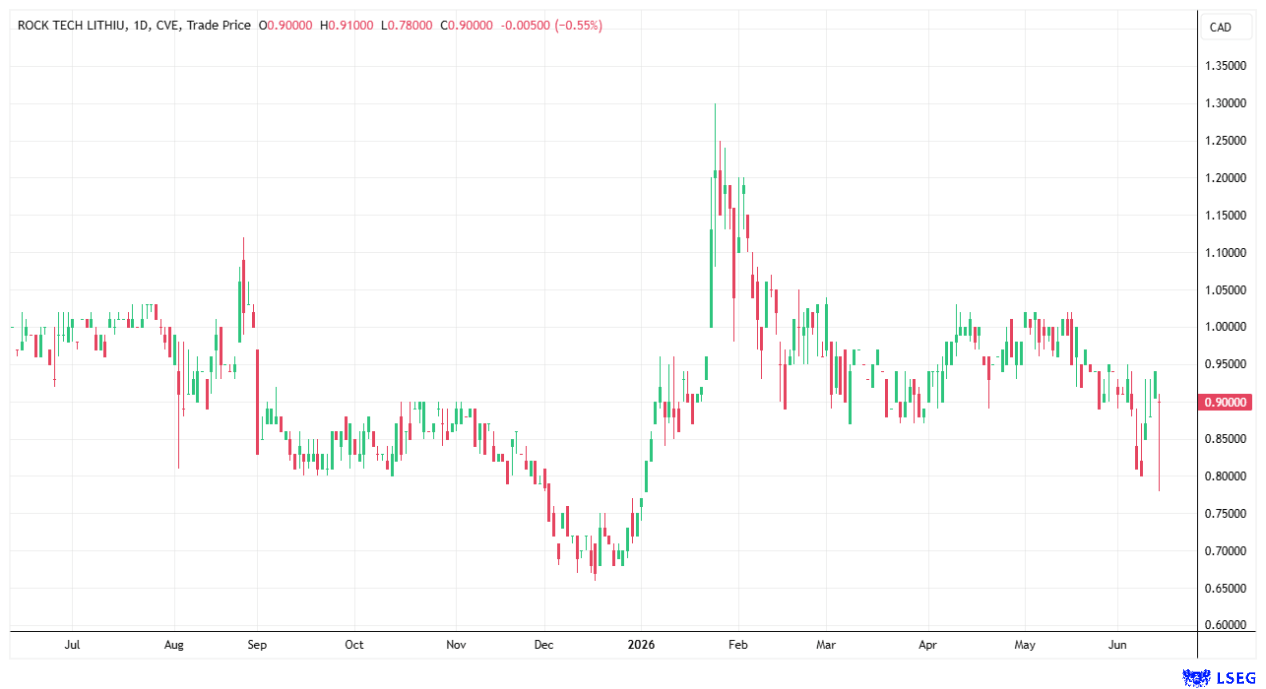
The 2023 winter drilling program confirmed the geological continuity of the ore bodies through high-grade lab results, with drill hole MV-23-05 returning a peak value of 1.66% lithium oxide over 2.7 m. Initial preparations for the Guben converter in Germany have been fully approved to produce 24,000 tonnes of battery-grade lithium hydroxide annually. Rock Tech is adopting a decentralized operator model with general partner/limited partner structures to license its lithium processing expertise to investors and generate ongoing revenue streams with minimal capital investment. For the North American Red Rock converter project in Canada, with a planned capacity of 32,000 tonnes, Rock Tech established a strategic anchor partnership worth CAD 200 million with the Canadian BMI Group. This model reduces financing risks for the approximately 337-acre site, which features a direct rail connection and a 120 MW power supply.
Conclusion: Rock Tech Gains Momentum – Insiders Buy Shares
Although the lithium ramp-up has faltered in recent years, particularly in Europe, the goals remain the same—many sectors in mobility and industry are being electrified and therefore have a critical need for lithium. With its partnerships, including one with Mercedes-Benz that provides for the delivery of an average of 10,000 tonnes of lithium hydroxide per year over a five-year term, Rock Tech has long been regarded as a serious partner for industry players. As country risk in supply chains for raw materials is now being reassessed, Rock Tech's approach—with mines and processing plants in Canada and Germany—is even better suited to the current climate and justifies valuation premiums. Added to this is more extensive mining activity on both sides of the Atlantic, from which the company is also likely to benefit. After years of struggling, Rock Tech's stock is once again worth considering, as the company has everything it needs to gain further operational momentum. Given that Supervisory Board Chairman Dirk Harbecke purchased shares himself in early 2026 and the company is valued at around EUR 100 million, the odds are good for a revaluation of this lithium player.
Watch YouTube videoConflict of interest
Pursuant to §85 of the German Securities Trading Act (WpHG), we point out that Apaton Finance GmbH as well as partners, authors or employees of Apaton Finance GmbH (hereinafter referred to as "Relevant Persons") may hold shares or other financial instruments of the aforementioned companies in the future or may bet on rising or falling prices and thus a conflict of interest may arise in the future. The Relevant Persons reserve the right to buy or sell shares or other financial instruments of the Company at any time (hereinafter each a "Transaction"). Transactions may, under certain circumstances, influence the respective price of the shares or other financial instruments of the Company.
In addition, Apaton Finance GmbH is active in the context of the preparation and publication of the reporting in paid contractual relationships.
For this reason, there is a concrete conflict of interest.
The above information on existing conflicts of interest applies to all types and forms of publication used by Apaton Finance GmbH for publications on companies.
Risk notice
Apaton Finance GmbH offers editors, agencies and companies the opportunity to publish commentaries, interviews, summaries, news and the like on news.financial. These contents are exclusively for the information of the readers and do not represent any call to action or recommendations, neither explicitly nor implicitly they are to be understood as an assurance of possible price developments. The contents do not replace individual expert investment advice and do not constitute an offer to sell the discussed share(s) or other financial instruments, nor an invitation to buy or sell such.
The content is expressly not a financial analysis, but a journalistic or advertising text. Readers or users who make investment decisions or carry out transactions on the basis of the information provided here do so entirely at their own risk. No contractual relationship is established between Apaton Finance GmbH and its readers or the users of its offers, as our information only refers to the company and not to the investment decision of the reader or user.
The acquisition of financial instruments involves high risks, which can lead to the total loss of the invested capital. The information published by Apaton Finance GmbH and its authors is based on careful research. Nevertheless, no liability is assumed for financial losses or a content-related guarantee for the topicality, correctness, appropriateness and completeness of the content provided here. Please also note our Terms of use.