July 28th, 2026 | 07:40 CEST
Energy Power Shift: US on the Rise, EU Under Pressure – A Look at Standard Uranium, E.ON, ITM, and Plug Power
The next wave of the AI revolution will be decided not by algorithms, but by megawatts. The US energy agency, the IEA, projects that data center electricity consumption will rise to just under 1,000 TWh by 2030. An analysis by Goldman Sachs goes even further, forecasting that electricity demand driven by AI workloads could rise by up to 160% over the same period. This brings an often-underestimated question to the forefront of the capital markets: Who will supply the energy for the digital age? Utilities like E.ON and hydrogen specialists such as ITM Power and Plug Power are small cogs in a large machine room. Countries like China, the US, and the dynamic EU member Poland have recognized the challenges and are mobilizing for their next phase of nuclear expansion. The race for electricity is on, and it will determine who will be among the big winners in the AI era. Globally, uranium production remains concentrated in just a few regions. This makes the market vulnerable to supply disruptions, permitting risks, and geopolitical disruptions. Standard Uranium demonstrates what consistent exploration can look like at a time when demand for uranium to fuel new power plant capacity is rising. It is worth taking a closer look.
time to read: 6 minutes | Author: André Will-Laudien
ISIN: E.ON SE NA O.N. | DE000ENAG999 , ITM POWER PLC LS-_05 | GB00B0130H42 , PLUG POWER INC. DL-_01 | US72919P2020 , STANDARD URANIUM LTD. | CA85422Q8487 | TSXV: STND , OTCQB: STTDF
Table of contents:
Author

André Will-Laudien
Born in Munich, he first studied economics and graduated in business administration at the Ludwig-Maximilians-University in 1995. As he was involved with the stock market at a very early stage, he now has more than 30 years of experience in the capital markets.
Tag cloud
Shares cloud
Standard Uranium: New Evidence of a Large-Scale Mineral System
The global uranium market is increasingly becoming a seller's market in 2026. While experts now estimate the annual supply deficit at around 30 million pounds of uranium, demand continues to grow due to the construction of new nuclear power plants and the rapidly rising electricity demand from AI data centers. Over the next 5 to 10 years, approximately 70 GW of additional reactor capacity will be added worldwide, potentially making high-quality exploration projects in politically stable regions into strategic acquisition targets. The sector's activity, driven by mining giants such as Cameco, suggests that a significant wave of consolidation is likely on the horizon. Major producers are securing promising deposits—a perfect environment for newcomer Standard Uranium, which has several exploration projects in the Athabasca Basin, a region regarded worldwide as the benchmark for high-grade uranium deposits.
The Corvo project is currently providing the strongest operational momentum. This is because the recently released laboratory analyses from the winter drilling campaign confirm for the first time that all nine completed drill holes intersected anomalous uranium mineralization. Particularly noteworthy is that six drill holes yielded significant uranium concentrations ranging from 100 to 350 ppm, while also demonstrating elevated uranium-to-thorium ratios of over 2:1. For exploration geologists, such values are considered a key indicator that hydrothermal uranium-bearing fluids have permeated the rock, confirming the presence of a mineralized system. In addition, significantly elevated concentrations of typical pathfinder elements such as boron were identified, reaching peak values of up to 13,600 ppm in drill hole CRV-26-002.
The geological interpretation also gains significant substance from the new data. The mineralization occurs in deformed paragneisses, pegmatites, and granitic orthogneisses and is concentrated along tectonically reactivated fault zones with quartz-carbonate veins. This distinctive combination of structure, alteration, and geochemistry characterizes numerous significant basement deposits in the Athabasca Basin. The current drilling program at Corvo is also the first exploration program on this project in more than 40 years. Despite this early stage, several mineralized targets were confirmed right away. Management is therefore already planning a second drilling phase as well as additional surface work, as there are still numerous untested targets along more than 25 km of structural corridors. Further momentum is provided by the historic surface discovery in the Manhattan Zone, with grades of up to 8.10% U₃O₈—a bonanza grade, as gold diggers would say.
But the flagship Davidson River project is also making progress. The company's largest drilling campaign to date is currently underway there, totaling approximately 8,000 m of drilling spread across the three prioritized corridors: Warrior, Bronco, and Thunderbird. For the first time, target identification is based on high-resolution multiphysics data from Fleet Space Technologies combined with AI-powered target modeling from GoldSpot Discoveries. This technology-driven exploration approach significantly increases the likelihood of targeting structurally controlled uranium mineralization with greater precision than with traditional methods. The portfolio is complemented by additional partner-funded projects, such as Rocas, which, due to their structure, do not require significant capital investment. With a combination of several concurrent drilling programs, modern exploration methods, and a very low market capitalization of just CAD 14 million, Standard Uranium remains one of the most exciting exploration companies in the Athabasca Basin. Who knows what else might one day come to the surface here.
IIF host Lyndsay Malchuk speaks with CEO Jon Bey about the progress of the drilling program in the Athabasca Basin.
E.ON Embraces Digital Transformation: Grid Stability Through AI and Expansion in the UK Market
Amid global power shortages, the Essen-based energy conglomerate E.ON is aggressively advancing its digital transformation and strategically optimizing its infrastructure with state-of-the-art AI capabilities. Through strategic partnerships with providers such as Salesforce, the company is deploying cutting-edge agent-based artificial intelligence to consolidate data flows and balance the volatile power grid with AI support. In doing so, the long-established German conglomerate is positioning itself in a highly dynamic market environment that promises highly predictable revenues by focusing on regulated grids and digital customer solutions.
A key milestone in this growth strategy is the planned acquisition of the British energy provider OVO Energy for an estimated 600 million pounds, which will make E.ON the market leader in the British residential electricity business. Although OVO was recently deep in the red and failed to meet the strict regulatory capital requirements set by British authorities, the acquisition offers significant opportunities for turnaround and scaling. E.ON management plans to replicate the proven restructuring strategy used in the earlier Npower acquisition to increase operating profit by a solid 5% over the long term. Through this move, the group also secures valuable access to state-of-the-art, flexible digital rate plans in the highly advanced British energy market. Recent analyst estimates on the LSEG platform point to a median 12-month price target of EUR 19.60. The positive estimates from Baader Europe and ODDO BHF stand out at EUR 21.40 and EUR 22.00, respectively. With a consistently rising dividend currently at 3.5%, E.ON remains a solid source of returns. Nevertheless, some market observers are urging operational caution due to OVO's temporary profitability issues and persistently high interest rates.
Plug Power and ITM Power: Can Hydrogen Solve the Global Energy Crisis?
That is a good question, because since the major stock market surge for hydrogen in 2021, valuations have come back down by 70 to 95%. However, industry pioneers Plug Power and ITM Power continue to be in the media spotlight even today. A recent study by the International Energy Agency (IEA) supports this fundamental growth and forecasts that global investment in electrolysis projects will rise dramatically. On the fundamentals front, however, this momentum is reflected in markedly different financial results for the two companies. Although US giant Plug Power shone in the first quarter with a 22% increase in revenue, it posted a net loss of USD 245 million. To generate fresh liquidity of approximately USD 275 million, management is resorting to radical measures and monetizing assets through a spectacular deal with Stream Data Centers. Despite this capital injection, the negative gross margin of 13% continues to weigh on investor sentiment. Hope lies with the ambitious new leadership under CEO Jose Luis Crespo, who has already announced that the company will reach the EBITDA break-even point as early as the fourth quarter. The exciting Q2 figures are expected on August 12.
On the other side of the Atlantic, the British company ITM Power is taking a significantly more defensive, but more profitable, course. A spectacular major contract with Rheinmetall for NATO forces catapulted the share price up by a staggering 300% in April, but this gain has since corrected by 60%. Nevertheless, the British company can proudly point to a well-filled order book of GBP 152 million, of which a remarkable 71% already consists of decidedly profitable contracts. Thanks to this strong order backlog, ITM Power optimistically raised its full-year revenue forecast to up to GBP 43 million. Nevertheless, at the end of the day, the books show an estimated adjusted EBITDA operating loss of GBP 27 to 29 million. Ultimately, a direct comparison with Plug Power reveals that while technological maturity is advancing rapidly, financial sustainability in the sector remains a balancing act. The path to true market maturity continues to require enormous operational discipline from both players. Investors' primary interest is therefore likely to remain speculative in nature.
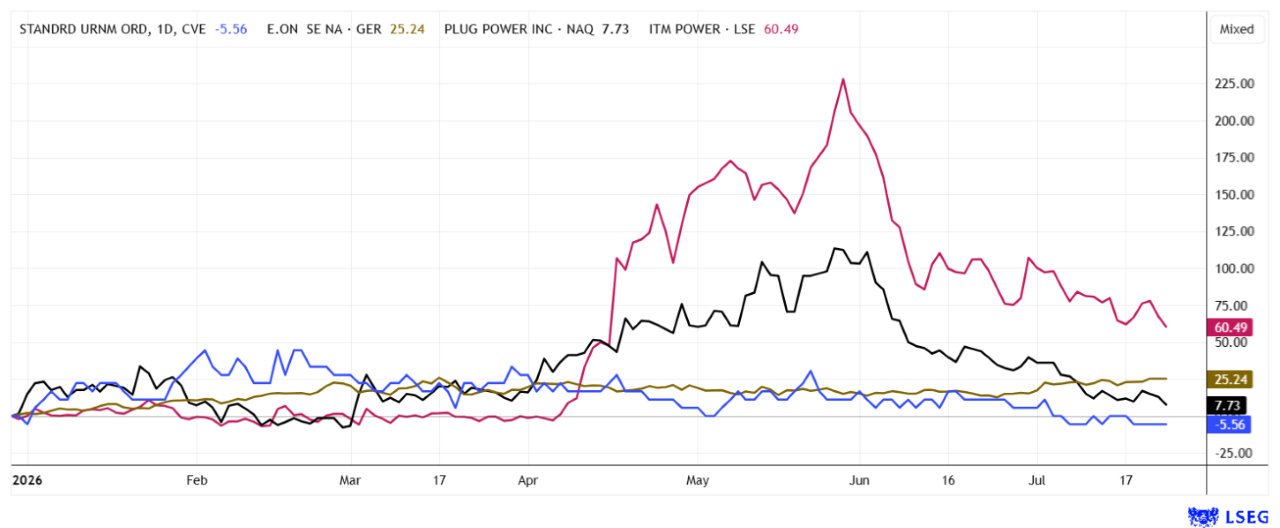
The energy markets remain in an upward trend. However, utility stocks such as E.ON, Plug Power, and ITM Power are progressing at varying paces. While E.ON is tapping into new profit margins in the UK, hydrogen innovations are advancing only slowly, creating a highly volatile environment—especially for speculative investors. Standard Uranium, with its forward-looking corporate strategy in the critical metals sector, demonstrates how a broad exploration portfolio can enable a company to be active on multiple fronts simultaneously.
Conflict of interest
Pursuant to §85 of the German Securities Trading Act (WpHG), we point out that Apaton Finance GmbH as well as partners, authors or employees of Apaton Finance GmbH (hereinafter referred to as "Relevant Persons") currently hold or hold shares or other financial instruments of the aforementioned companies and speculate on their price developments. In this respect, they intend to sell or acquire shares or other financial instruments of the companies (hereinafter each referred to as a "Transaction"). Transactions may thereby influence the respective price of the shares or other financial instruments of the Company.
In this respect, there is a concrete conflict of interest in the reporting on the companies.
In addition, Apaton Finance GmbH is active in the context of the preparation and publication of the reporting in paid contractual relationships.
For this reason, there is also a concrete conflict of interest.
The above information on existing conflicts of interest applies to all types and forms of publication used by Apaton Finance GmbH for publications on companies.
Risk notice
Apaton Finance GmbH offers editors, agencies and companies the opportunity to publish commentaries, interviews, summaries, news and the like on news.financial. These contents are exclusively for the information of the readers and do not represent any call to action or recommendations, neither explicitly nor implicitly they are to be understood as an assurance of possible price developments. The contents do not replace individual expert investment advice and do not constitute an offer to sell the discussed share(s) or other financial instruments, nor an invitation to buy or sell such.
The content is expressly not a financial analysis, but a journalistic or advertising text. Readers or users who make investment decisions or carry out transactions on the basis of the information provided here do so entirely at their own risk. No contractual relationship is established between Apaton Finance GmbH and its readers or the users of its offers, as our information only refers to the company and not to the investment decision of the reader or user.
The acquisition of financial instruments involves high risks, which can lead to the total loss of the invested capital. The information published by Apaton Finance GmbH and its authors is based on careful research. Nevertheless, no liability is assumed for financial losses or a content-related guarantee for the topicality, correctness, appropriateness and completeness of the content provided here. Please also note our Terms of use.