June 17th, 2026 | 07:10 CEST
Innovative Nuclear Power Drives AI Computing! Oklo, NuScale, American Atomics, and Siemens Energy
And right back to square one! While capital markets were braced for a correction in early June, two major events completely shifted the landscape. First, Elon Musk successfully listed his flagship venture, SpaceX, on the stock market at a staggering USD 1.7 trillion valuation. Second, US President Donald Trump announced a breakthrough resolution to the Iran conflict. This created the ultimate breeding ground for market optimism: stocks, gold, and silver surged upward, while interest rates and oil prices plummeted. Lower inflation revives the possibility of interest rate cuts in an already bubble-like tech environment, drawing vivid comparisons to the dot-com era of 2000. Today, it is the soaring profits of semiconductor manufacturers that are driving the markets. Whether artificial intelligence (AI) will start turning a profit anytime soon is highly debatable. US investment bankers are anticipating a fee bonanza worth tens of billions of dollars from the next wave of trillion-dollar IPOs. The prerequisite: the party must continue. Anyone who does the math carefully will realize that, amid all the euphoria, cheap electricity has become the lifeblood of the tech industry. This is where nuclear energy is regaining its relevance. For investors, the key question is which stocks to include in their portfolios now.
time to read: 7 minutes | Author: André Will-Laudien
ISIN: SIEMENS ENERGY AG NA O.N. | DE000ENER6Y0 , AMERICAN ATOMICS INC | CA0240301089 | CSE: NUKE , OKLO INC | US02156V1098 , NUSCALE POWER CORPORATION | US67079K1007
Table of contents:
Author

André Will-Laudien
Born in Munich, he first studied economics and graduated in business administration at the Ludwig-Maximilians-University in 1995. As he was involved with the stock market at a very early stage, he now has more than 30 years of experience in the capital markets.
Tag cloud
Shares cloud
Oklo and NuScale: Who Will Build the First Functioning SMR?
For the US president, the Iran conflict is a catalyst for shifting public opinion on nuclear energy. Despite record-high oil and gas production in the US, prices for consumers at the gas station remain historically high. This is causing widespread dissatisfaction with the President's policies, and the crucial midterm elections are approaching. The current euphoria surrounding Small Modular Reactors (SMRs) is somewhat reminiscent of the early years of the wind and solar industries. The technology is considered promising, and demand appears to be there, but regulatory, technical, and financial hurdles still stand between the vision and commercial reality. Two companies are particularly in the spotlight of the capital markets: Oklo and NuScale Power. Both are pursuing different concepts but are at different points along the same development curve.
From a regulatory standpoint, NuScale has been the clear frontrunner so far. Back in 2020, the company became the world's first SMR provider to receive a Standard Design Approval from the US regulatory agency, the NRC, for its original 50-MW design. This was followed in 2025 by approval of the more powerful 77-MW version, which is now marketed as the ENTRA1 plant. As a result, NuScale currently has the only SMR design in the US that has been largely approved by regulatory authorities. High hopes are now pinned on the first project in Romania. There, NuScale is working with the state-owned energy provider Nuclearelectrica on a plant featuring six modules and a total capacity of approximately 460 MW. As things stand, the goal is to begin construction toward the end of this decade, with commissioning expected around 2029. The project is backed by billions in financing commitments from the US government. The US EXIM Bank alone has pledged up to USD 3 billion, while the US Development Finance Corporation has committed an additional USD 1 billion.
Oklo, on the other hand, is pursuing a significantly different approach. Instead of a traditional light-water reactor, the company is developing Aurora, a fast sodium reactor intended to be smaller, more compact, and more cost-effective to operate over the long term. The risk is higher, however, as the technology is less established from a regulatory standpoint. In 2022, Oklo's first NRC license application was rejected; in May 2026, the NRC finally accepted the reactor's basic design criteria, while the DOE approved the preliminary safety analysis in June 2026. The construction site in Idaho is already in the early stages of preparation. This marks Oklo's first move from the conceptual phase toward actual implementation.
Financing is not currently a bottleneck. Following its SPAC-based IPO and several capital raises, Oklo has several hundred million dollars in liquidity. In 2025 alone, the company raised an additional approximately USD 400 million in equity. The current market valuations of both companies already reflect significant expectations regarding future power supply for data centers and AI infrastructure. Although both stocks have lost a good 75% from their all-time highs, investor confidence appears unwavering. Profits are hardly expected before 2033, especially since a functioning reference model must first be connected to the grid!
American Atomics: Keeping an Eye on the Entire Supply Chain
Oil at USD 125—that came as a shock in March 2026, when the first missiles were fired at Iran. Iran is not supposed to be enriching uranium, yet the issue is taking center stage among political decision-makers elsewhere. Due to ongoing disruptions in the fossil fuel supply chain, nuclear energy is experiencing a global renaissance. However, the supply of uranium threatens to fall short of future demand. Industry leaders such as Cameco point to a structural supply deficit, as the volumes of uranium secured through long-term supply contracts still fall significantly short of global annual consumption.
In such an environment, exploration and development companies with promising projects in politically stable regions are increasingly coming into focus for investors. The Canadian company American Atomics continues to stand out with an ambitious strategy that goes far beyond traditional mineral exploration. The company is pursuing the establishment of a vertically integrated North American uranium value chain, ranging from exploration and mining through processing to conversion and enrichment processes. It could thus benefit from increasing demand for supply security.
An important milestone has now been reached with the first NI 43-101-compliant resource estimate for the Blue Streak project in the US state of Colorado. The project comprises 194 claims covering approximately 3,400 acres in the historic Uravan Mineral Belt, a region that has been one of North America's most significant uranium and vanadium areas for more than a century. Historical production data underscores the property's quality. The Pickett Corral Mine alone produced nearly 294,000 pounds of uranium oxide and almost 2 million pounds of vanadium oxide during earlier phases of operation. The current resource estimate includes approximately 124,900 pounds of contained triuranium octoxide (U₃O₈) across all categories; it is one of the most important chemical compounds and the most common form of uranium oxide, serving as an intermediate product in the manufacture of nuclear fuel.
However, the exploration potential beyond this appears particularly interesting. A total of 693 historical drill holes have been identified in the project area; analysis of these reveals several target areas with significant expansion potential. At the same time, historical data indicate significant vanadium deposits, which could enable Blue Streak to benefit from two strategically important raw materials in the future. The company is currently working to obtain the necessary permits to resume mining in the medium term. The most recent financing round of CAD 2 million, based on CAD 0.25 per share, should last for several more months. Given the company's strong positioning, historically verified resources, and promising prospects in the US nuclear power push, a market valuation of just under CAD 20 million appears very low. Time to buy!
Co-founder Conor Lynch discusses American Atomics' strategic direction in an interview with IIF host Lyndsay Malchuk.
Siemens Energy: Demand Remains Unabated
Europe is facing a rocky road when it comes to energy. Although Germany is now a pioneer in wind power, Siemens Energy warns of a bottleneck in offshore wind turbines across Europe. If policymakers continue to delay expansion, the affected companies will have to cut capacity and downsize plants due to resource constraints starting in 2028. Vinod Philip, head of the Siemens Gamesa wind division, said the EU is currently about 40 gigawatts short of offshore wind capacity to reach its 2030 target of 120 GW. The European supplier association has already invested EUR 14 billion, but a lack of follow-on orders could force production facilities into fierce competition for contracts starting in 2028, triggering price wars.
At the same time, demand for gas turbines at Siemens Energy is booming massively, driven by two factors: the war in Iran and the excessive expansion of AI data centers. The Gulf states are putting new gas-fired power plants out to tender to strengthen their energy systems, while hyperscalers continue to place large orders for AI applications. CEO Christian Bruch confirms that data centers account for about a quarter of the gas turbine order backlog, with the US market representing 30 to 40% of the global market of 100 to 120 gigawatts. "We are firing on all cylinders," said Bruch, noting that capacity will continue to increase through 2030, but that more is not currently possible. The company is operating at full capacity; delivery times might be shortened by three to six months in 2029 or 2030. Investors took advantage of the peak prices above EUR 190 to exit their positions, thereby heeding our warnings. Since the plunge last week even reached as low as EUR 138, we believe the biggest sell-off has likely already occurred. The share is now in neutral territory; mwb research and DZ Bank see further room for adjustment with price targets of EUR 100 and EUR 128, respectively.
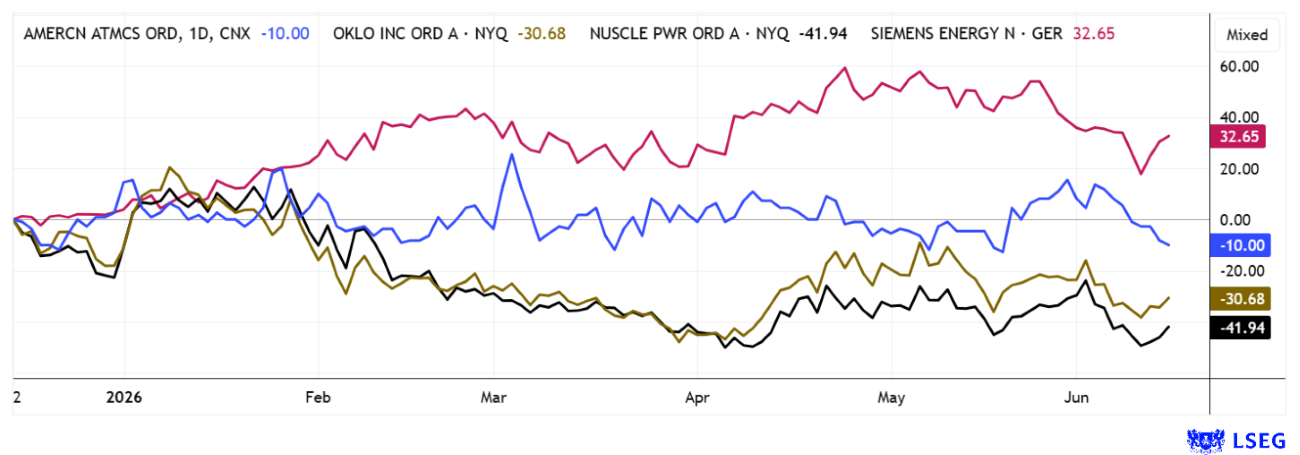
The energy markets are currently being reshuffled. With the announcement of the "Iran solution," Brent crude oil plummeted 30% to USD 79, and oil stocks are experiencing their biggest sell-off since March 2026. Investors should keep a close eye on the nuclear energy and uranium sector, as a wave of investment is expected to sweep through it in the coming years. Then, alongside top pick American Atomics, Siemens Energy could also make a fresh run.
Conflict of interest
Pursuant to §85 of the German Securities Trading Act (WpHG), we point out that Apaton Finance GmbH as well as partners, authors or employees of Apaton Finance GmbH (hereinafter referred to as "Relevant Persons") currently hold or hold shares or other financial instruments of the aforementioned companies and speculate on their price developments. In this respect, they intend to sell or acquire shares or other financial instruments of the companies (hereinafter each referred to as a "Transaction"). Transactions may thereby influence the respective price of the shares or other financial instruments of the Company.
In this respect, there is a concrete conflict of interest in the reporting on the companies.
In addition, Apaton Finance GmbH is active in the context of the preparation and publication of the reporting in paid contractual relationships.
For this reason, there is also a concrete conflict of interest.
The above information on existing conflicts of interest applies to all types and forms of publication used by Apaton Finance GmbH for publications on companies.
Risk notice
Apaton Finance GmbH offers editors, agencies and companies the opportunity to publish commentaries, interviews, summaries, news and the like on news.financial. These contents are exclusively for the information of the readers and do not represent any call to action or recommendations, neither explicitly nor implicitly they are to be understood as an assurance of possible price developments. The contents do not replace individual expert investment advice and do not constitute an offer to sell the discussed share(s) or other financial instruments, nor an invitation to buy or sell such.
The content is expressly not a financial analysis, but a journalistic or advertising text. Readers or users who make investment decisions or carry out transactions on the basis of the information provided here do so entirely at their own risk. No contractual relationship is established between Apaton Finance GmbH and its readers or the users of its offers, as our information only refers to the company and not to the investment decision of the reader or user.
The acquisition of financial instruments involves high risks, which can lead to the total loss of the invested capital. The information published by Apaton Finance GmbH and its authors is based on careful research. Nevertheless, no liability is assumed for financial losses or a content-related guarantee for the topicality, correctness, appropriateness and completeness of the content provided here. Please also note our Terms of use.