August 4th, 2026 | 08:30 CEST
400% Upside with AI and Big Data? TeamViewer, SAP, and Aspermont Gain Momentum While Oracle Stumbles
Digital transformation is reaching a new stage of development through artificial intelligence and massive data streams, opening up historic return opportunities for visionary investors. While established tech giants like Oracle are currently faltering dangerously and risk missing the next wave of innovation, a new group of high-flyers is emerging at the forefront. The European software giant SAP is impressively demonstrating how the seamless integration of AI into global business processes leads to healthy margins and a return to share price growth. Also worth mentioning is the remote maintenance and software specialist TeamViewer, which is using sophisticated big data analytics to try to raise industrial efficiency to a new record level. Another absolute hidden gem is the commodities platform Aspermont, which is monetizing its historically accumulated data treasures using AI and is thus poised for a significant revaluation. Those who set the right course now and bet on data-driven pioneers will secure a low entry point into interesting turnaround candidates. The key lies in the right timing.
time to read: 5 minutes | Author: André Will-Laudien
ISIN: ASPERMONT LTD. | AU000000ASP3 | ASX: ASP , SAP SE O.N. | DE0007164600 , TEAMVIEWER AG INH O.N. | DE000A2YN900 , ORACLE CORP. DL-_01 | US68389X1054
Table of contents:
Author

André Will-Laudien
Born in Munich, he first studied economics and graduated in business administration at the Ludwig-Maximilians-University in 1995. As he was involved with the stock market at a very early stage, he now has more than 30 years of experience in the capital markets.
Tag cloud
Shares cloud
SAP and TeamViewer: This Looks Like a Breakout
The global software and ERP sector is undergoing a fundamental transformation driven by autonomous systems and cutting-edge cloud technologies. At the heart of this technological shift are two European companies that have endured a long and loss-ridden period of adjustment. The crux of the matter: Traditional ERP architecture is increasingly giving way to intelligent, self-learning control platforms. Software giant SAP is consistently capitalizing on this structural shift to embed data-driven business processes directly at the customer site. Since the last reporting quarter, investors have recognized that the accelerated migration of on-premises systems to the cloud generates highly transparent and recurring license revenue. Embedded AI applications also enable automated real-time decision-making and deliver significant productivity gains. Following a price pullback in May to the EUR 127–135 range, the DAX-listed stock has recently rebounded very strongly to approximately EUR 168. The aggregate price targets on LSEG Refinitiv of around EUR 208 signal an expected return of approximately 25% over a 12-month horizon. The technical breakout at around EUR 150 has also been confirmed.
Remote support specialist TeamViewer is also in a decisive phase of strategic realignment and has been showing clear signs of life on the stock market since last week. From its April low of EUR 4.11, the stock surged by nearly 70% to EUR 6.70 by early August. While the high-margin Enterprise segment serves as the remaining growth driver, business with small and medium-sized enterprises (SMEs) is currently stagnating. The operational integration of the latest acquisition, 1E, continues to require management resources and strategic fine-tuning. Consequently, the private bank Berenberg has maintained its rating for TeamViewer at "Hold" with a price target of EUR 6.70. In a report published yesterday following the Q2 results, analyst Gustav Froberg highlighted the software group's business with corporate clients. The encouraging progress with major clients was supported by strong demand for the "TeamViewer ONE" platform. However, the operational turnaround is likely to take some time. 8 out of 16 experts on the LSEG platform agree on a median 12-month price target of EUR 8.43, which is still a good 30% above yesterday's closing price.
Aspermont: Big Data and AI Specialist for the Global Mining Industry Posts Record Revenue
In the tech industry, the most important raw material is data. About 50 years ago, the new industrial trend of "data processing" began, which later evolved into information technology (IT). Today, there are a wide variety of high-tech segments, but they all use data models to drive modern technologies. A major collector of data from the commodities sector is the Australian company Aspermont. The company has long since ceased to be a traditional media conglomerate and has instead become a specialized B2B data and intelligence company focused on the international commodities and mining industry. Aspermont monetizes the content it has built up over more than 190 years through digital subscriptions, databases, marketing services, industry events, and, increasingly, AI-powered analytics platforms. At the heart of its business model are recurring subscription revenues, which generate stable cash flows while simultaneously financing the development of new, high-margin data products. With this scalable platform approach, Aspermont positions itself as an indispensable provider of information and data for mining companies, investors, banks, and suppliers across the entire value chain.
The Aspermont ecosystem now comprises more than 4,000 corporate clients in over 150 countries, with more than a quarter of the Fortune 100 companies utilizing the company's services. The stable subscription base continues to form the foundation of the growth strategy and has now grown for the 40th consecutive quarter. Annual Recurring Revenue (ARR) currently stands at approximately AUD 11 million and has shown steady growth over the past few years. At the same time, average revenue per user (ARPU) has been growing at a double-digit rate for years, underscoring the successful monetization of existing customers. With Mining IQ, Aspermont now has an AI-powered platform that processes historical archives, project data, and risk analyses into new digital products for customers such as Rio Tinto.
The latest third-quarter figures show a significant acceleration. Revenue rose by 25% year-over-year to a record AUD 4.5 million, while non-subscription revenue improved by as much as 73%. Normalized EBITDA reached a key operational milestone by breaking even, after posting a loss of AUD 0.6 million in the same quarter of the previous year. Over the first nine months of the fiscal year, consolidated revenue increased to AUD 11.9 million, representing 18% growth, with 64% of revenue now coming from subscriptions and data licensing. For the coming quarters, management is focusing on expanding enterprise contracts, introducing additional data and intelligence products, and further monetizing the existing customer base.
Analysts at GBC Research view the investment case very positively. For the current fiscal year, they expect revenue of AUD 16.9 million and EBITDA of AUD 0.15 million. By 2028, revenue is projected to rise to AUD 21.3 million and EBITDA to increase to approximately AUD 2.93 million, representing a clear scaling up of operating profitability. The current valuation level is particularly striking: despite the prospect of significantly growing cash flows, the stock is trading below the level of many comparable data and software companies. Against this backdrop, GBC reaffirmed its "Buy" recommendation in June and raised its price target to AUD 5.45, or EUR 3.30, per share. At the current price of AUD 1.25, this implies substantial upside potential.
IIF host Lyndsay Malchuk interviewed the company's founder and CEO, Alex Kent, about the company's future prospects.
Oracle: Are AI Investments Starting to Get Out of Hand?
Oracle appears to have sent completely misleading signals to its investors. With massive investments of over USD 120 billion in its AI infrastructure, the company has taken on extreme debt and already posted a negative free cash flow of USD 23.7 billion in the last fiscal year, while its total debt ballooned to a staggering USD 130 billion. This aggressive expansion strategy, financed primarily through new bonds and loans, has already prompted rating agencies such as S&P Global to downgrade the tech giant's credit rating to BBB-. Investors reacted with outright panic in July, sending the share price to a two-year low of USD 114.75. However, in the wake of the broad recovery in software stocks, the price has been climbing steeply again since the end of last week. It is currently trading around USD 140. With a 2027 P/E ratio of 16, Oracle has reached a multi-year valuation low. Will CEO Larry Ellison be able to turn this around? It is incredibly exciting!
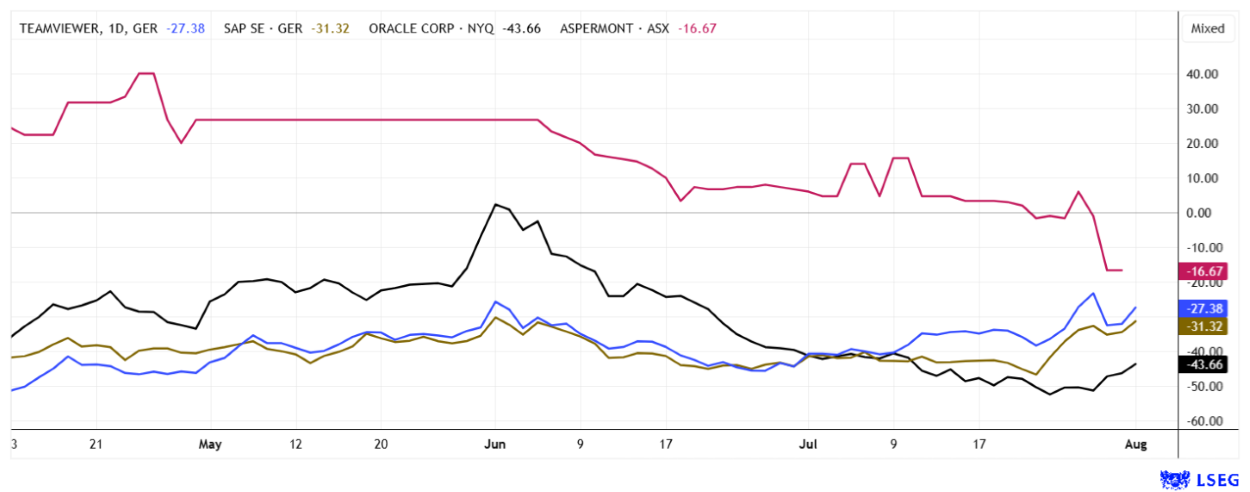
International stock markets are caught in a constant rollercoaster ride between strong earnings and dire geopolitical conditions. On the one hand, rising oil prices are fueling both inflation and interest rates; on the other, volatility shows no significant signs of abating. For investors looking to rebalance or diversify their portfolios, the long-beaten-down software sector is now offering opportunities once again. Valuations have fallen by as much as 50% compared to 2024.
Conflict of interest
Pursuant to §85 of the German Securities Trading Act (WpHG), we point out that Apaton Finance GmbH as well as partners, authors or employees of Apaton Finance GmbH (hereinafter referred to as "Relevant Persons") currently hold or hold shares or other financial instruments of the aforementioned companies and speculate on their price developments. In this respect, they intend to sell or acquire shares or other financial instruments of the companies (hereinafter each referred to as a "Transaction"). Transactions may thereby influence the respective price of the shares or other financial instruments of the Company.
In this respect, there is a concrete conflict of interest in the reporting on the companies.
In addition, Apaton Finance GmbH is active in the context of the preparation and publication of the reporting in paid contractual relationships.
For this reason, there is also a concrete conflict of interest.
The above information on existing conflicts of interest applies to all types and forms of publication used by Apaton Finance GmbH for publications on companies.
Risk notice
Apaton Finance GmbH offers editors, agencies and companies the opportunity to publish commentaries, interviews, summaries, news and the like on news.financial. These contents are exclusively for the information of the readers and do not represent any call to action or recommendations, neither explicitly nor implicitly they are to be understood as an assurance of possible price developments. The contents do not replace individual expert investment advice and do not constitute an offer to sell the discussed share(s) or other financial instruments, nor an invitation to buy or sell such.
The content is expressly not a financial analysis, but a journalistic or advertising text. Readers or users who make investment decisions or carry out transactions on the basis of the information provided here do so entirely at their own risk. No contractual relationship is established between Apaton Finance GmbH and its readers or the users of its offers, as our information only refers to the company and not to the investment decision of the reader or user.
The acquisition of financial instruments involves high risks, which can lead to the total loss of the invested capital. The information published by Apaton Finance GmbH and its authors is based on careful research. Nevertheless, no liability is assumed for financial losses or a content-related guarantee for the topicality, correctness, appropriateness and completeness of the content provided here. Please also note our Terms of use.