December 30th, 2025 | 09:30 CET
Higher, faster, further! Why NEO Battery Materials Could Be Among the Next Market Leaders in 2026
The year 2025 is coming to an end, but investors remain in full swing. At the end of the year, the conflict between growth and the availability of critical raw materials remains the focus of attention. While Rheinmetall and D-Wave achieved a significant marker in the increase in wealth of invested investors last year with a return of approximately 140%, there are also promising protagonists for 2026 who could take the baton in the relay race this time. In terms of the most important topics, battery systems stand out because, with the new EU-wide promotion of e-mobility next year, battery stocks that have lagged behind should come back into the picture. BYD is one of these high-tech industrial groups that, in addition to automobiles, also has the entire supply chain under control. NEO Battery Materials (NBM) is a true specialist in the adaptation of perfect battery systems. The Company combines patented silicon anode technology with production facilities in South Korea that are already operational. The plan is to achieve higher energy densities, faster charging, and lower costs than conventional lithium-ion batteries. At the same time, strong partnerships, from the South Korean defense industry to Fortune 500 OEMs, are opening up direct access to high-growth markets such as drones, robotics, and e-mobility.
time to read: 3 minutes | Author: André Will-Laudien
ISIN: NEO BATTERY MATERIALS LTD | CA62908A1003
Table of contents:
Author

André Will-Laudien
Born in Munich, he first studied economics and graduated in business administration at the Ludwig-Maximilians-University in 1995. As he was involved with the stock market at a very early stage, he now has more than 30 years of experience in the capital markets.
Tag cloud
Shares cloud
NEO Battery Materials – Market disruption through silicon power
The global e-mobility and drone markets are demanding significantly more powerful battery systems. Today, roughly 90% of lithium-ion cell manufacturing capacity is concentrated in Asia, with other countries still lagging far behind in their research efforts. This is exactly where NEO Battery Materials comes into play. The Canadian company specializes in silicon-enhanced lithium-ion technology, which enables higher energy densities, faster charging cycles, and improved cycle stability compared to conventional graphite-based solutions. With its proprietary NBMSiDE® anode, NEO targets a broad range of applications, including electric vehicles, grid storage, robotics, and defense technology. Strategically, North America remains the focal point of NEO's value-chain ambition, but operationally, the technology is being further developed in South Korea. Commercialization is now being driven forward at a rapid pace.
Technology with "TSMC DNA" – Customer-driven battery engineering
The approach of developing batteries closely in line with customer requirements is particularly exciting, similar to that of leading semiconductor manufacturer TSMC, which operates according to the specifications of world-renowned chip designers. Technologically, NEO integrates silicon into established Li-ion concepts, achieving performance increases of up to 40% depending on the application, as well as capacity advantages of several times that of graphite. Cost reduction and speed are just as important as absolute performance. The market is hot, as large OEMs are under delivery pressure and order books for drones, robotics, and AI electronics are bursting at the seams. This calls for tailor-made solutions that not only offer price advantages but also create real customer benefits. With its current positioning, NEO clearly stands out from standard Chinese products and could soon move up to the big leagues.
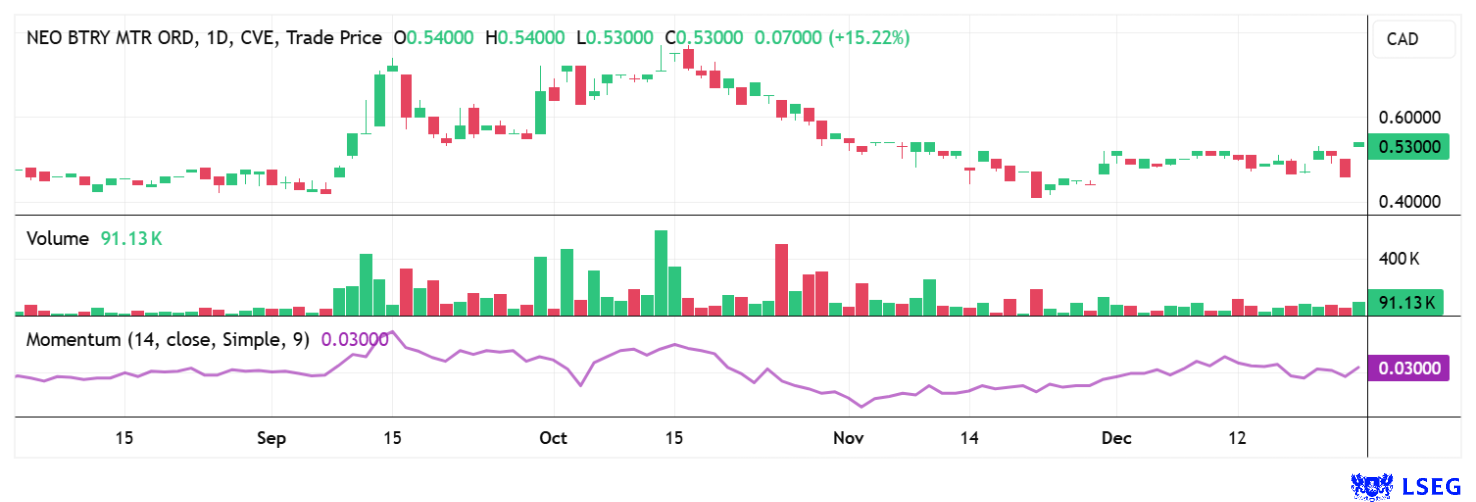
From research to the store shelf
The transition from the lab to the market has now finally taken place. NEO has leased an already operational production facility in South Korea to start directly on an industrial scale without construction risks. Already successfully producing in the megawatt-hour range, the capacity of the new systems can be doubled through shift expansion and automation. This will enable the Company to generate revenue on a larger scale for the first time from 2026 onwards, as all regulatory hurdles have already been cleared. Analysts are predicting significant growth rates in the market for battery electric vehicles (BEV/EV) in the coming years. Accordingly, detailed sector analyses indicate that the global market for e-mobility will grow at double-digit annual rates of approximately 14% from 2025 through at least 2035 (CAGR 2025-2035). High-performance next-generation batteries will be a key component of this growth.
Strategic opening in the defense sector
Shortly before Christmas, NEO announced a strategically important partnership with the Korea Institute for Defense Industry. The organization, accredited by the Ministry of Defense, provides NEO with access to South Korea's defense ecosystem. Within a joint task force, the Company's battery technologies will be tested and qualified for drone and UAS applications under operational conditions. This positions NEO within a highly regulated, rapidly growing high-tech segment and represents a meaningful validation milestone. Over the medium term, the partnership could elevate the Company into a new strategic dimension within an internationally recognized defense market, with potentially significant long-term value creation.
Danny Huh, SVP of Strategy & Operations, explains the details of his strategic positioning and the Company's medium-term growth strategy in an interview with IIF moderator Lyndsay Malchuk.
The commercialization of NBM batteries has begun. NEO has established scalable partnerships with drone and robotics companies, secured multi-year silicon anode supply agreements, and recently received initial battery orders from a Fortune 500 automaker in Asia. Production is planned in South Korea, with first meaningful revenues expected from 2026 onward. NEO Battery Materials combines technological excellence, growing industrial readiness, and strategic anchoring in one of the most important future growth markets. In addition, a market capitalization of CAD 75 million opens the door to institutional investors - marking the early phase of a potentially compelling battery growth story.
Conflict of interest
Pursuant to §85 of the German Securities Trading Act (WpHG), we point out that Apaton Finance GmbH as well as partners, authors or employees of Apaton Finance GmbH (hereinafter referred to as "Relevant Persons") currently hold or hold shares or other financial instruments of the aforementioned companies and speculate on their price developments. In this respect, they intend to sell or acquire shares or other financial instruments of the companies (hereinafter each referred to as a "Transaction"). Transactions may thereby influence the respective price of the shares or other financial instruments of the Company.
In this respect, there is a concrete conflict of interest in the reporting on the companies.
In addition, Apaton Finance GmbH is active in the context of the preparation and publication of the reporting in paid contractual relationships.
For this reason, there is also a concrete conflict of interest.
The above information on existing conflicts of interest applies to all types and forms of publication used by Apaton Finance GmbH for publications on companies.
Risk notice
Apaton Finance GmbH offers editors, agencies and companies the opportunity to publish commentaries, interviews, summaries, news and the like on news.financial. These contents are exclusively for the information of the readers and do not represent any call to action or recommendations, neither explicitly nor implicitly they are to be understood as an assurance of possible price developments. The contents do not replace individual expert investment advice and do not constitute an offer to sell the discussed share(s) or other financial instruments, nor an invitation to buy or sell such.
The content is expressly not a financial analysis, but a journalistic or advertising text. Readers or users who make investment decisions or carry out transactions on the basis of the information provided here do so entirely at their own risk. No contractual relationship is established between Apaton Finance GmbH and its readers or the users of its offers, as our information only refers to the company and not to the investment decision of the reader or user.
The acquisition of financial instruments involves high risks, which can lead to the total loss of the invested capital. The information published by Apaton Finance GmbH and its authors is based on careful research. Nevertheless, no liability is assumed for financial losses or a content-related guarantee for the topicality, correctness, appropriateness and completeness of the content provided here. Please also note our Terms of use.