June 22nd, 2026 | 07:05 CEST
HALEU Enrichment Bottleneck Threatens Cameco and Amazon—American Atomics Benefits
The electricity demand of AI data centers cannot be met by renewable energy alone—even the greatest idealists have come to understand this by now. The result is an unprecedented renaissance of nuclear energy. The latest "Red Book Report" from the OECD Nuclear Energy Agency (NEA) and the International Atomic Energy Agency shows that, with accelerated reactor expansion, existing mining capacity would not be sufficient to meet demand in the medium term. Decades of underinvestment in mining projects have led to a supply deficit, while geopolitical risks and severe production bottlenecks at the world's largest producer, Kazatomprom, are further exacerbating the situation. As a result, established players in the nuclear value chain are under pressure to act. Investors are capitalizing on this to make investments in secure jurisdictions.
time to read: 3 minutes | Author: Nico Popp
ISIN: AMERICAN ATOMICS INC | CA0240301089 | CSE: NUKE , CAMECO CORP. | CA13321L1085 , AMAZON.COM INC. DL-_01 | US0231351067
Table of contents:
Author

Nico Popp
At home in Southern Germany, the passionate stock exchange expert has been accompanying the capital markets for about twenty years. With a soft spot for smaller companies, he is constantly on the lookout for exciting investment stories.
Tag cloud
Shares cloud
Amazon Bets on Nuclear Power for Data Centers
Retail and tech giant Amazon has long since moved beyond relying solely on carbon credits and is now making targeted investments in nuclear power for its data centers. The hyperscaler acquired a 960 MW data center campus directly adjacent to the Susquehanna Nuclear Power Plant for USD 650 million. In the spring of 2024, AWS received approval for a 15-building campus spanning approximately 650 hectares around the Susquehanna site. The infrastructure expansion is placing a significant strain on Amazon's cash flow: Free cash flow fell to USD 11.2 billion in 2025, as Amazon made USD 128.3 billion in capital investments. In the first quarter of 2026, the company generated revenue of USD 181.5 billion, up 17% from the same period a year earlier. For the full year 2025, Amazon reported net income of USD 77.7 billion. On the markets, the share recently experienced a minor correction.
Cameco: Uranium Giant Benefits from Long-Term Supply Contracts
Cameco operates as a vertically integrated uranium producer whose revenue streams are derived from uranium mining, refining and conversion services, and reactor maintenance through its stake in Westinghouse Electric Company. The company bases its market leadership on the high ore grades of its core mines in Canada's Athabasca Basin. As of 2024, the proven reserves at the Cigar Lake mine totaled 118.4 million pounds of uranium (U₃O₈) at a grade of 16.68%. The company has firm off-take commitments averaging 28 million pounds of uranium per year through 2030. In 2025, the group generated revenue of CAD 3.482 billion and a net profit of CAD 590 million. Cameco shares have also consolidated somewhat recently.
American Atomics: "Rocks-to-Reactor" Strategy Focuses on HALEU Fuels
The Canadian company American Atomics is pursuing a far-reaching "Rocks-to-Reactor" strategy, in which its own exploration in the US Uravan Belt, conducted through a joint venture, is intended to lead directly to the development of domestic conversion capacities for specialty fuels such as HALEU. In April of this year, the company acquired a 100% stake in the Blue Streak project in Colorado. According to the NI 43-101 report completed in May 2026, the resources of the Blue Streak Main Area total 29,000 short tons at a grade of 0.189% U3O8, corresponding to approximately 109,700 pounds of U3O8.
Uranium Mill in the Approval Process
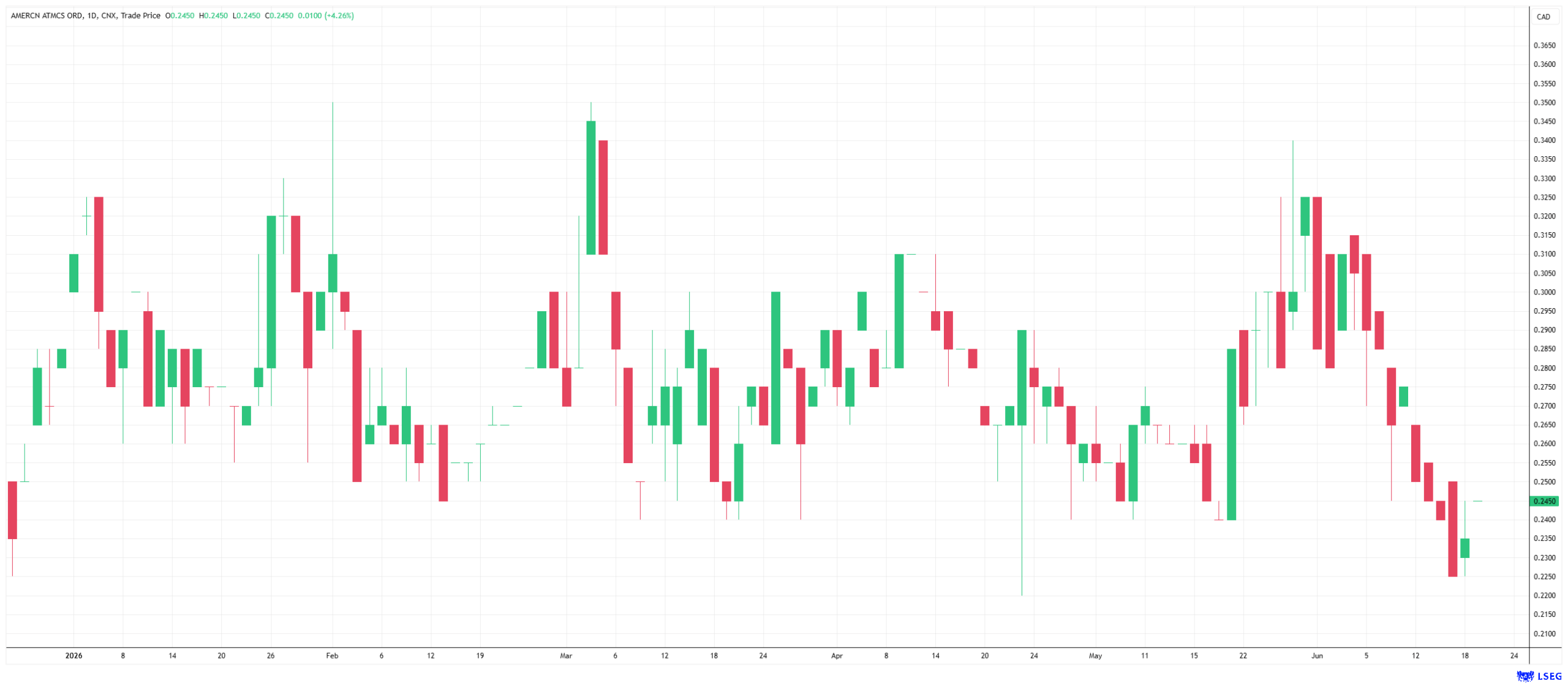
At its current stage of exploration, the company is not yet generating operating revenue—a situation it shares with many exploration companies. Investors in American Atomics should therefore focus on the long-term outlook. With the uranium mill planned in collaboration with CVMR, American Atomics could secure a significant share of the future US nuclear fuel market. The processing plant is currently still in the permitting process. However, since domestic sources of raw materials are in high demand and the US government is doing everything it can to become self-sufficient, such permitting procedures are looking promising. Given the boom in data centers and the supply shortage of uranium, such a market position would be worth its weight in gold for American Atomics. However, the coming months will have to show what progress the company can make along this path. There is tailwind from renowned analysts—so the odds for American Atomics are not bad. This is all the more true given that, with a market capitalization of only about CAD 15 million, the market has hardly given the company any premature praise yet.
Conclusion: Supply Shortage Offers Potential for Juniors Like American Atomics
Market reports from the research firm Sprott emphasize that years of under-contracting by energy providers have created enormous supply gaps. This has driven the spot price back above the USD 100/lb mark. A 2025 Deloitte analysis estimates that new nuclear power capacity could meet about 10% of the increase in electricity demand from data centers by 2035. While Cameco serves as a solid core investment, American Atomics offers the greatest leverage for those with a speculative mindset. If the American Atomics management team makes progress, this could turn the undervalued junior company into a takeover target. Currently, the stock is speculative but equally promising. Since the share was trading at a much higher level just last fall and has remained in a sideways trend since the start of the year, any positive company news could trigger a revaluation.
Watch YouTube videoConflict of interest
Pursuant to §85 of the German Securities Trading Act (WpHG), we point out that Apaton Finance GmbH as well as partners, authors or employees of Apaton Finance GmbH (hereinafter referred to as "Relevant Persons") may hold shares or other financial instruments of the aforementioned companies in the future or may bet on rising or falling prices and thus a conflict of interest may arise in the future. The Relevant Persons reserve the right to buy or sell shares or other financial instruments of the Company at any time (hereinafter each a "Transaction"). Transactions may, under certain circumstances, influence the respective price of the shares or other financial instruments of the Company.
In addition, Apaton Finance GmbH is active in the context of the preparation and publication of the reporting in paid contractual relationships.
For this reason, there is a concrete conflict of interest.
The above information on existing conflicts of interest applies to all types and forms of publication used by Apaton Finance GmbH for publications on companies.
Risk notice
Apaton Finance GmbH offers editors, agencies and companies the opportunity to publish commentaries, interviews, summaries, news and the like on news.financial. These contents are exclusively for the information of the readers and do not represent any call to action or recommendations, neither explicitly nor implicitly they are to be understood as an assurance of possible price developments. The contents do not replace individual expert investment advice and do not constitute an offer to sell the discussed share(s) or other financial instruments, nor an invitation to buy or sell such.
The content is expressly not a financial analysis, but a journalistic or advertising text. Readers or users who make investment decisions or carry out transactions on the basis of the information provided here do so entirely at their own risk. No contractual relationship is established between Apaton Finance GmbH and its readers or the users of its offers, as our information only refers to the company and not to the investment decision of the reader or user.
The acquisition of financial instruments involves high risks, which can lead to the total loss of the invested capital. The information published by Apaton Finance GmbH and its authors is based on careful research. Nevertheless, no liability is assumed for financial losses or a content-related guarantee for the topicality, correctness, appropriateness and completeness of the content provided here. Please also note our Terms of use.