October 8th, 2026 | 07:40 CEST
ExxonMobil, Shell and Zefiro Methane: EU Considers Postponing Methane Regulations—US Well Remediation Market Grows Regardless
Created and Published on Behalf of Zefiro Methane Corp.
The European Commission plans to postpone the proposed methane reporting requirements for oil and gas imports by one year. Member states and the European Parliament must still approve this. Regardless, the market for remediating orphaned wells is growing in the US. Specialized service providers are plugging dilapidated production wells, largely financed through government programs. Regulation is by no means the only driver: Methane continuously escapes from countless abandoned wells, creating local pressure to act. We explain the situation and highlight the companies profiting from it.
time to read: 3 minutes
|
Author:
Nico Popp
ISIN:
ZEFIRO METHANE CORP | CA98926D1069 | Cboe: ZEFI , Shell PLC | GB00BP6MXD84 , EXXONMOBIL HOLDINGS CORPORATION | US30233Q1085 | NYSE: XOM
Table of contents:
Author

Nico Popp
At home in Southern Germany, the passionate stock exchange expert has been accompanying the capital markets for about twenty years. With a soft spot for smaller companies, he is constantly on the lookout for exciting investment stories.
Tag cloud
Shares cloud
ExxonMobil: Opposition to Europe's Import Rules
The US corporation ExxonMobil is vehemently opposing the regulation from Brussels. As early as February 2026, Matt Crocker, president of the Product Solutions division, warned, according to Bloomberg, of serious disruptions for the European continent. According to ExxonMobil's calculations, approximately 80% of current EU crude oil imports would fail to meet European criteria starting in 2027. As a result, European refineries face additional oil costs of about 13%, or roughly USD 9 per barrel, according to ExxonMobil. The US government also ramped up the pressure: Energy Secretary Chris Wright threatened to redirect liquefied natural gas (LNG) to markets without comparable regulations. In its home market, ExxonMobil is pursuing its own reduction targets. By 2030, Scope 1 and Scope 2 emissions from the company's own unconventional operations in the Permian Basin are to drop to net zero. The company centralizes monitoring at its Vantage operations centre. However, management rejects the documentation requirements from Europe.
Shell: Pragmatism Instead of Confrontation
Shell takes a different approach. The British company generally supports the EU's regulatory direction. As a founding member of the Oil and Gas Methane Partnership 2.0, Shell has committed to disclosing methane emissions even for non-operated assets. Emissions monitoring has long been an integral part of its own processes. For facilities under its own operational control, Shell reduced reported methane emissions by 78% to 31,000 metric tons between 2016 and 2025. In addition, the company ended routine flaring at its upstream facilities in January 2025, five years ahead of the deadline set by the World Bank's "Zero Routine Flaring" initiative.
Zefiro Methane: Remediation Business Gains Momentum
Largely independent of developments in Brussels, Zefiro Methane is pushing ahead with the remediation of orphaned wells in the US. A study by the Institute for Energy Economics and Financial Analysis (IEEFA), authored by analyst Trey Cowan and using New Mexico as an example, illustrates the scale of the problem. There, the number of wells that become inactive each year quadrupled between 2016 and 2025. Environmental groups estimate the number of illegally inactive wells in the state at around 3,300. At the same time, the average cost of plugging a well rose from about USD 50,000 before 2021 to approximately USD 250,000 in 2026. In this environment, Zefiro is positioning itself as a specialized service provider.
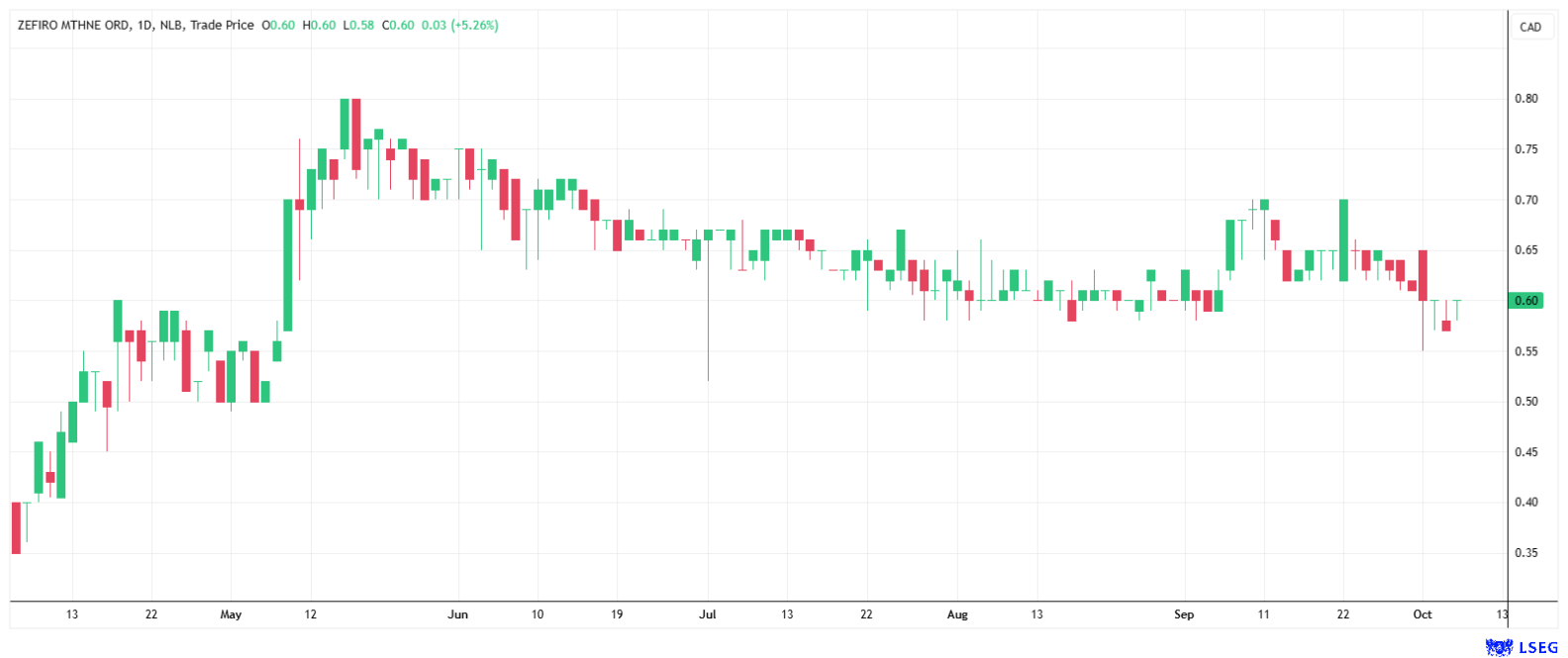
On September 30, 2026, the company announced the completion of its second project in Cuyahoga Valley National Park in Ohio: Its subsidiary, Plants & Goodwin, permanently plugged two oil and gas wells there. In addition, Zefiro can monetize well remediation projects through tradable emission credits in accordance with the American Carbon Registry methodology. For a single well in Oklahoma (Project ACR959), the company was issued 2,025 credits totaling 92,956 metric tons of CO₂ equivalent. These credits represent verified and verifiable emissions reductions. They were transferred under a forward contract to, among others, the commodities trader Mercuria Energy America. An updated ACR methodology is required for additional credits. Operationally, Zefiro is expanding its reach through partnerships, such as with the Well Done Foundation, which has already plugged more than 120 wells.
Zefiro Methane: Scaling Up and a Jump in Revenue
In May 2026, Zefiro Methane acquired Viking Well Service's operational assets for USD 4.3 million. This acquisition added five drilling rigs and capacity in five additional states. Today, Zefiro serves customers in 15 US states. The acquisition is expected to increase annual revenue capacity by approximately USD 10 million. The audited figures for the fiscal year ending June 30, 2026, reflect this upward trend. Revenue rose 31.1% to a record USD 42.5 million. Gross profit climbed by 66.0% to USD 12.4 million, and the gross margin improved to 29.2%. Adjusted EBITDA turned from a loss of USD 4.0 million in the prior year to a profit of USD 3.8 million. Management reduced the net loss by 67.5% to USD 3.5 million. In the fourth quarter, the integration of the Viking fleet and start-up costs for new major contracts weighed on earnings.
The US market environment supports the business model. The Bipartisan Infrastructure Law provides USD 4.7 billion in federal funds to plug abandoned wells nationwide. States such as Ohio, which can access up to USD 326 million, are continuously awarding contracts to qualified service providers. The US well remediation market is primarily supported by government subsidies—strict regulations do not need to be in place for this. Upcoming climate regulations could further bolster demand for specialized remediation companies like Zefiro Methane, even though they are likely to take effect later in Europe.
Conflict of interest
Pursuant to §85 of the German Securities Trading Act (WpHG), we point out that Apaton Finance GmbH as well as partners, authors or employees of Apaton Finance GmbH (hereinafter referred to as "Relevant Persons") may hold shares or other financial instruments of the aforementioned companies in the future or may bet on rising or falling prices and thus a conflict of interest may arise in the future. The Relevant Persons reserve the right to buy or sell shares or other financial instruments of the Company at any time (hereinafter each a "Transaction"). Transactions may, under certain circumstances, influence the respective price of the shares or other financial instruments of the Company.
In addition, Apaton Finance GmbH is active in the context of the preparation and publication of the reporting in paid contractual relationships.
For this reason, there is a concrete conflict of interest.
The above information on existing conflicts of interest applies to all types and forms of publication used by Apaton Finance GmbH for publications on companies.
Risk notice
Apaton Finance GmbH offers editors, agencies and companies the opportunity to publish commentaries, interviews, summaries, news and the like on news.financial. These contents are exclusively for the information of the readers and do not represent any call to action or recommendations, neither explicitly nor implicitly they are to be understood as an assurance of possible price developments. The contents do not replace individual expert investment advice and do not constitute an offer to sell the discussed share(s) or other financial instruments, nor an invitation to buy or sell such.
The content is expressly not a financial analysis, but a journalistic or advertising text. Readers or users who make investment decisions or carry out transactions on the basis of the information provided here do so entirely at their own risk. No contractual relationship is established between Apaton Finance GmbH and its readers or the users of its offers, as our information only refers to the company and not to the investment decision of the reader or user.
The acquisition of financial instruments involves high risks, which can lead to the total loss of the invested capital. The information published by Apaton Finance GmbH and its authors is based on careful research. Nevertheless, no liability is assumed for financial losses or a content-related guarantee for the topicality, correctness, appropriateness and completeness of the content provided here. Please also note our Terms of use.