January 21st, 2026 | 08:30 CET
E-subsidy 2.0 and now the boom! Taking off with BYD, NEO Battery Materials, and VW
Now it is official! The German federal government is relaunching its e-subsidy program. Low- and middle-income earners can apply for environmental incentives of up to EUR 6,000 for the purchase of an electric or hybrid vehicle. Annual household income must not exceed EUR 80,000 for households without children, and EUR 90,000 for those with children. Fully electric vehicles will receive a base subsidy of EUR 3,000. What initially sounds like positive news was met with little enthusiasm on the stock market. On the contrary, automotive stocks ended up with a 2 to 3% correction. The reason: the math is a zero-sum game. The German automotive market continues to be dominated by combustion engine technology. Those who take advantage of the EV incentive are simply subsidizing their switch to electric mobility, while at the same time, a new combustion-engine purchase disappears from sales pipelines. Worse still, German manufacturers still do not appear to be competitive with Chinese suppliers. Ultimately, this suggests that foreign suppliers could win the race. Investors should therefore take a close look at where the real private-sector leverage may lie.
time to read: 5 minutes | Author: André Will-Laudien
ISIN: BYD CO. LTD H YC 1 | CNE100000296 , NEO BATTERY MATERIALS LTD | CA62908A1003 , VOLKSWAGEN AG VZO O.N. | DE0007664039
Table of contents:
Author

André Will-Laudien
Born in Munich, he first studied economics and graduated in business administration at the Ludwig-Maximilians-University in 1995. As he was involved with the stock market at a very early stage, he now has more than 30 years of experience in the capital markets.
Tag cloud
Shares cloud
NEO Battery Materials – Tailwind from the automotive, robotics, and defense industries
Innovative solution providers wanted! The global rise of electromobility and autonomous systems is increasing the pressure on powerful and reliable battery technologies, while the market has so far been strongly dominated by Asian suppliers. Against this backdrop, NEO Battery Materials is positioning itself as a specialized supplier of silicon-reinforced lithium-ion batteries that specifically address high-performance applications. The Company pursues an approach that focuses less on mass-produced goods and more on maximum performance and customer-specific optimization. At the core of the technology are patented silicon anodes, which enable significantly higher energy densities, faster charging times, and improved service life compared to traditional graphite solutions. These properties are of particular strategic importance for drones, robotics, defense applications, electric vehicles, and stationary storage. At the same time, geopolitical risks in the global battery supply chain, exacerbated by China's more restrictive export rules, are increasing the value of Western production and technology capacities.
NEO Battery is benefiting from the current environment, as industrial production has already started in South Korea, creating an alternative to Chinese supply chains. With the commissioning of a megawatt-hour scale operational factory, the Company has made the transition from the development phase to commercialization. Initial pilot and series orders from Fortune 500 companies in the automotive industry and the drone and robotics sector confirm the industrial maturity of the solutions.
Another strategically important factor is the Company's integration into the South Korean defense ecosystem, which facilitates access to security-related applications.
The combination of in-house material development and increasing vertical integration across different cell formats remains a long-term differentiating factor. This integration gives NEO Battery a clear competitive advantage, particularly in weight-sensitive niche applications. To finance further expansion, the Company completed a fully placed capital increase of approximately CAD 7 million at the beginning of 2026. The funds will primarily be used for additional production facilities and the expansion of cell formats, laying the foundation for rising revenue in the medium term. Given the recent dynamic development, the current market capitalization of CAD 106 million marks the starting point for significantly higher valuation levels. Technically, a continuation of the breakout above CAD 0.80 would be a strong buy signal.
Danny Huh, SVP of Strategy & Operations, explains the details of the Company's strategic positioning and medium-term growth strategy in an interview with IIF host Lyndsay Malchuk.
BYD's triumph in the electric race
BYD is revolutionizing the electric vehicle market and has replaced Tesla as the global leader in 2025 with a staggering 2.26 million pure electric vehicles (+28%) compared to Tesla's disappointing 1.64 million (-8.4%)! This triumphant takeover is based on BYD's smart model diversity, ranging from affordable city vehicles to luxurious premium EVs, coupled with explosive demand from China and global conquest, while Tesla stumbled in the US and Europe. Now BYD is also set to start EU production in Hungary, which means it will no longer be subject to EU punitive tariffs and can even benefit from the German e-premium.
BYD remains focused in 2026 and plans to stay on the winning track. After a breather at EUR 10 to 11, the share price has been sniffing the rarefied air again in recent days. Analysts on the LSEG platform are also singing from the same hymn sheet with 28 "Buy" recommendations, 42% upside potential and a 2026 P/E ratio of 11.1. The integrated high-tech company offers a balanced mix of economies of scale, geopolitical momentum and an electrification boom. BYD will present its figures for the full year 2025 at the end of March. Investors should actively take advantage of the small setback to EUR 10.65, as the turnaround scenario could already be fulfilled in a few months.
VW – Actually in the fast lane with electric vehicles
Who would have thought it? VW can boast positive sales figures for electric vehicles. In terms of numbers, the Volkswagen Group delivered around 9 million vehicles worldwide last year, almost maintaining its previous year's level. Overall, the Wolfsburg-based company achieved only a slight decline in sales of 0.5%, with growth in Europe and South America offset by declines in China and North America. In Europe, deliveries even rose by 4.5% to 3.94 million vehicles. Surprisingly, the Group saw particularly strong growth in fully electric vehicles: global deliveries of battery electric vehicles (BEVs) increased by 32% to 983,100 vehicles, and in Europe by a whopping 66%. Order intake also rose significantly. In Europe, BEV orders were around 55% higher than in the previous year, and the order backlog for electric vehicles grew by 21% to more than 200,000 vehicles. The Group's three best-selling fully electric vehicles in the previous year were the ID.4/ID.5 with 163,400 units, the VW ID.3 with only 11,770 units, and the Skoda Elroq with 95,300 units, which was the best performer among the sub-brands. Deliveries of plug-in hybrids also experienced strong growth last year. With 428,000 vehicles, this drive type was up 58%, and in Europe, even 72% – who would have thought it!
Group CEO Oliver Blume spoke of robust development in a challenging market environment. "With around nine million vehicles delivered, our sales remain stable," commented the CEO. Investors should take another look at VW shares: in addition to a 7% dividend, a 2026 P/E ratio of 4.6 is also on the agenda. The stock has now consolidated for a full three years, and technically, the path from EUR 110 upwards would be clear. Currently, however, analysts on the LSEG platform are still very conservative with an average 12-month price target of EUR 116. But highly interesting in the medium term!
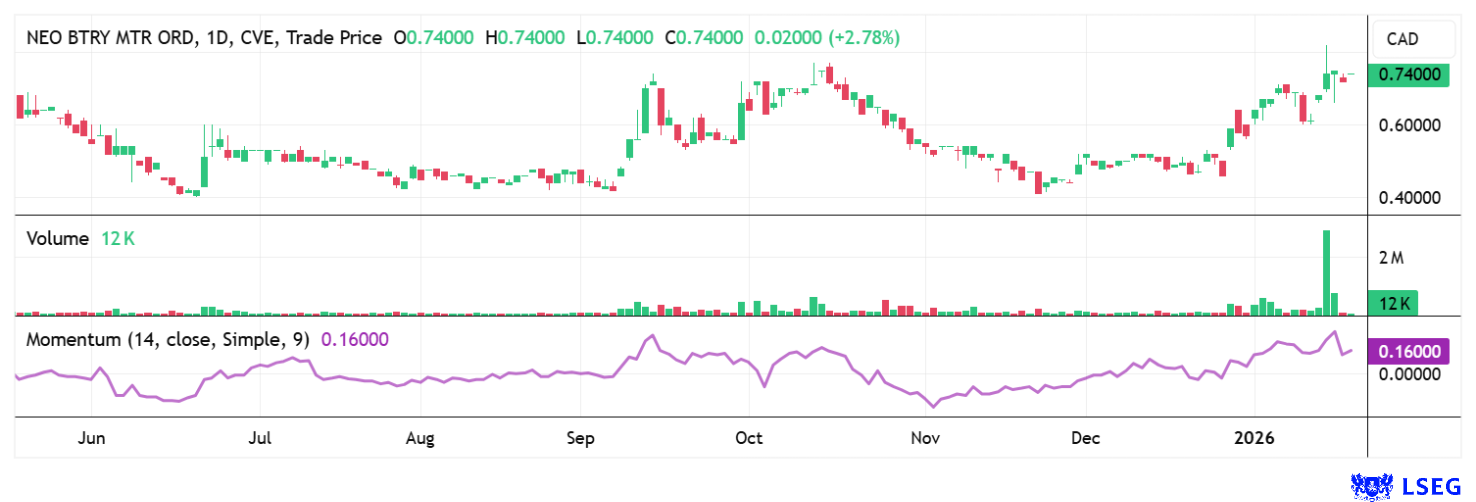
The automotive sector is facing another challenging year. But while vehicle manufacturers have to look for customers who are willing to pay, technology suppliers such as NEO Battery Materials can reap the benefits. After all, what sweetens the relationship with an OEM more than delivering strong performance and innovation? BYD and VW are reasonably valued at EUR 10.8 and EUR 97.50, respectively, but NEO Battery Materials offers greater potential for value multiplication!
Conflict of interest
Pursuant to §85 of the German Securities Trading Act (WpHG), we point out that Apaton Finance GmbH as well as partners, authors or employees of Apaton Finance GmbH (hereinafter referred to as "Relevant Persons") currently hold or hold shares or other financial instruments of the aforementioned companies and speculate on their price developments. In this respect, they intend to sell or acquire shares or other financial instruments of the companies (hereinafter each referred to as a "Transaction"). Transactions may thereby influence the respective price of the shares or other financial instruments of the Company.
In this respect, there is a concrete conflict of interest in the reporting on the companies.
In addition, Apaton Finance GmbH is active in the context of the preparation and publication of the reporting in paid contractual relationships.
For this reason, there is also a concrete conflict of interest.
The above information on existing conflicts of interest applies to all types and forms of publication used by Apaton Finance GmbH for publications on companies.
Risk notice
Apaton Finance GmbH offers editors, agencies and companies the opportunity to publish commentaries, interviews, summaries, news and the like on news.financial. These contents are exclusively for the information of the readers and do not represent any call to action or recommendations, neither explicitly nor implicitly they are to be understood as an assurance of possible price developments. The contents do not replace individual expert investment advice and do not constitute an offer to sell the discussed share(s) or other financial instruments, nor an invitation to buy or sell such.
The content is expressly not a financial analysis, but a journalistic or advertising text. Readers or users who make investment decisions or carry out transactions on the basis of the information provided here do so entirely at their own risk. No contractual relationship is established between Apaton Finance GmbH and its readers or the users of its offers, as our information only refers to the company and not to the investment decision of the reader or user.
The acquisition of financial instruments involves high risks, which can lead to the total loss of the invested capital. The information published by Apaton Finance GmbH and its authors is based on careful research. Nevertheless, no liability is assumed for financial losses or a content-related guarantee for the topicality, correctness, appropriateness and completeness of the content provided here. Please also note our Terms of use.