May 4th, 2026 | 07:10 CEST
Drone Boom Boosts Volatus Aerospace – Nearly 100% Upside Potential! Get in Before the Crowd
Imagine a company that not only builds drones but also manages entire operations remotely—from a central hub across hundreds of kilometres. That is exactly what this Canadian provider has mastered, having spent years serving pipeline operators and energy utilities. Today, even NATO member states are adopting this technology. In March 2026, the company made its debut on the Toronto Stock Exchange. But what is driving this story? The numbers, orders, and a strategic realignment paint the picture of a serious player in a billion-dollar market.
time to read: 4 minutes | Author: Armin Schulz
ISIN: VOLATUS AEROSPACE INC | CA92865M1023 | TSXV: FLT , OTCQB: TAKOF
Table of contents:
Author

Armin Schulz
Born in Mönchengladbach, he studied business administration in the Netherlands. In the course of his studies he came into contact with the stock exchange for the first time. He has more than 25 years of experience in stock market business.
Tag cloud
Shares cloud
Tailwind from the government
A few weeks ago, the Canadian government made it clear that it takes the country's defence seriously, with CAD 81.8 billion in defence spending, of which CAD 6.6 billion is earmarked for building domestic industry. Unmanned systems are officially designated as a "core sovereign capability." Up to 70% of contracts are expected to go to domestic companies in the future.
This is not a policy paper to be filed away. It is a wake-up call. And at this very moment, a company that recognized the signs early on is stepping into the spotlight.
From Service Provider to System Provider
Volatus Aerospace has reinvented itself over the past two years. In 2024, it was still a consortium of various drone service providers; today, it is an integrated platform. The company has its own manufacturing facility in Mirabel (Québec), drone defence software called SKYDRA™, a central operations center for long-range missions, and a customer base ranging from energy providers to NATO headquarters.
The transformation is reflected in the numbers. In 2025, revenue grew by 26% to CAD 34.2 million. But that is not the real story. The decisive factor is the internal shift. The defence segment's share of total business climbed from 5% two years ago to 25% today. Management still considers itself in the growth phase, but the direction is right.
A look at the balance sheet supports this thesis. At the end of 2025, Volatus held CAD 41 million in cash and cash equivalents, up from just CAD 1.5 million a year earlier. Working capital turned from a deficit of CAD 8.4 million to a surplus of CAD 36.5 million.
The Moat Is Operational Experience
What sets Volatus apart from many drone manufacturers is its operational depth. The company has been conducting inspections of pipelines and energy facilities for years. This experience cannot be bought.
The offshore wind contract from March 2026 demonstrates the capability for remote-controlled missions over open water. For the Arctic, a strategic priority for Canada, there is currently no operational solution. Volatus is working on it.
Software as a Margin Booster
SKYDRA™, a SaaS platform for planning and simulating drone defence operations, has been on the market since March 2026. It might not sound like much, but it reflects a strategically smart shift. Instead of relying on the sale of capital-intensive hardware, Volatus is offering a digital training environment with significantly higher scalability and margins.
Expected gross margins are 80–85%. That is a completely different ballgame compared to the hardware business, which has a margin of around 32%.
At a time when conflicts have shown how vulnerable critical infrastructure is to drones, governments and operators are seeking preventive solutions. SKYDRA™ addresses precisely this demand. Management expects this segment to contribute tens of millions in the medium term. This is primarily because Volatus is an early mover; there are only a few comparable cloud-based simulation platforms for this purpose worldwide.
The concrete evidence
In December 2025, Volatus secured a defence contract worth up to CAD 9 million from a NATO-allied organization. In April 2026, another training contract worth CAD 2.1 million followed with a NATO member. In the corresponding press release dated April 15, 2026, the company emphasized that this multi-year agreement further solidifies its role as a trusted partner for governments and defence stakeholders.
This is further compounded by the order pipeline. Analysts estimate the value of commercial and government opportunities at over CAD 600 million. That is more than ten times the current annual revenue.
Operational Improvement
Losses are declining in parallel with revenue growth. The adjusted EBITDA loss improved by 25% in 2025 to a negative CAD 7.2 million, attributable to investments. Given the current growth momentum, the defence segment alone has more than doubled year-over-year, bringing the break-even point into view.
Recurring revenue from service and maintenance contracts already stands at around CAD 20 million per year.
The Stock and Insiders
A closer look reveals another exciting development for investors. More than 20% of the shares are held by insiders. According to company sources, no member of the executive board has sold shares in the past 7 years. That does not necessarily mean anything, but it is an unusually strong signal.
In February 2026, Krish Srinivasan was brought on as Chief Technology Officer, a man with over 10 years of experience in autonomous systems and EU-funded defence programs totalling EUR 40 million. In April, retired Major General Peter Fesler, a former NORAD commander with 2,200 flight hours on the F-15 and F-22, joined the advisory board. This demonstrates just how strong the company's connections already are.
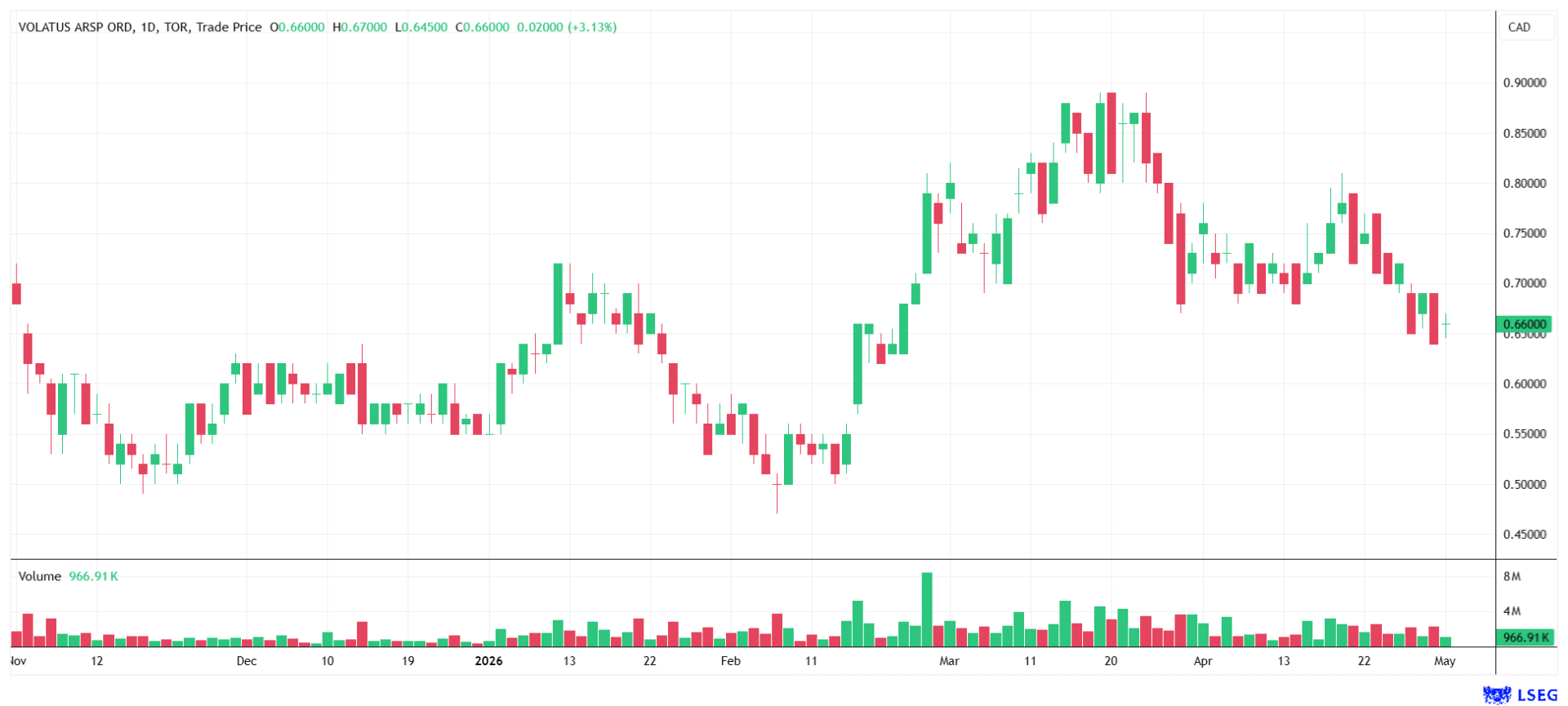
Analysts see price potential between CAD 0.95 and 1.25. That is more than 40–90% above the current level. Stifel, Canaccord, Desjardins, the Maxim Group, and Haywood are among the firms that see substantial upside potential here.
The stock is currently trading at CAD 0.66.
Volatus Aerospace has made the leap from an inspection service provider to a serious defence platform. The numbers demonstrate operational discipline, the pipeline is fully loaded, and the Canadian government's new strategy is opening a billion-dollar window for domestic suppliers. The valuation is well below that of US peers. Anyone who believes in the industrial maturity of the drone market will find a supplier here that is already delivering today. The direction is right.
Conflict of interest
Pursuant to §85 of the German Securities Trading Act (WpHG), we point out that Apaton Finance GmbH as well as partners, authors or employees of Apaton Finance GmbH (hereinafter referred to as "Relevant Persons") currently hold or hold shares or other financial instruments of the aforementioned companies and speculate on their price developments. In this respect, they intend to sell or acquire shares or other financial instruments of the companies (hereinafter each referred to as a "Transaction"). Transactions may thereby influence the respective price of the shares or other financial instruments of the Company.
In this respect, there is a concrete conflict of interest in the reporting on the companies.
In addition, Apaton Finance GmbH is active in the context of the preparation and publication of the reporting in paid contractual relationships.
For this reason, there is also a concrete conflict of interest.
The above information on existing conflicts of interest applies to all types and forms of publication used by Apaton Finance GmbH for publications on companies.
Risk notice
Apaton Finance GmbH offers editors, agencies and companies the opportunity to publish commentaries, interviews, summaries, news and the like on news.financial. These contents are exclusively for the information of the readers and do not represent any call to action or recommendations, neither explicitly nor implicitly they are to be understood as an assurance of possible price developments. The contents do not replace individual expert investment advice and do not constitute an offer to sell the discussed share(s) or other financial instruments, nor an invitation to buy or sell such.
The content is expressly not a financial analysis, but a journalistic or advertising text. Readers or users who make investment decisions or carry out transactions on the basis of the information provided here do so entirely at their own risk. No contractual relationship is established between Apaton Finance GmbH and its readers or the users of its offers, as our information only refers to the company and not to the investment decision of the reader or user.
The acquisition of financial instruments involves high risks, which can lead to the total loss of the invested capital. The information published by Apaton Finance GmbH and its authors is based on careful research. Nevertheless, no liability is assumed for financial losses or a content-related guarantee for the topicality, correctness, appropriateness and completeness of the content provided here. Please also note our Terms of use.