April 10th, 2026 | 07:25 CEST
Desert Gold: The Next Gold Miner in West Africa
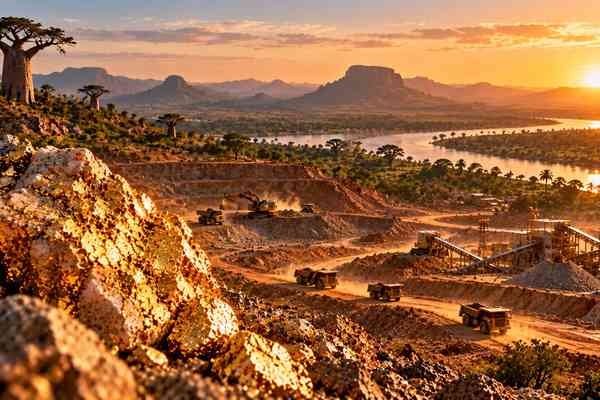
The past 50 years in mining belonged to Latin America, as they say in the industry. That is where mining giants like Chile, Mexico, and Brazil emerged; countries that are now indispensable to the global economy. But this century belongs to Africa; all experts agree on that. Many undiscovered deposits are still waiting to be discovered by the world. The western part of the continent is becoming increasingly important in the gold sector. Desert Gold has established itself in Mali and plans to start production as early as this summer. The company's valuation is attractive, and the stock is still flying under the radar of many investors. This presents a buying opportunity for bold investors.
time to read: 4 minutes | Author: Tarik Dede
ISIN: DESERT GOLD VENTURES | CA25039N4084 | TSXV: DAU , OTCQB: DAUGF
Table of contents:
Author

Tarik Dede
Even as a high school student in northern Germany, he developed a strong interest in the “Neuer Markt” and the dynamics of the equity markets. Small- and mid-cap companies were at the center of his focus from the very beginning. After completing his training as a certified bank clerk, he deepened his economic expertise through formal studies in economics as well as through various positions within Frankfurt’s financial sector. Today, he has been actively involved in the capital markets for more than 25 years, both professionally and as a private investor.
Tag cloud
Shares cloud
Africa: Endless Expanses
After more than 200 years of industrialization, the low-hanging "fruits" of mining have already been picked. This is particularly true for large parts of Europe and North America. There are hardly any large, easily minable deposits left there. Furthermore, the bureaucratic hurdles are high, and approval processes often take a long time. And then there is the social factor: Even in traditional resource-rich countries like Canada and the US, many citizens do not want a mine on their doorstep: "Not in my Backyard" (NIMBY) is often the prevailing motto.
That is why Africa's rise began as early as two decades ago. Apart from South Africa, Namibia, and Botswana, the continent has largely been uncharted territory—less densely populated than Europe and open to investment. As a result, West Africa has risen to the top tier of mining nations after two decades. According to the World Gold Council, the mostly small countries there collectively produced more than 450 tons of gold in 2024. By comparison, the undisputed world leader is currently China with about 380 tons.
West Africa: World-Class Gold Mines
In West African countries, from Senegal through Mali down to Côte d'Ivoire and Ghana, a solid infrastructure for the industry has developed. There are now numerous world-class mines (Tier 1) in the region, some of which produce more than 500,000 ounces of gold per year. It is in this environment that Desert Gold (CAD 0.13; CA25039N4084) has established itself. The company secured the 440 km² SMSZ project in Mali within the so-called Senegal-Mali Shear Zone Belt. Desert Gold is in the transition from explorer to producer and plans to begin gold production as early as this summer. Yet the Canadian company currently has a market capitalization of just around CAD 35 million. That sounds like a bargain.
Economical and Efficient Production Planned
However, the project is also well-supported by a feasibility study. At the end of last year, Desert Gold presented a so-called PEA (Preliminary Economic Assessment) summarizing the key economic data. It is based on a resource comprising approximately 1.3 million ounces of gold. The company initially plans to focus on surface-level oxide ores, which are easier and cheaper to mine. By targeting these "low-hanging fruits," the company saves enormous costs and initially excludes the deeper-lying sulfide ores. Consequently, Desert Gold estimates that only USD 23 million will be required to start production. The economic indicators look promising. The after-tax IRR (internal rate of return) stands at a robust 57%, which is top-tier in the gold sector. This means the investment costs would be recouped within about two and a half years. However, the actual economics are likely to be far better. The independent consultant Minxcon has assumed a gold price of just USD 2,850 per ounce. By comparison, the current gold price is around USD 4,700.
Initially, gold production is expected to run for 10 years and total 113,120 ounces. The consultant estimates costs at USD 1,137 per ounce (AISC). This would result in a margin of more than USD 3,000 per ounce. Desert Gold plans to use the cash flow to gradually expand production and later also extract the deeper-lying sulfide ores. This two-stage approach has a major advantage: shareholders do not have to face excessive dilution.
With the two oxide deposits and the later planned mining of sulfide ore, the potential of the SMSZ project is far from exhausted. The 440 km² site is located in the immediate vicinity of world-class mines such as B2Gold's Fekola and Barrick Mining's Loulo-Gounkoto. As a result, the area benefits from good infrastructure, and further exploration can expand the deposit. Metal mineralization does not typically stop at man-made property boundaries.
Another Ace Up Its Sleeve
And Desert Gold has a second ace up its sleeve. In Côte d'Ivoire, considered one of the best places for mining in Africa, the company has secured another project in Tiegba. It has acquired an option to purchase up to 90% of this 297 km² project. In principle, this is a greenfield project, meaning it has not been explored to date. However, it once belonged to Newmont, which conducted geophysical surveys but never drilled a single meter. Desert Gold is banking on classic exploration successes here. Plans include collecting soil samples, conducting magnetic surveys, and ultimately drilling. A completely new discovery of this kind would provide another catalyst for the share. And there is plenty of potential here as well: Allied Gold Corporation's Agbaou and Bonikro gold mines (Côte d'Ivoire Complex, CDI) are located in the immediate vicinity. This at least increases the likelihood of encountering similar geological structures at Tiegba.
Desert Gold is a gold company still largely undiscovered by the market, which plans to commence production as early as this summer. With a market capitalization of CAD 35 million, there is therefore significant potential. Investors appear to believe this as well. Most recently, the Canadian company sought to raise CAD 5 million from them. Interest was so high that it ultimately raised more than CAD 7 million. There is also a clear commitment from management, which holds approximately 10% of the shares. Additionally, the shareholder base includes two well-known names from the mining industry: Ross Beaty and EMX Royalty. GBC Research recently published a research report on the stock and issued a price target of CAD 0.81. This would represent a doubling compared to the current level.
Conflict of interest
Pursuant to §85 of the German Securities Trading Act (WpHG), we point out that Apaton Finance GmbH as well as partners, authors or employees of Apaton Finance GmbH (hereinafter referred to as "Relevant Persons") may hold shares or other financial instruments of the aforementioned companies in the future or may bet on rising or falling prices and thus a conflict of interest may arise in the future. The Relevant Persons reserve the right to buy or sell shares or other financial instruments of the Company at any time (hereinafter each a "Transaction"). Transactions may, under certain circumstances, influence the respective price of the shares or other financial instruments of the Company.
In addition, Apaton Finance GmbH is active in the context of the preparation and publication of the reporting in paid contractual relationships.
For this reason, there is a concrete conflict of interest.
The above information on existing conflicts of interest applies to all types and forms of publication used by Apaton Finance GmbH for publications on companies.
Risk notice
Apaton Finance GmbH offers editors, agencies and companies the opportunity to publish commentaries, interviews, summaries, news and the like on news.financial. These contents are exclusively for the information of the readers and do not represent any call to action or recommendations, neither explicitly nor implicitly they are to be understood as an assurance of possible price developments. The contents do not replace individual expert investment advice and do not constitute an offer to sell the discussed share(s) or other financial instruments, nor an invitation to buy or sell such.
The content is expressly not a financial analysis, but a journalistic or advertising text. Readers or users who make investment decisions or carry out transactions on the basis of the information provided here do so entirely at their own risk. No contractual relationship is established between Apaton Finance GmbH and its readers or the users of its offers, as our information only refers to the company and not to the investment decision of the reader or user.
The acquisition of financial instruments involves high risks, which can lead to the total loss of the invested capital. The information published by Apaton Finance GmbH and its authors is based on careful research. Nevertheless, no liability is assumed for financial losses or a content-related guarantee for the topicality, correctness, appropriateness and completeness of the content provided here. Please also note our Terms of use.