May 20th, 2026 | 08:20 CEST
Drones over Moscow! Soon over Florida too? Profit from the Drone Rally 2.0 with Volatus Aerospace
Are we witnessing the beginning of a Drone Rally 2.0 on the stock market? Over the weekend, footage of Ukrainian drones flying over Moscow made headlines around the world. Until now, the airspace surrounding the Russian capital had been considered among the most heavily protected in the world. In the US, concerns are growing that Iranian drones could reach Donald Trump's residence in Florida from Cuba. Against this geopolitical backdrop, Volatus Aerospace is igniting its next phase of growth. While many defence and drone stocks have recently corrected significantly, Volatus Aerospace has demonstrated remarkable relative strength. At the same time, the Canadian company's revenue growth is set to accelerate significantly starting this quarter. NATO-related contracts, defence training programs, proprietary software solutions, and the establishment of Canadian drone production could catapult Volatus into an entirely new league.
time to read: 4 minutes | Author: Fabian Lorenz
ISIN: VOLATUS AEROSPACE INC | CA92865M1023 | TSXV: FLT , OTCQB: TAKOF
Table of contents:
Author

Fabian Lorenz
For more than twenty years, the Cologne native has been intensively involved with the stock market, both professionally and privately. He is particularly passionate about national and international small and micro caps.
Tag cloud
Shares cloud
This is What Relative Strength Looks Like
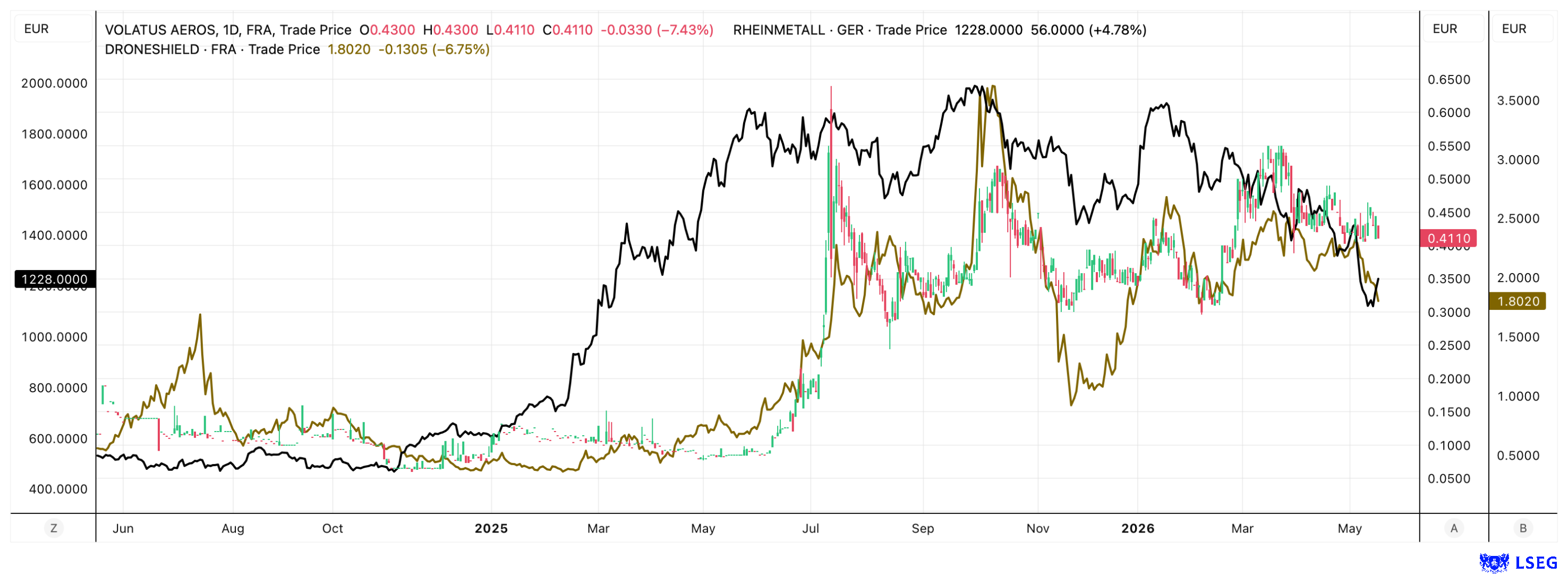
About a year ago, the first drone rally began on the stock market. Volatus Aerospace's stock is right in the thick of it. At that time, the Canadian drone specialist's stock was still trading at EUR 0.09. Within 10 months, the stock surged to a peak of EUR 0.54. Since March, it has been consolidating, much like the rest of the defence sector. While shares of Rheinmetall and DroneShield have recently come under significant pressure, Volatus has remained relatively stable despite the broader weakness in the drone and defence sectors.
It is particularly striking that the stock has consolidated only moderately following the sharp rise in the summer of 2025. A stable support zone appears to be forming between approximately EUR 0.40 and EUR 0.45.
Overall, the chart pattern of Volatus shares currently appears significantly more robust than many of its peers in the sector. Should market sentiment for defence and drone stocks improve again, Volatus could therefore be among the stocks that gain new momentum disproportionately quickly.
Key Milestones in Q1
Another sign of strength last week was the market's reaction to Volatus's first-quarter 2026 results. At first glance, the figures appear unspectacular. Yet behind them lies a trend pointing to significantly more dynamic growth in the coming quarters. The main driver is the booming defence and government business, which is the company's fastest-growing segment.
CEO Glen Lynch clarified that several contracts intended to contribute to revenue in the first quarter were held back by short-term supply chain bottlenecks. The reasons for this are heightened geopolitical tensions in the Middle East as well as new US export controls. It is precisely these projects that are now expected to provide a significant additional boost to revenue and earnings starting in the second quarter.
Nevertheless, Volatus made enormous strategic progress in the first quarter. With the move to the Toronto Stock Exchange, the company took its next step toward maturity. At the same time, Volatus was recognized as one of the most successful technology companies on the TSX Venture 50. Incidentally, the stock is also actively traded on German exchanges.
However, the operational development is likely to be even more important. The group is consistently expanding its position in the defence and security market. Particularly significant was the award of a NATO contract to train drone pilots for complex mission profiles, such as reconnaissance, surveillance, search-and-rescue, or border protection. In addition, delivery of the ISR training system, valued at up to CAD 9 million, is now underway; the first tranche was originally scheduled to be booked in the first quarter.
The market seems to be increasingly recognizing that Volatus is far more than a traditional drone operator. The company is increasingly evolving into an integrated technology provider with its own hardware, software, training capabilities, and production infrastructure. A key component of this is the new SKYDRA platform, which was unveiled in early March. The software is aimed at the armed forces, government agencies, and operators of critical infrastructure, and, for the first time, opens up a recurring SaaS business model for Volatus with potentially attractive margins. It is a system for the detection, surveillance, and potential defence against drones. In the current environment, this is very exciting.
At the same time, the company is advancing the development of other proprietary platforms, such as the AI-based V-Cortex autonomy platform and the heavy-duty Condor XL system. Volatus even receives support for this through government innovation funding in Canada.
Volatus is also pushing ahead with the expansion of its own infrastructure. Over the coming years, more than CAD 10 million is to be invested in the Mirabel, Québec, site to establish a self-sufficient Canadian drone production facility. This aligns with the new Canadian defence strategy, which calls for billions in investments and specifically favours domestic suppliers. It is particularly interesting that unmanned systems, autonomous technologies, sensor technology, and training solutions are officially among the prioritized areas for the future. Volatus is exceptionally well-positioned in precisely these segments.
Successful in Civil Applications as Well
Another reason why the stock is holding up well and has significant potential is that the company is also successful in civil applications. For example, Volatus is tapping into a new growth market with heavy-lift drones for offshore wind farms. In the future, loads of up to 100 kg are to be transported between ships and wind turbines. At the same time, the international training business is growing, in part through a partnership with the University of Technology in Jamaica. Meanwhile, established infrastructure projects continue to run smoothly. This includes inspection contracts for one of the largest North American power grid networks, as well as pipeline monitoring operations with more than 75,000 flight hours of accumulated experience.
Growth Financing Secured
The financial situation is noteworthy. Despite ongoing expansion, Volatus had approximately CAD 31.7 million in cash and cash equivalents at the start of the second quarter. This gives the company sufficient financial flexibility to implement its growth strategy without financing pressure. Management also makes it clear that the path to EBITDA break-even will be achieved through rising revenues rather than further cost-cutting measures.
https://youtu.be/F4ajDCojMRo?si=x_aUVn0wCV-GCTXv
Conclusion: Critical Phase Ahead
The decisive phase may now be beginning. The first quarter could, in hindsight, turn out to have been the last period of only moderate growth. With the start of the delayed NATO deliveries, new training contracts, the expansion of the defence business, and the first software revenues, Volatus Aerospace is supported by several potential growth drivers. If the company confirms this operational momentum, the recent relative strength of the stock compared to other drone and defence names could signal a significantly larger upward move.
Conflict of interest
Pursuant to §85 of the German Securities Trading Act (WpHG), we point out that Apaton Finance GmbH as well as partners, authors or employees of Apaton Finance GmbH (hereinafter referred to as "Relevant Persons") may hold shares or other financial instruments of the aforementioned companies in the future or may bet on rising or falling prices and thus a conflict of interest may arise in the future. The Relevant Persons reserve the right to buy or sell shares or other financial instruments of the Company at any time (hereinafter each a "Transaction"). Transactions may, under certain circumstances, influence the respective price of the shares or other financial instruments of the Company.
In addition, Apaton Finance GmbH is active in the context of the preparation and publication of the reporting in paid contractual relationships.
For this reason, there is a concrete conflict of interest.
The above information on existing conflicts of interest applies to all types and forms of publication used by Apaton Finance GmbH for publications on companies.
Risk notice
Apaton Finance GmbH offers editors, agencies and companies the opportunity to publish commentaries, interviews, summaries, news and the like on news.financial. These contents are exclusively for the information of the readers and do not represent any call to action or recommendations, neither explicitly nor implicitly they are to be understood as an assurance of possible price developments. The contents do not replace individual expert investment advice and do not constitute an offer to sell the discussed share(s) or other financial instruments, nor an invitation to buy or sell such.
The content is expressly not a financial analysis, but a journalistic or advertising text. Readers or users who make investment decisions or carry out transactions on the basis of the information provided here do so entirely at their own risk. No contractual relationship is established between Apaton Finance GmbH and its readers or the users of its offers, as our information only refers to the company and not to the investment decision of the reader or user.
The acquisition of financial instruments involves high risks, which can lead to the total loss of the invested capital. The information published by Apaton Finance GmbH and its authors is based on careful research. Nevertheless, no liability is assumed for financial losses or a content-related guarantee for the topicality, correctness, appropriateness and completeness of the content provided here. Please also note our Terms of use.