March 5th, 2026 | 07:30 CET
Between market panic and profit: What Almonty has in common with Apple and IBM
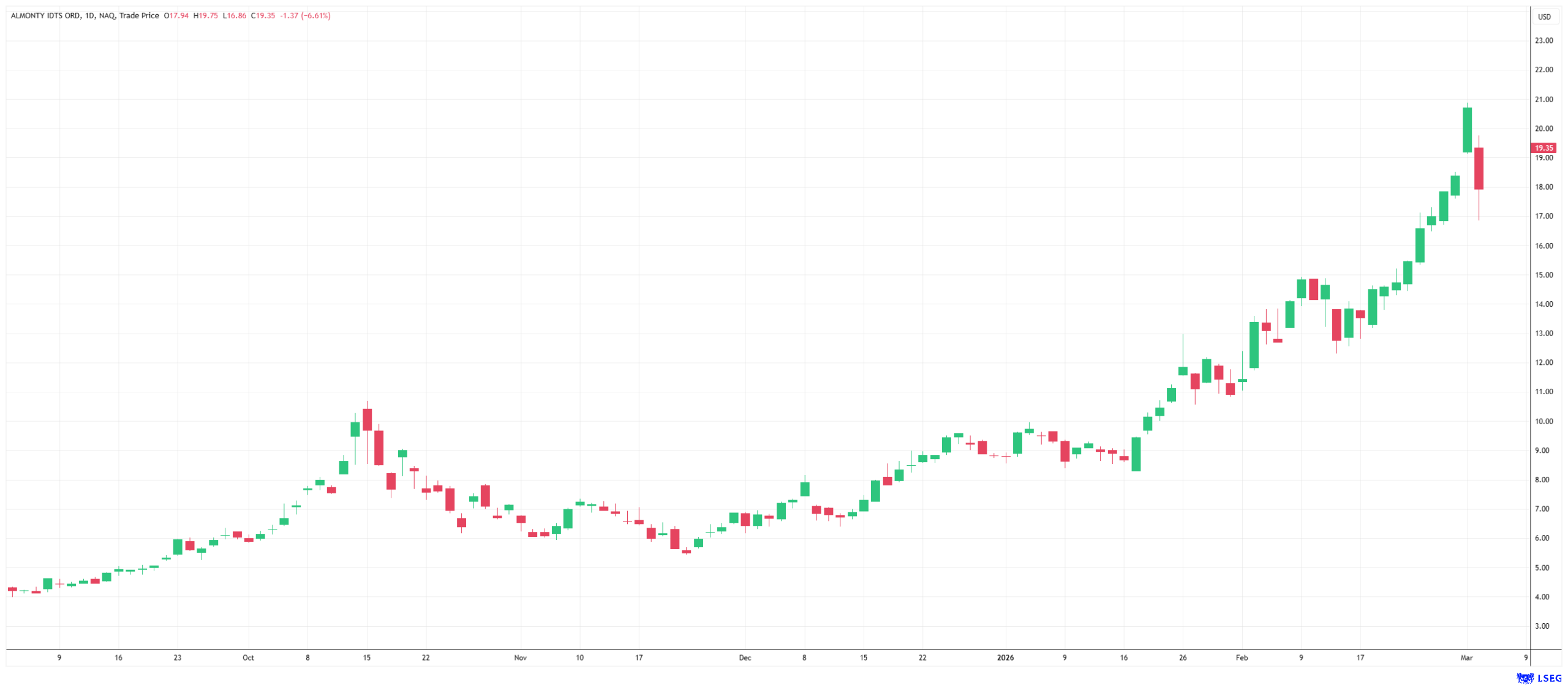
The war in Iran has long since become a conflagration in the Middle East, including energy price shocks. Trading on Tuesday was particularly typical of this market environment. The day perfectly reflects the psychological state of market participants. Driven by horror stories from the Middle East and concerns about a global energy crisis, many stocks experienced drastic fluctuations. But while many stocks are still under pressure, Almonty's share price revealed a pattern that experienced market participants interpret as a sign of relative strength. After initially falling sharply, the stock stabilized rapidly, pushing the price back up significantly before the close of trading. In periods of extreme uncertainty, investors are not looking for short-term speculation, but rather for companies with a unique market position, a crisis-proof margin structure, and operating potential based on irreplaceable resources. We draw historical comparisons and explain that even heavyweights such as IBM and Apple have had to weather headwinds in the past.
time to read: 3 minutes | Author: Nico Popp
ISIN: ALMONTY INDUSTRIES INC. | CA0203987072 | TSX: AII , NASDAQ: ALM , ASX: AII , APPLE INC. | US0378331005 , IBM | US4592001014
Table of contents:
Author

Nico Popp
At home in Southern Germany, the passionate stock exchange expert has been accompanying the capital markets for about twenty years. With a soft spot for smaller companies, he is constantly on the lookout for exciting investment stories.
Tag cloud
Shares cloud
Apple and the lessons of the dot-com crash
Historically, it has often been precisely those moments of panic that, in retrospect, have proven to be the best buying opportunities for long-term investors. Apple's history is marked by extreme periods of volatility, which are often forgotten today in the glow of success. On September 29, 2000, the technology company experienced the darkest day in its stock market history when its shares lost nearly 51.89% of their value in a single day. The trigger for this slump was a profit warning due to weak demand for the Power Mac G4. However, those who dared to invest amid the market panic at the time were betting on a company that changed the world with innovative products and delivered breathtaking returns to its investors. A quarter of a century after this crash, Apple is a giant whose key figures exceed all benchmarks. In the first fiscal quarter of 2026, the group recorded total sales of USD 143.8 billion and a net profit of USD 42.1 billion, demonstrating its transformation from a hardware seller to a highly profitable service provider. Those who bravely bought on September 29, 2000, are rich today.
IBM and the power of operational transformation
The IT group IBM offers another lesson in resilience and dealing with short-term shocks. In the 1970s, the company faced a protracted antitrust lawsuit, during which its market share fell from over 50% to around 31%. But beneath the surface of these legal upheavals, IBM was preparing for its next leap forward and unbundled its software from its hardware, which is considered the birth of the modern software industry. In February 2026, the stock also experienced a brief slump of 13.2% after the startup Anthropic introduced a tool for automating COBOL systems. In its panic reaction, the market overlooked the fact that IBM had already entered into a close partnership with this developer to integrate AI technologies into its own portfolio. With free cash flow of USD 14.7 billion for the full year 2025, IBM is proving that it is capable of leveraging new technologies as growth drivers.
Almonty and the potential of scarcity
Today, Almonty is also in a crucial phase, which is sometimes perceived as volatile in everyday stock market trading, but which offers enormous operational opportunities. The mining company's business model is based on the recognition that global supply chains are vulnerable. March 2026 will go down in history as the month when shadow wars in the Middle East turned into open confrontations and triggered a de facto blockade of the Strait of Hormuz. In a world divided into geopolitical blocs, Almonty has specialized in securing the Western supply of tungsten. CEO Lewis Black summed up the company's credo in his recent presentation at the International Investment Forum (IIF) in a sentence that seems very apt given the global situation: "We have what many want." With the US government having strictly banned the import of Chinese tungsten for military purposes from 2027, Almonty is consolidating its position as the only relevant Western supplier of this defense and industrial metal.
Strong margins thanks to the reactivated Sangdong mine
At the heart of the company's operational realignment is the historic Sangdong mine in South Korea, which completed its transition to the production phase in December 2025. The project has ore grades well above the global average and is expected to serve around 40% of the market outside China in its final stage of development. Market dynamics are playing massively into the company's hands. Ammonium paratungstate (APT), the most important commercial form of tungsten, has seen its price explode from USD 300 to just under USD 2,000 per ton, with some analysts seeing further potential. With low production costs estimated at USD 300 per MTU, Almonty would achieve an enormous gross margin of around 80% in this market environment, providing a large buffer against operational risks.
Following the successful capital increases in 2025, the balance sheet is also in a strong position. The prompt recovery of the stock on days of extreme market panic is a clear signal that savvy investors are using the window of opportunity to position themselves in a company with strong pricing power. Almonty is in a unique position to generate substantial returns in the future, regardless of exogenous shocks. While IBM in the 1970s and Apple in the early 2000s at least had competition, Almonty is in an even better position than the two tech pioneers due to the long lead times involved in developing mining projects and the few truly good tungsten deposits worldwide.
Watch YouTube videoConflict of interest
Pursuant to §85 of the German Securities Trading Act (WpHG), we point out that Apaton Finance GmbH as well as partners, authors or employees of Apaton Finance GmbH (hereinafter referred to as "Relevant Persons") currently hold or hold shares or other financial instruments of the aforementioned companies and speculate on their price developments. In this respect, they intend to sell or acquire shares or other financial instruments of the companies (hereinafter each referred to as a "Transaction"). Transactions may thereby influence the respective price of the shares or other financial instruments of the Company.
In this respect, there is a concrete conflict of interest in the reporting on the companies.
In addition, Apaton Finance GmbH is active in the context of the preparation and publication of the reporting in paid contractual relationships.
For this reason, there is also a concrete conflict of interest.
The above information on existing conflicts of interest applies to all types and forms of publication used by Apaton Finance GmbH for publications on companies.
Risk notice
Apaton Finance GmbH offers editors, agencies and companies the opportunity to publish commentaries, interviews, summaries, news and the like on news.financial. These contents are exclusively for the information of the readers and do not represent any call to action or recommendations, neither explicitly nor implicitly they are to be understood as an assurance of possible price developments. The contents do not replace individual expert investment advice and do not constitute an offer to sell the discussed share(s) or other financial instruments, nor an invitation to buy or sell such.
The content is expressly not a financial analysis, but a journalistic or advertising text. Readers or users who make investment decisions or carry out transactions on the basis of the information provided here do so entirely at their own risk. No contractual relationship is established between Apaton Finance GmbH and its readers or the users of its offers, as our information only refers to the company and not to the investment decision of the reader or user.
The acquisition of financial instruments involves high risks, which can lead to the total loss of the invested capital. The information published by Apaton Finance GmbH and its authors is based on careful research. Nevertheless, no liability is assumed for financial losses or a content-related guarantee for the topicality, correctness, appropriateness and completeness of the content provided here. Please also note our Terms of use.