March 12th, 2026 | 07:20 CET
Antimony Resources: Why a war in Iran could unleash the silent antimony crisis
The first 48 hours of a modern conflict consume billions and reveal a dangerous dependency. When fighting in Iran escalated at the end of February 2026, the Pentagon estimated ammunition costs of USD 5.6 billion for the first two days alone. More than 2,000 precision weapons struck over 5,000 targets. What is missing from this tally, however, is the question of what material the projectiles are made of. Behind every missile fired lies a silent but critical raw material: antimony. The semi-metal hardens lead bullets, ensures precision in primers, and enables thermal imaging technology in guidance systems. And this is exactly where the real problem begins.
time to read: 5 minutes | Author: Armin Schulz
ISIN: ANTIMONY RESOURCES CORP | CA0369271014 | CSE: ATMY , OTCQB: ATMYF
Table of contents:
Author

Armin Schulz
Born in Mönchengladbach, he studied business administration in the Netherlands. In the course of his studies he came into contact with the stock exchange for the first time. He has more than 25 years of experience in stock market business.
Tag cloud
Shares cloud
Billions spent with a blind spot
The Washington Post reports on ammunition consumption that is causing stocks to melt away at a breathtaking pace. Think tanks such as CSIS estimate that the first 100 hours of combat operations alone will cost USD 3.1 billion in ammunition. The US is already switching to cheaper bombs. This is not for reasons of economy, but because stocks of high-precision systems are running low. However, even if the production lines were running around the clock, the crucial element might still be missing in the end.
Antimony is ubiquitous in the defense industry, but largely unknown outside of specialist circles. 2-5% of the metal in the projectile transforms soft lead into a powerful projectile core. Antimony sulfide ensures reliable initial ignition. Indium antimonide makes infrared sensors in warheads possible in the first place. The defense industry accounts for about 18% of global antimony demand. This share is likely to have skyrocketed in recent weeks.
The China problem: A market controlled by a few
Those who need antimony have to look to China. Beijing controls over 60% of global production. Russia, the second-largest producer, is under sanctions. By the end of 2024, China had already drastically restricted exports of this strategic metal. Although material is now flowing again, the process is bureaucratic. Each shipment requires an individual license. At a time when the US is replenishing its strategic reserves and NATO countries are modernizing their arsenals, this is a highly unfavorable situation.
The Defense Logistics Agency in Washington has placed antimony at the top of its list of critical raw materials. A USD 839 billion defense budget for 2026 allocates USD 12 billion for strategic raw material reserves alone. The only question remains: Where to get it when the only major suppliers either do not want to deliver or are not allowed to deliver?
A project at the right moment: Bald Hill
A company that, until recently, was only known to raw material insiders is filling this gap. Antimony Resources operates the Bald Hill project in the Canadian province of New Brunswick, one of the most promising antimony deposits in North America. What sets the project apart from others is not only the grades, but the sheer continuity of the mineralization.
The company has made significant progress in recent months. Over 8,000 m of drilling in 2025 has traced the main zone to more than 700 m in length and at least 400 m in depth. Average grades are 3-4% antimony. These values are among the highest in the world. A technical report in accordance with NI 43-101 estimates the exploration potential at 2.7 million tonnes with an antimony content of 80,000 to 106,000 tonnes. This is not yet an official resource, but it is a figure that makes people sit up and take notice.
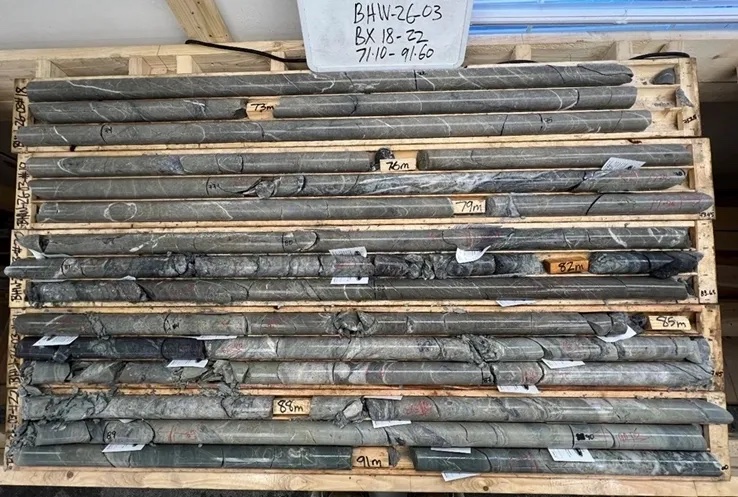
A 10,000 m definition drilling program is currently underway with three drill rigs. Approximately 4,000 m have already been completed, and the results confirm the picture. Massive antimony-bearing stibnite has been found in several drill holes. The mineralization occurs in highly altered sedimentary rocks, often as meter-wide, massive bodies. CEO Jim Atkinson comments on the progress, saying: "We are increasingly convinced that the mineralization in the Bald Hill area represents a large and extensive system."
More than just one zone: New discoveries expand the picture
What makes the project even more interesting is the recent discovery of additional mineralized areas. During construction work on an access road, the field team encountered a completely new zone. The Marcus Zone in the western part of the main area shows massive stibnite mineralization extending over at least 100 m. In the south, previously known mineralization has been extended to a length of 150 m. And in the central zone, there are impressive historical excavation results: 2.9% antimony over 8.18 m, including 8.47% over 1.53 m.
Atkinson sees this as evidence of an extensive system, commenting: "Antimony-bearing stibnite mineralization has now been identified in four different areas of the property as massive and brecciated bodies. This bodes well for the extension of the project's potential resources beyond the main zone."
Solidly financed and on schedule
The question of financing is crucial for any exploration company. Here, Antimony Resources has more than CAD 7 million in the bank. That is enough to cover the current program fully. Drilling is expected to be completed in April, with the first official resource estimate likely to follow in June.
Discussions with the authorities are ongoing in parallel. The provincial government of New Brunswick has recognized the importance of critical minerals and is working on accelerated approval procedures. The submission of documents for the environmental assessment is scheduled for late 2026 or early 2027.
A changing market: Antimony is being rediscovered
The price of antimony reached a historic high of nearly USD 60,000 per ton in the summer of 2025. After a correction, the metal is still trading at a level that is well above historical averages in the long term. Analysts at Fortune Business Insights expect the global market to grow from USD 1.22 billion in 2026 to over USD 2 billion by 2034.
There are many drivers behind this growth: in addition to the defense industry, demand is growing in the photovoltaic sector, where sodium antimonate is used as a purifying agent in solar glass. Data centers require antimony in flame-retardant cable sheathing. And the metal is also present in lead-acid batteries, which remain indispensable in vehicles and uninterruptible power supplies.
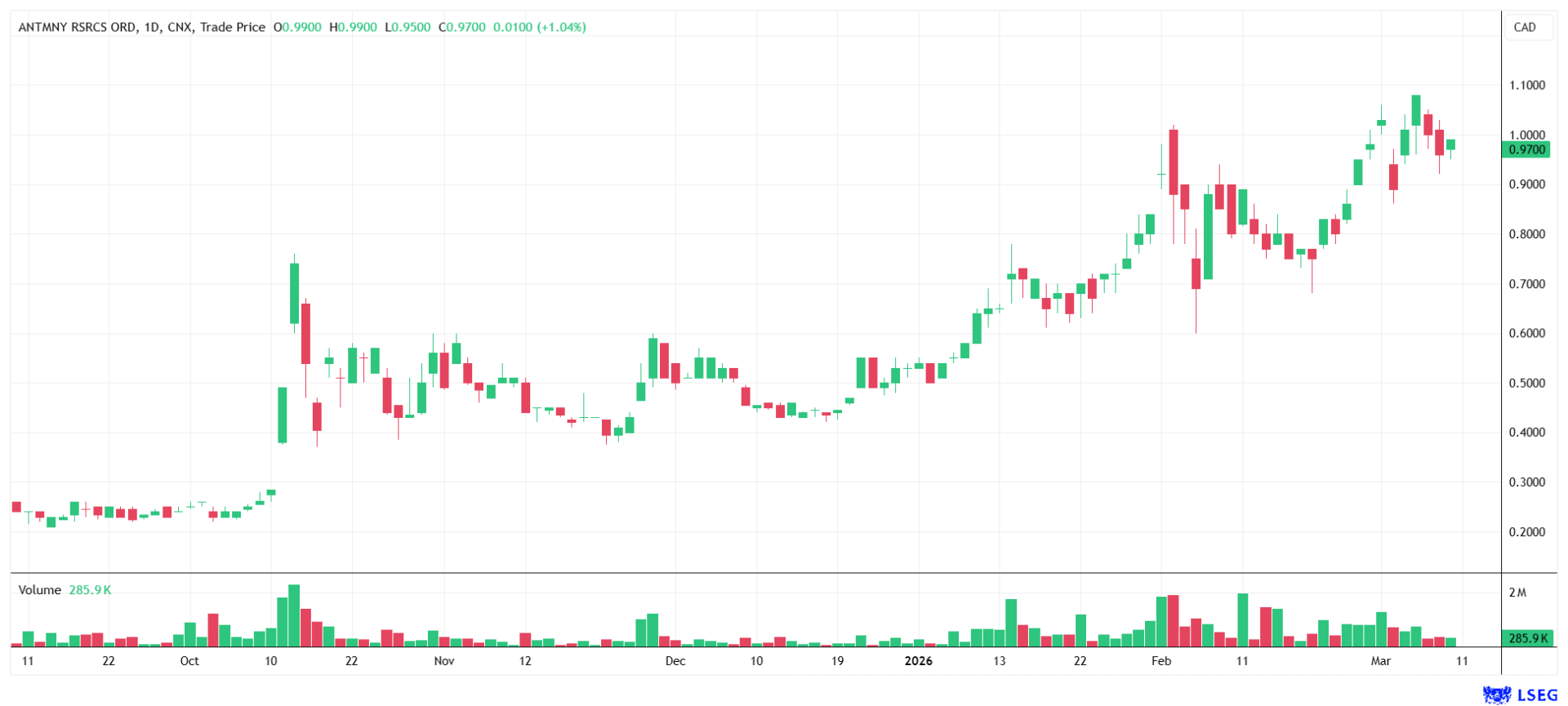
This is also reflected in the share price of Antimony Resources, which has doubled since the beginning of the year. The stock is currently trading at CAD 0.97.
Events in Iran have ruthlessly exposed how vulnerable Western supply chains are when it comes to strategic raw materials. While political rhetoric speaks of "unlimited ammunition," a look at the industrial reality paints a different picture. Without antimony, production lines come to a standstill. China controls the market, Russia is out of the picture, and the West faces years of building up its own capacity. In this constellation, projects such as Bald Hill take on strategic importance. Antimony Resources not only has a high-grade deposit in a stable legal environment, but also the management, financing, and timeline to turn geological potential into real value. The first official resource estimate in the summer could be the moment when the market realizes what is actually emerging here. In an environment where every additional ton of antimony from Western production has strategic value, the current valuation of the company appears to be extremely moderate. In any case, the days when antimony led a shadowy existence in the commodity tables are over.
Conflict of interest
Pursuant to §85 of the German Securities Trading Act (WpHG), we point out that Apaton Finance GmbH as well as partners, authors or employees of Apaton Finance GmbH (hereinafter referred to as "Relevant Persons") currently hold or hold shares or other financial instruments of the aforementioned companies and speculate on their price developments. In this respect, they intend to sell or acquire shares or other financial instruments of the companies (hereinafter each referred to as a "Transaction"). Transactions may thereby influence the respective price of the shares or other financial instruments of the Company.
In this respect, there is a concrete conflict of interest in the reporting on the companies.
In addition, Apaton Finance GmbH is active in the context of the preparation and publication of the reporting in paid contractual relationships.
For this reason, there is also a concrete conflict of interest.
The above information on existing conflicts of interest applies to all types and forms of publication used by Apaton Finance GmbH for publications on companies.
Risk notice
Apaton Finance GmbH offers editors, agencies and companies the opportunity to publish commentaries, interviews, summaries, news and the like on news.financial. These contents are exclusively for the information of the readers and do not represent any call to action or recommendations, neither explicitly nor implicitly they are to be understood as an assurance of possible price developments. The contents do not replace individual expert investment advice and do not constitute an offer to sell the discussed share(s) or other financial instruments, nor an invitation to buy or sell such.
The content is expressly not a financial analysis, but a journalistic or advertising text. Readers or users who make investment decisions or carry out transactions on the basis of the information provided here do so entirely at their own risk. No contractual relationship is established between Apaton Finance GmbH and its readers or the users of its offers, as our information only refers to the company and not to the investment decision of the reader or user.
The acquisition of financial instruments involves high risks, which can lead to the total loss of the invested capital. The information published by Apaton Finance GmbH and its authors is based on careful research. Nevertheless, no liability is assumed for financial losses or a content-related guarantee for the topicality, correctness, appropriateness and completeness of the content provided here. Please also note our Terms of use.