June 18th, 2026 | 08:05 CEST
AI and Semiconductors Soaring with SpaceX! AMD, Broadcom, Microsoft, and Aspermont in the Spotlight
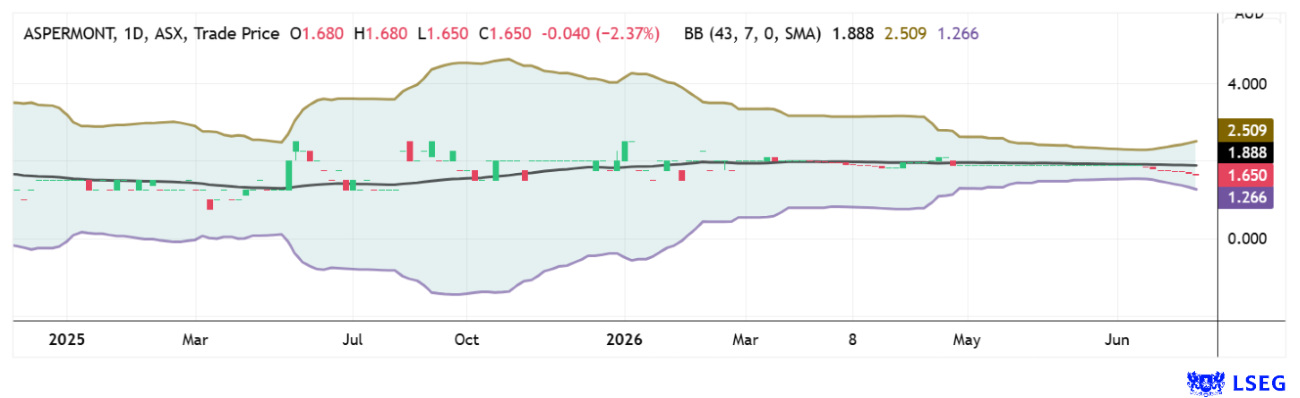
With SpaceX's IPO, one thing is clear: the tech rally continues! This brings the favourites of recent weeks back into the spotlight: chip and AI stocks. Leading the way in the return rankings are semiconductor giants AMD and Broadcom. After repeatedly testing the USD 550 mark, AMD recently suffered significant daily losses. Broadcom also set its sights on USD 500 but fell short just before reaching it. We are also keeping an eye on Aspermont. There was an interesting pullback here, and now institutional investors can finally step in. Things certainly remain exciting, as SpaceX had already gained for four consecutive days before correcting for the first time yesterday. Its initial market capitalization of USD 1.8 trillion was heavily criticized, but now Elon Musk's latest venture is valued at USD 2.8 trillion and has caught up to Microsoft quite quickly. We are diving even deeper!
time to read: 5 minutes | Author: André Will-Laudien
ISIN: ASPERMONT LTD. | AU000000ASP3 | ASX: ASP , BROADCOM INC. DL-_001 | US11135F1012 , ADVANCED MIC.DEV. DL-_01 | US0079031078 , SPACE EXPLORATION TECHNOLOGIES CORP | US84615Q1031 | NASDAQ: SPCX , MICROSOFT DL-_00000625 | US5949181045
Table of contents:
Author

André Will-Laudien
Born in Munich, he first studied economics and graduated in business administration at the Ludwig-Maximilians-University in 1995. As he was involved with the stock market at a very early stage, he now has more than 30 years of experience in the capital markets.
Tag cloud
Shares cloud
Aspermont: The Quiet Transformation Turns Commodity Intelligence into a Business Model
The Australian company Aspermont is a good example of how a long-established company can reinvent itself. In recent years, a historic trade publisher with roots dating back to 1835 has evolved into a specialized provider of data, market information, and digital intelligence solutions for the global commodities and mining industry. In a world where commodities have become the strategic currency of the energy transition, the value of reliable information is steadily rising. This is where Aspermont comes in. The company monetizes the datasets it has built over decades through digital subscriptions, analytical products, and data-driven services. The high quality of its revenue streams is particularly attractive, as a large portion of its revenue now comes from recurring subscription models, which ensure stability and planning certainty.
Operational performance shows that the chosen course is increasingly bearing fruit. Over more than nine years, Aspermont has grown revenue from recurring subscriptions quarter after quarter and now has more than 4,000 corporate customers worldwide. At the same time, management has consistently increased average revenue per customer. While many market participants still perceive the company as a traditional media provider, a data-driven business model with significantly greater scalability is emerging behind the scenes. At the heart of this development is the Mining IQ platform, which combines historical content, current market data, and artificial intelligence to provide decision-makers in the commodities industry with valuable insights.
IIF host Lyndsay Malchuk interviewed the company's founder and CEO, Alex Kent, about the company's future prospects.
The latest financial results also indicate that the investments are slowly paying off. In the first half of the year, revenue rose to AUD 7.48 million, and the company posted a net profit of approximately AUD 0.6 million. The new data offerings are still in the ramp-up phase, which is why profitability at the operating level is being weighed down by development and sales expenses. At the same time, performance improved significantly on a quarter-over-quarter basis. Management expects the company to achieve self-financing on a cash flow basis as early as the current fiscal year.
Analysts at GBC also view this development positively and reaffirm their "Buy" recommendation. For the current fiscal year, they anticipate revenue of approximately AUD 16.9 million, accelerating to about AUD 18.9 million and AUD 21.3 million in the coming years. In parallel, EBITDA is expected to grow from its current moderate levels to just under AUD 3 million by 2028. The price target was most recently raised to AUD 5.45; a key factor here is likely to be how quickly Mining IQ and other data-driven products grow to significant revenue levels in the coming years. If the monetization of the new intelligence offerings proceeds as planned, the currently still comparatively low valuation should soon be a thing of the past!
AMD: Is There a Ceiling for the Chip Specialist?
Everyone is currently talking about the tech stock AMD. The recent rally ranks among the most impressive success stories of the current stock market year. After reporting its quarterly results in early May, the chip developer kicked into high gear, leaving a long-contested resistance zone between USD 250 and USD 280 well behind. The move was driven by strong financial results, dynamic growth in the data center segment, and an optimistic outlook that significantly exceeded market expectations. AMD is becoming increasingly successful at positioning itself alongside established competitors in this lucrative market.
Traders and brokers were quick to issue price targets, which averaged USD 470 across 44 "Buy" recommendations on the LSEG Refinitiv platform. Early in the week, the popular stock even broke through the USD 550 mark, setting a new all-time high; however, the overall chart pattern now resembles a double top. Corrections are therefore likely; should the price sustainably fall below the support level around USD 450, the technical picture is likely to darken noticeably. Fundamentally, however, the story remains intact. Demand for high-performance processors for AI, cloud infrastructures, and data centers continues to grow strongly. AMD benefits from a product portfolio that is technologically on par with industry leaders. One additional point should be noted: the re-rating occurred very rapidly, while long-term moving averages remain comparatively low (50-day around USD 350, 200-day around USD 215). Q2 results are expected on August 4, with analysts estimating net earnings of USD 1.60 per share. AMD is likely to deliver another strong performance.
Broadcom: Plummeting After the Earnings Debacle
While AMD is primarily perceived as competing with Nvidia through its CPUs and AI accelerators, Broadcom pursues a significantly more diversified approach. The company does not just make its money from semiconductors; thanks to the VMware acquisition, software has now become a strong pillar of its business. As a result, Broadcom has a more robust and higher-margin business model than many traditional chipmakers.
The latest quarterly results impressively underscored this strength. In the second fiscal quarter, Broadcom posted record revenue of USD 15.0 billion, representing 20% year-over-year growth. Adjusted earnings per share rose to USD 1.58, while EBITDA reached USD 10.0 billion, representing an exceptional margin of 67%. The AI business once again showed particularly strong growth. Revenue from AI semiconductors climbed 46% to USD 4.4 billion. At the same time, the software segment grew by 25% to USD 6.6 billion, driven by VMware. For the current quarter, management forecast revenue of approximately USD 15.8 billion and AI revenue of about USD 5.1 billion.
Despite these strong figures, the stock came under significant pressure at times, falling 20%. The trigger was not the company's operational performance, but rather investor expectations. Following the massive AI rally, many investors had hoped for even higher forecasts. However, several analysts described the stock's reaction as more of a "sell-on-good-news" effect than a sign of operational weakness. On the LSEG platform, 47 analysts expect an average 12-month price of USD 504—the pullback of the past few weeks could therefore be a good buying opportunity. The next quarterly results are expected on September 3.
Growth markets are keeping a close eye on SpaceX's stock performance, as it could set the tone for the next major NASDAQ IPOs—which, with OpenAI and Anthropic, are already shaping up to be trillion-dollar IPOs. In this climate, tech stocks remain in demand, with AMD and Broadcom hitting new highs and Aspermont also slowly gaining momentum.
Conflict of interest
Pursuant to §85 of the German Securities Trading Act (WpHG), we point out that Apaton Finance GmbH as well as partners, authors or employees of Apaton Finance GmbH (hereinafter referred to as "Relevant Persons") currently hold or hold shares or other financial instruments of the aforementioned companies and speculate on their price developments. In this respect, they intend to sell or acquire shares or other financial instruments of the companies (hereinafter each referred to as a "Transaction"). Transactions may thereby influence the respective price of the shares or other financial instruments of the Company.
In this respect, there is a concrete conflict of interest in the reporting on the companies.
In addition, Apaton Finance GmbH is active in the context of the preparation and publication of the reporting in paid contractual relationships.
For this reason, there is also a concrete conflict of interest.
The above information on existing conflicts of interest applies to all types and forms of publication used by Apaton Finance GmbH for publications on companies.
Risk notice
Apaton Finance GmbH offers editors, agencies and companies the opportunity to publish commentaries, interviews, summaries, news and the like on news.financial. These contents are exclusively for the information of the readers and do not represent any call to action or recommendations, neither explicitly nor implicitly they are to be understood as an assurance of possible price developments. The contents do not replace individual expert investment advice and do not constitute an offer to sell the discussed share(s) or other financial instruments, nor an invitation to buy or sell such.
The content is expressly not a financial analysis, but a journalistic or advertising text. Readers or users who make investment decisions or carry out transactions on the basis of the information provided here do so entirely at their own risk. No contractual relationship is established between Apaton Finance GmbH and its readers or the users of its offers, as our information only refers to the company and not to the investment decision of the reader or user.
The acquisition of financial instruments involves high risks, which can lead to the total loss of the invested capital. The information published by Apaton Finance GmbH and its authors is based on careful research. Nevertheless, no liability is assumed for financial losses or a content-related guarantee for the topicality, correctness, appropriateness and completeness of the content provided here. Please also note our Terms of use.